Trade Gold (XAU) Perpetual Futures in Crypto: A Complete Guide for Traders
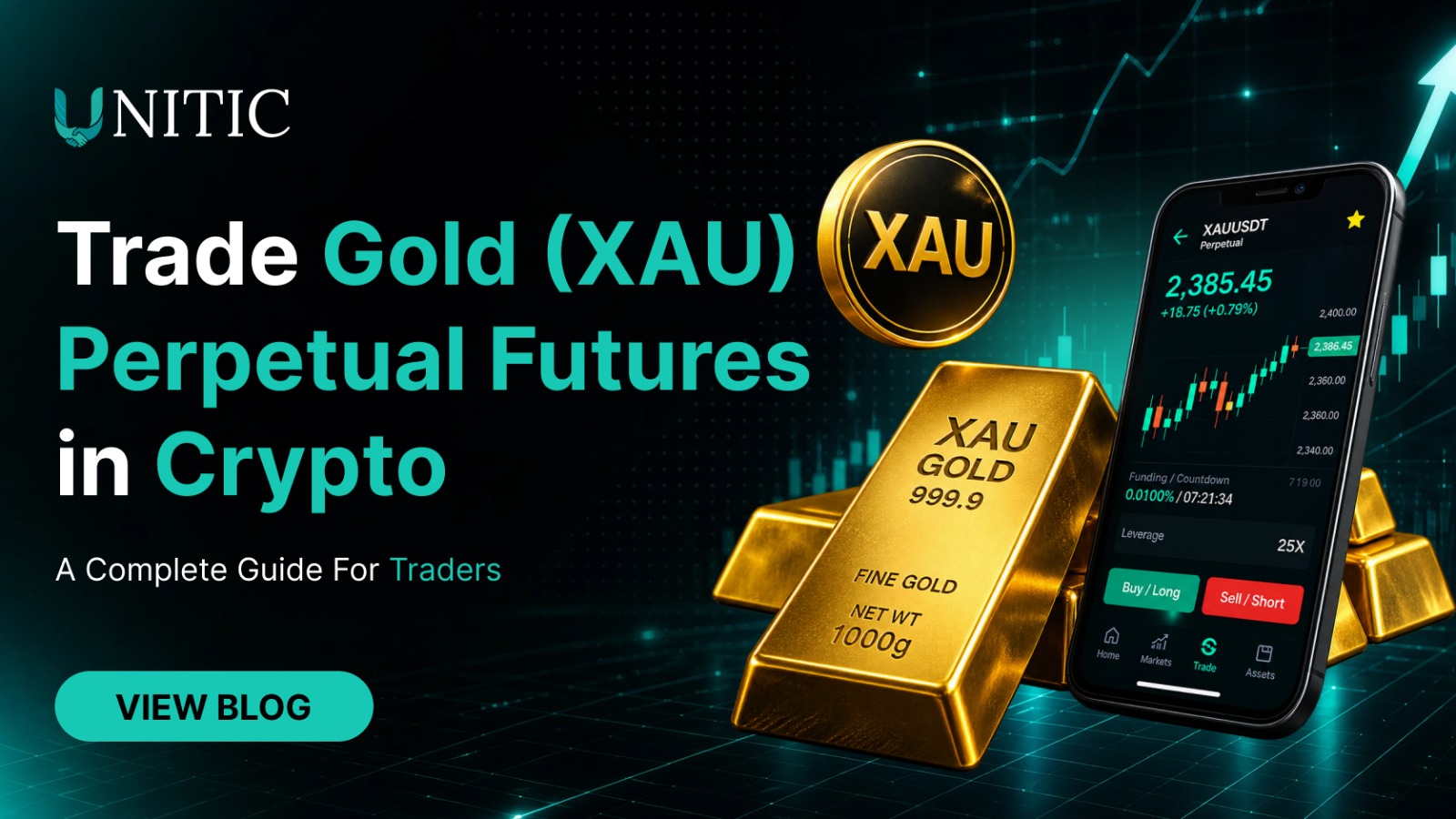
Trade Gold (XAU) Perpetual Futures in Crypto
Gold has been used as a store of value for thousands of years and remains one of the world's most closely watched financial assets. Investors and traders monitor gold for its relationship with inflation, interest rates, the U.S. dollar, geopolitical uncertainty, and global risk sentiment.
Traditionally, gaining exposure to gold could involve physical bullion, gold ETFs, futures contracts, CFDs, or other financial instruments.
The growth of cryptocurrency derivatives has introduced another way for traders to seek price exposure to traditional assets: Gold (XAU) perpetual futures.
This guide explains how Gold (XAU) perpetual futures work, why traders may consider them, how margin and leverage affect positions, how P&L works, and what to consider before trading them on a cryptocurrency exchange such as Unitic Exchange.
What Is Gold (XAU)?
XAU is the commonly used financial-market code representing one troy ounce of gold.
You may see gold quoted as:
XAU/USD
This represents the price of one troy ounce of gold in U.S. dollars.
What Are Gold Perpetual Futures?
A perpetual futures contract is a derivative that tracks the price of an underlying asset without a traditional expiration date.
Unlike conventional futures contracts, which generally have specified expiry dates, perpetual contracts can remain open as long as the trader maintains sufficient margin and the position remains supported under the platform's rules.
A Gold (XAU) perpetual futures product is designed to provide exposure to movements in the price of gold.
A trader can generally choose between:
Long Position
A long position seeks to benefit if the referenced gold price rises.
Short Position
A short position seeks to benefit if the referenced gold price falls.
The trader does not necessarily need to own physical gold.
How Gold Perpetual Futures Work in Crypto
The basic process can be summarized as:
Deposit collateral → Select Gold perpetual contract → Choose position direction → Select position size → Apply margin/leverage if available → Monitor P&L → Close position or manage it according to the strategy
For example, imagine gold is trading around $2,500 per troy ounce.
A trader believes gold will rise.
They open a long XAU perpetual position.
If the reference price rises, the position may generate an unrealized profit.
If gold falls, the position may generate an unrealized loss.
The trader's actual result depends on:
- Entry price
- Exit price
- Position size
- Contract specifications
- Leverage
- Fees
- Funding
- Slippage
- Margin requirements
- Exchange pricing methodology
Gold Spot vs. Gold Perpetual Futures
It is important to understand the difference between gold exposure and a gold derivative.
Buying Physical Gold
You own physical bullion.
You may need to consider:
- Storage
- Insurance
- Dealer spreads
- Transportation
- Authentication
- Liquidity
Gold ETF
You purchase shares in a fund designed to provide exposure to gold.
The structure and risks depend on the specific ETF.
Gold Futures
You trade a standardized derivative contract with a defined structure and, traditionally, an expiration date.
Gold Perpetual Futures
You trade a derivative designed to track gold without a traditional expiration date.
This can provide flexibility but introduces additional derivative-specific risks such as funding and liquidation when leverage is used.
Why Trade Gold Perpetual Futures Through a Crypto Exchange?
One of the attractions of crypto-based derivatives is the ability to access different types of market exposure through a digital trading environment.
Depending on the platform and product, traders may benefit from:
- Digital account management
- Integrated crypto and derivative markets
- Long and short positioning
- Margin-based trading
- Trading interfaces designed for active traders
- Portfolio monitoring
- Risk-management tools
However, convenience should not be confused with lower risk.
A derivative product can be complex regardless of the platform through which it is accessed.
Gold (XAU) Perpetual Futures on Unitic Exchange
Unitic Exchange is a cryptocurrency exchange that provides access to crypto trading products and markets.
For traders interested in gold-related derivatives, the key question is whether the relevant XAU perpetual futures product is currently available for their account, jurisdiction, and intended use.
Before trading, users should check the latest information on Unitic Exchange regarding:
- XAU perpetual contract availability
- Underlying/reference price
- Contract specifications
- Leverage limits
- Initial margin
- Maintenance margin
- Funding rate
- Funding intervals
- Trading fees
- Minimum order size
- Maximum position size
- Liquidation methodology
- Mark-price methodology
- Settlement rules
- Geographic or account restrictions
Product specifications can change, so the current exchange interface and official documentation should always take priority over general educational examples.
Why Traders May Be Interested in Gold Futures
Gold has a unique position in global finance.
It is often monitored as:
- A potential store of value
- A diversification asset
- An inflation-sensitive asset
- A safe-haven asset
- A U.S.-dollar-related market
- A macroeconomic indicator
This means gold can behave differently from many cryptocurrencies.
A trader who primarily follows crypto markets may find gold interesting because it introduces exposure to a traditional financial asset.
Gold and Cryptocurrency: Different Market Drivers
Bitcoin and gold can sometimes be discussed together as alternative or scarce assets, but they are not the same market.
Gold's price can be influenced by:
- Central-bank policy
- Real interest rates
- Inflation expectations
- U.S. dollar movements
- Geopolitical risk
- Central-bank gold purchases
- Global economic growth
- Investor demand
Cryptocurrencies can be influenced by:
- Crypto-specific regulation
- Network developments
- Liquidity
- Token economics
- Institutional flows
- Market sentiment
- Blockchain activity
- Broader risk appetite
There can be periods when gold and crypto move in similar directions, but there can also be significant divergence.
Traders should not assume that a strategy that works for Bitcoin will automatically work for gold.
Why Leverage Requires Caution
Gold is often considered less volatile than some cryptocurrencies, but that does not make leveraged gold derivatives risk-free.
Economic announcements can produce rapid price movements.
Examples include:
- U.S. inflation data
- Employment reports
- Central-bank interest-rate decisions
- Federal Reserve communications
- Major geopolitical developments
- Unexpected economic data
If a trader uses high leverage, even a relatively moderate market movement can have a significant effect on account equity.
What Is Liquidation?
Liquidation is the forced closure of a futures position when the account or position no longer satisfies the exchange's margin requirements.
Suppose a trader uses significant leverage.
The market moves sharply against the position.
Losses reduce available margin.
If the position reaches the exchange's liquidation threshold, the exchange may forcibly close it.
This is one of the biggest risks associated with leveraged perpetual futures.
Liquidation Is Not the Same as a Stop-Loss
A stop-loss is a trader-controlled risk-management order designed to close a position when a specified condition is reached.
Liquidation is forced closure initiated by the exchange when margin requirements are no longer met.
A disciplined trader should generally understand their liquidation level before entering a leveraged position and avoid treating liquidation as a substitute for risk management.
What Is Funding in Perpetual Futures?
Perpetual futures generally use a funding mechanism to help keep the contract's price aligned with its underlying reference price.
Depending on the funding rate and position direction, traders may pay or receive funding.
Funding can become important when positions are held for extended periods.
For example, a trader may correctly predict that gold will rise but discover that the final return is lower than expected after considering:
- Trading fees
- Funding payments
- Slippage
This is why evaluating the total cost of a trade matters.
Gold Trading and Macroeconomic Events
Gold traders often monitor macroeconomic developments closely.
Interest Rates
Changes in interest rates can influence the attractiveness of non-yielding assets such as gold.
Real Yields
Changes in real interest rates can affect gold demand.
U.S. Dollar
Gold is commonly quoted in U.S. dollars, so changes in the dollar can influence its price.
Inflation
Gold is frequently discussed in the context of inflation expectations and purchasing power.
Geopolitical Risk
Periods of heightened uncertainty can influence demand for perceived safe-haven assets.
These relationships are complex and do not operate consistently in every market environment.
Why the U.S. Dollar Matters for XAU
Gold is commonly quoted in dollars.
This creates an important relationship between gold and the U.S. dollar.
All else equal, a stronger dollar can create downward pressure on dollar-denominated gold prices, while a weaker dollar can provide support.
However, markets are driven by multiple variables simultaneously.
A trader should not assume that a dollar move will always produce a predictable gold move.
Gold Trading Around Economic Announcements
Gold can become volatile around major economic events.
Examples include:
- Federal Reserve interest-rate decisions
- U.S. Consumer Price Index releases
- U.S. employment reports
- GDP data
- Central-bank speeches
- Major geopolitical developments
A trader holding a leveraged XAU perpetual position during such events may face rapid price movements.
This can result in:
- Increased volatility
- Slippage
- Rapid P&L changes
- Liquidation risk
Traders should understand the event calendar before opening leveraged positions.
Gold Perpetual Futures Trading Strategies
There is no single strategy that works in every market.
However, traders may use several approaches.
1. Trend Following
The trader identifies a broader trend and attempts to trade in the same direction.
For example:
- Gold above a rising moving average
- Higher highs and higher lows
- Positive momentum
- Pullbacks holding key support
A trader may then look for long opportunities.
2. Breakout Trading
A trader identifies a significant resistance level.
If gold breaks above it with strong momentum, the trader may consider a long setup.
The opposite can apply to downside breakouts.
Breakouts can fail, so confirmation and risk management remain important.
3. Pullback Trading
Instead of entering after a large move, a trader waits for price to retrace toward a support area or technical level.
The goal is to enter after a pullback while maintaining a favorable risk/reward structure.
4. Range Trading
When gold is moving sideways between established support and resistance, some traders attempt to trade the range.
For example:
Buy near support → Sell near resistance
or potentially:
Short near resistance → Cover near support
Range strategies can fail when a strong breakout occurs.
5. Hedging
Some traders use futures to hedge exposure to gold or other assets.
Hedging is a more advanced application and requires an understanding of correlation, position sizing, basis risk, and derivative mechanics.
Technical Indicators for Gold Perpetual Futures
Traders may use technical indicators to analyze XAU price action.
Common examples include:
Moving Averages
Used to identify trend direction and dynamic levels.
RSI
Used to analyze momentum and potential overbought or oversold conditions.
MACD
Used to examine momentum and trend changes.
Bollinger Bands
Used to analyze volatility and price positioning.
Volume
Used to provide additional context around price movements where reliable volume data is available.
Indicators should not be treated as guaranteed prediction tools.
A better approach is to combine indicators with:
- Price action
- Market structure
- Support and resistance
- Fundamental context
- Risk management
Risk Management for Gold Perpetual Futures
Risk management is essential.
Use Appropriate Position Sizes
Do not determine position size solely by asking how much leverage is available.
Instead, consider how much you are willing to lose if the trade is wrong.
Define an Exit Before Entering
Know where you will exit if the trade thesis fails.
This can help prevent emotional decisions during market volatility.
Monitor Liquidation Risk
Always know how the exchange calculates liquidation.
High leverage can bring liquidation closer to the entry price.
Consider Funding
If holding a perpetual futures position for an extended period, monitor funding costs.
Avoid Concentration
Do not assume that because gold has historically behaved differently from cryptocurrencies, a large leveraged XAU position is automatically low risk.
Common Mistakes When Trading Gold Perpetual Futures
Mistake 1: Treating Gold as Risk-Free
Gold can experience substantial price movements.
A leveraged derivative can magnify those movements.
Mistake 2: Using Excessive Leverage
High leverage can make relatively small market movements financially significant.
Mistake 3: Ignoring Economic Events
Major economic announcements can cause rapid price movements.
Mistake 4: Forgetting Funding Costs
A profitable directional call can still produce a lower net return after costs.
Mistake 5: Confusing Gold Exposure With Physical Ownership
Trading an XAU perpetual contract does not necessarily mean you own physical gold.
It provides derivative exposure to the referenced gold price.
Mistake 6: Assuming Past Correlations Always Continue
Gold's relationship with the dollar, interest rates, Bitcoin, or equities can change.
Gold vs. Bitcoin: Should Traders Compare Them?
Gold and Bitcoin are often compared because both can be viewed by some investors as alternative or scarce assets.
However, they have fundamentally different characteristics.
|
Gold |
Bitcoin |
|
Physical commodity |
Digital asset |
|
Centuries of financial history |
Relatively new asset |
|
Central-bank holdings |
Decentralized network |
|
Traditional financial markets |
Crypto ecosystem |
|
Physical storage considerations |
Digital custody considerations |
|
Influenced by macroeconomic factors |
Influenced by crypto and macro factors |
A trader should avoid assuming that Bitcoin and gold will always behave similarly.
Benefits of Gold Perpetual Futures
Depending on the product and platform, traders may value Gold perpetual futures because they can provide:
Long and Short Exposure
Potentially trade in either direction.
No Traditional Expiry
Perpetual contracts are designed without a conventional expiration date.
Margin-Based Trading
Traders can potentially control larger positions with less upfront collateral.
Access Through a Digital Platform
Users may be able to manage gold-related derivative positions alongside other digital-asset products.
Portfolio Diversification
Gold exposure may provide a different market risk profile from individual cryptocurrencies.
However, these benefits do not eliminate derivative risk.
Risks of Gold Perpetual Futures
Important risks include:
- Leverage risk
- Liquidation risk
- Funding costs
- Market volatility
- Slippage
- Trading fees
- Pricing risk
- Platform risk
- Liquidity risk
- Regulatory or jurisdictional restrictions
- Correlation assumptions
Before trading, users should understand the specific contract rather than relying on generic descriptions of gold futures.
How to Start Trading Gold Perpetual Futures
If the relevant product is available to you, a basic workflow may look like this:
Step 1: Understand the Contract
Read the product specifications.
Check:
- Contract size
- Settlement asset
- Reference price
- Funding mechanism
- Leverage limits
- Margin requirements
Step 2: Fund Your Account
Deposit the supported collateral according to the exchange's requirements.
Only use capital that you can afford to lose.
Step 3: Select XAU Perpetual
Locate the relevant Gold perpetual contract on the exchange.
Confirm that you are trading the intended product.
Step 4: Choose Long or Short
Determine whether your strategy expects gold to rise or fall.
Step 5: Set Position Size
Calculate your exposure before opening the position.
Do not automatically use the maximum available leverage.
Step 6: Review Liquidation Information
Check the estimated liquidation price and understand what can cause it to change.
Step 7: Define Your Exit
Determine your stop-loss and profit-taking conditions before entering.
Step 8: Monitor Funding and P&L
If the position remains open, monitor:
- Unrealized P&L
- Funding
- Margin ratio
- Liquidation price
- Market conditions
Gold (XAU) Perpetual Futures on Unitic Exchange: What to Check
If you are considering Unitic Exchange for Gold perpetual futures, review the product page and current trading interface before placing an order.
Pay particular attention to:
Contract: Confirm the exact XAU product.
Price source: Understand what reference price or index the contract follows.
Leverage: Check the maximum and available leverage.
Margin: Understand initial and maintenance requirements.
Liquidation: Learn how the exchange calculates liquidation.
Funding: Check the funding rate and funding intervals.
Fees: Review maker/taker and other applicable fees.
Order types: Understand market, limit, stop, and other available orders.
Trading hours: Verify whether the product follows continuous crypto-market availability or specific underlying-market conventions.
These details can materially affect your trading experience.
Why the Example Matters
The example illustrates a key principle:
Your P&L is driven by position exposure, while leverage determines how much margin is needed to obtain that exposure.
Understanding this distinction is fundamental to leveraged trading.
Disclaimer
This article is for educational and informational purposes only and does not constitute financial, investment, trading, legal, or professional advice. Gold perpetual futures and other leveraged derivatives are speculative products and can result in substantial losses, including liquidation. Product availability, leverage, margin requirements, fees, funding, pricing methodology, and other conditions can change. Always review the current information and risk disclosures provided by Unitic Exchange or the relevant platform before trading. Past performance does not guarantee future results.
FAQs
Gold (XAU) perpetual futures are derivative contracts designed to provide exposure to the price movement of gold without a traditional futures expiration date. The exact contract structure depends on the exchange.
XAU is the commonly used financial-market code representing one troy ounce of gold.
Some cryptocurrency exchanges offer derivative products that reference gold. Availability depends on the platform, product, jurisdiction, and account eligibility.
Typically, perpetual futures allow both long and short positions. A long position generally benefits from rising prices, while a short position generally benefits from falling prices.
Perpetual futures are designed without a conventional expiration date. However, they use mechanisms such as funding to help keep the contract aligned with its underlying reference price.

Your Crypto Gateway


Unitic Exchange
All rights reserved 2026