Trade US Stocks on Unitic Exchange: A Simple Guide for Indian Investors
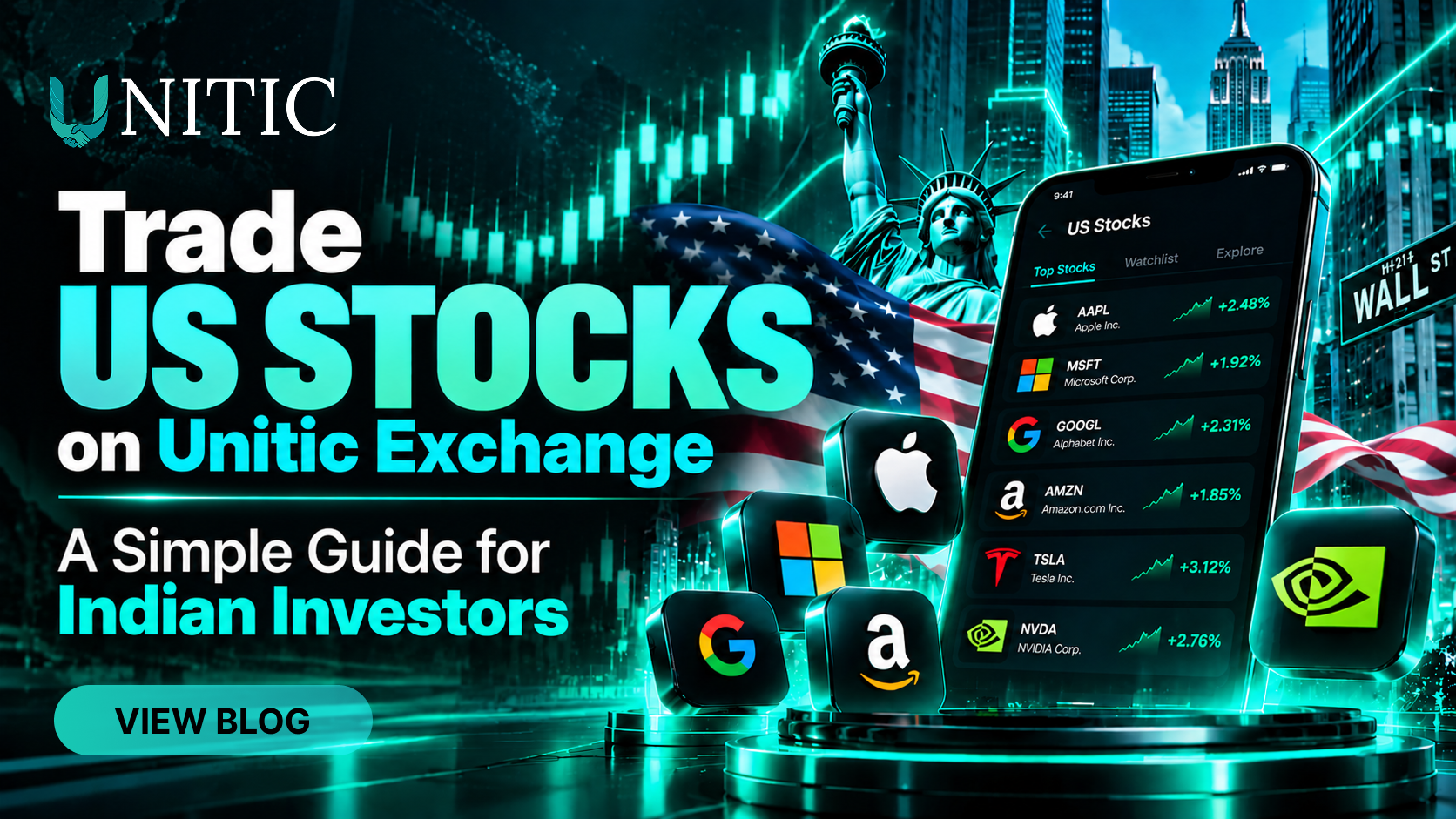
For Indian investors, the opportunity to participate in global financial markets has become increasingly attractive. While the Indian stock market offers exposure to many established businesses and fast-growing companies, the U.S. market provides access to some of the world's most recognized technology, consumer, healthcare, financial, and multinational companies. This has made US stocks for Indian investors an increasingly popular investment topic.
Investors who want international diversification may consider U.S. equities as part of a broader portfolio. Companies listed on U.S. exchanges can provide exposure to sectors and business models that may not have direct equivalents in India's domestic market. At the same time, investing internationally introduces additional considerations, including currency movements, market hours, taxation, regulatory requirements, transaction costs, and geopolitical risk.
This guide explains the fundamentals of trading US stocks from India, what investors should understand before entering the U.S. equity market, and how a platform such as Unitic Exchange can fit into a broader digital-asset and global-market ecosystem.
Before investing, Indian residents should verify the latest applicable rules, tax requirements, remittance provisions, and the specific products actually offered by the platform they intend to use. Regulations and product availability can change.
Why Indian Investors Are Interested in US Stocks
The U.S. stock market is one of the world's largest and most influential financial markets. It includes companies operating across technology, artificial intelligence, semiconductors, healthcare, financial services, entertainment, retail, energy, and other industries.
For an Indian investor, owning eligible U.S. securities can provide international diversification. Instead of having an investment portfolio concentrated entirely in Indian assets, an investor can potentially gain exposure to companies whose revenues and operations span different economies.
Another attraction is access to global businesses. Many internationally recognized companies are listed on U.S. exchanges, making American equities an important consideration for investors seeking global exposure.
However, diversification should not be confused with guaranteed risk reduction. U.S. stocks can decline, currency exchange rates can move against Indian investors, and global economic events can affect international investments.
What Does It Mean to Trade US Stocks From India?
When an Indian investor buys a U.S.-listed share, they are gaining exposure to an overseas security rather than an Indian-listed equity.
The investment process can involve converting Indian rupees into a foreign currency, transferring funds through an eligible mechanism, placing an order for a supported security, holding the investment, and eventually selling the position and converting the proceeds back into Indian currency.
The exact process depends on the intermediary, investment structure, product offered, and applicable Indian and foreign regulations.
This is why investors should understand more than simply how to click the "Buy" button.
The important questions include how the investment is legally structured, where the securities are held, how money moves between jurisdictions, what fees apply, how corporate actions are handled, and how gains and income are reported for tax purposes.
Understanding the Indian Regulatory Framework
Indian residents investing overseas need to consider the rules governing foreign exchange and overseas investments.
The Reserve Bank of India's Liberalised Remittance Scheme, or LRS, provides a framework for eligible resident individuals to make certain permitted remittances overseas, subject to applicable conditions and limits. RBI's published framework has historically specified a USD 250,000 overall limit per financial year for eligible purposes, although investors should always verify the latest applicable rules before making a remittance.
The practical takeaway is simple: an Indian investor should not assume that every overseas investment product or transaction is automatically permitted.
Before transferring funds for US stock investment from India, investors should confirm the transaction's eligibility and the latest requirements with their authorized bank, intermediary, tax adviser, or other qualified professional where appropriate.
Regulatory compliance is an essential part of international investing.
How the US Stock Market Works
The U.S. equity market consists of multiple exchanges and trading venues. Some of the world's largest publicly listed companies trade in the United States.
Investors generally buy shares through a broker or another authorized investment platform.
A share represents an ownership interest in a company. If the company's value increases and the market price rises, an investor may potentially benefit from capital appreciation. Some companies may also distribute dividends.
However, share prices can fall as well.
Stock prices respond to company earnings, economic growth, interest rates, inflation, investor expectations, industry conditions, management decisions, competition, and global events.
Therefore, investing in a well-known U.S. company does not eliminate investment risk.
US Stocks and Currency Risk for Indian Investors
Currency risk is one of the most important differences between domestic and international investing.
Suppose an Indian investor purchases a U.S. stock when the exchange rate is ₹80 per U.S. dollar. If the stock price remains unchanged but the rupee subsequently strengthens against the dollar, the investment's value measured in rupees could decline.
The opposite can also happen.
If the U.S. dollar strengthens against the Indian rupee, an Indian investor's dollar-denominated investment could gain value in rupee terms even if the underlying stock price remains unchanged.
This means the return experienced by an Indian investor can have two components: the performance of the U.S. security and the movement of the USD/INR exchange rate.
Understanding currency risk in US stocks is therefore essential.
Why Diversification Matters
International diversification can help investors reduce dependence on a single economy or market.
India has its own economic cycle, interest-rate environment, currency dynamics, industries, and political factors.
The United States has a different economic structure and market composition.
By gaining exposure to both markets, investors may diversify across companies, sectors, currencies, and economies.
However, diversification does not guarantee profits or protect against losses.
Global markets can fall simultaneously during major financial crises.
The goal of diversification is to construct a portfolio whose risk and return characteristics are appropriate for the investor's objectives rather than attempting to eliminate risk completely.
Large-Cap US Companies and Global Exposure
Many U.S.-listed companies generate revenue from customers around the world.
This means that purchasing a U.S. stock can sometimes provide indirect exposure to global economic growth.
A multinational technology company, for example, may generate revenue from North America, Europe, Asia, and other regions.
Similarly, consumer companies can have customers across numerous countries.
This global revenue exposure is one reason U.S. equities attract international investors.
However, investors should analyze individual companies rather than assuming that every U.S. stock offers the same diversification benefits.
Growth Stocks vs Value Stocks
U.S. equities include different investment styles.
Growth stocks are generally companies whose investors expect relatively strong future earnings or revenue growth. Technology and innovative businesses are often associated with this category, although not every technology company is a growth stock.
Value stocks are generally companies that investors believe may be trading at attractive valuations relative to their fundamentals.
Some investors combine growth and value exposures.
For an Indian investor entering the U.S. market, understanding these distinctions can help build a more deliberate portfolio.
Rather than purchasing stocks simply because they are popular online, investors should consider valuation, financial health, competitive advantages, business models, and long-term prospects.
ETFs as an Alternative to Individual US Stocks
Investors seeking U.S. market exposure do not necessarily have to select individual companies.
Exchange-traded funds can provide exposure to a group of securities through a single investment product.
For example, an ETF can track a broad market index or focus on a particular sector.
This can reduce company-specific concentration compared with holding one or two individual stocks.
However, ETFs still carry market risk, and the specific product structure, fees, taxation, and availability should be carefully reviewed.
Whether an investor should choose individual stocks or diversified funds depends on their objectives, risk tolerance, knowledge, and investment strategy.
US Market Trading Hours for Indian Investors
One practical difference between Indian and U.S. markets is their trading schedule.
U.S. stock markets operate according to U.S. market hours, while Indian investors operate on Indian Standard Time.
The time difference also changes during U.S. daylight-saving periods.
As a result, the U.S. market may open during India's evening or night depending on the time of year.
This can be useful for investors who work during Indian market hours, but it also means that investors should understand the trading schedule before placing orders.
Extended-hours trading, where available, has its own considerations, including liquidity and potentially wider spreads.
Investors should check the actual trading hours and order types supported by their chosen platform.
Market Orders and Limit Orders
When buying U.S. stocks, investors may encounter different order types.
A market order generally seeks execution at the best available market price, but the final execution price can differ from the price visible when the order is placed.
A limit order allows the investor to specify a maximum purchase price or minimum selling price.
Limit orders can provide greater price control, although there is no guarantee that the order will execute.
Understanding order types is particularly important when trading markets that may experience rapid price movements.
Investors should learn how their chosen platform handles market, limit, stop, and other available order types before using them with real capital.
Understanding Fees When Buying US Stocks
The cost of investing internationally can involve more than an advertised brokerage fee.
Investors should examine the complete cost structure.
Potential costs may include brokerage or trading fees, currency-conversion spreads, payment or remittance charges, custody-related costs, withdrawal fees, regulatory charges, and other platform-specific fees.
Even small recurring costs can affect long-term returns.
Before investing, compare the complete fee schedule rather than focusing only on whether a platform advertises "zero commission."
A transaction can still have other embedded costs.
Fractional Shares and US Stocks
Some investment platforms offer fractional shares, allowing investors to purchase a portion of a share rather than an entire share.
This can make expensive stocks more accessible to investors with smaller amounts of capital.
For example, if a stock trades at a price that is higher than an investor wants to allocate, fractional ownership may allow a smaller investment.
However, fractional-share availability depends on the platform and security.
Investors should understand how fractional shares are held, whether they can be transferred, how corporate actions are handled, and what happens when the investor sells.
The product structure matters just as much as the headline feature.
Dividends From US Stocks
Some U.S. companies distribute dividends to shareholders.
For an Indian investor, dividend income from foreign securities can have tax and withholding implications.
The actual treatment depends on applicable laws, tax residency, the security, the investor's circumstances, and relevant tax treaties or rules.
Investors should not assume that the dividend amount shown by a platform is necessarily the final amount they will receive.
Tax may be withheld before the dividend reaches the investor.
Professional tax advice can be valuable when foreign-source income becomes a meaningful part of a portfolio.
Tax Considerations for Indian Investors
Taxation is one of the most important topics when investing in U.S. stocks.
An Indian tax resident may have reporting and tax obligations relating to foreign assets and foreign-source income, depending on their circumstances.
Capital gains from selling foreign securities can be subject to Indian tax treatment, and dividends can also have tax implications.
The applicable rules depend on factors such as residential status, holding period, nature of income, tax law in force, and other personal circumstances.
The Income Tax Department's current guidance also highlights that holding assets located outside India can affect which income-tax return forms are appropriate; for example, its guidance for certain individuals states that ITR-1 and ITR-4 cannot be used where the taxpayer has an asset or financial interest located outside India.
Because tax laws can change, investors should verify the rules applicable to the relevant assessment year and consult a qualified tax professional where necessary.
Why Investors Should Track Their Transactions
International investing can create additional record-keeping responsibilities.
Investors should maintain records of purchases, sales, transaction dates, quantities, prices, currency conversion rates, fees, dividends, taxes withheld, and relevant statements.
These records can make tax reporting significantly easier.
They can also help investors calculate their actual returns in both U.S. dollars and Indian rupees.
Good record keeping is especially important for investors who make frequent transactions.
Instead of relying exclusively on an app's transaction history, investors should maintain appropriate supporting documentation.
US Stocks and Interest Rates
U.S. interest rates can significantly affect American equities.
When interest rates rise, borrowing can become more expensive and the present value investors assign to future corporate earnings can change.
Growth-oriented companies can be particularly sensitive to changes in interest-rate expectations.
When rates decline, financial conditions may become more supportive for certain companies and sectors.
However, the relationship is not universal.
Banks, insurers, technology companies, industrial businesses, and consumer companies can respond differently to monetary policy.
Indian investors should therefore consider the economic environment when evaluating U.S. stocks rather than viewing the entire market as one homogeneous asset.
How Inflation Can Affect US Equities
Inflation affects companies through multiple channels.
Higher input costs can reduce profit margins.
Companies may raise prices to compensate, but their ability to do so depends on customer demand and competitive conditions.
Persistent inflation can also influence central-bank policy.
If interest rates rise in response, equity valuations can be affected.
For Indian investors holding U.S. stocks, inflation therefore matters both at the company level and at the broader market level.
Reading earnings reports and understanding a company's pricing power can provide useful insight into how it may respond to inflation.
Why Earnings Matter
Ultimately, stocks represent ownership in businesses.
Macroeconomic conditions matter, but company fundamentals remain important.
Investors should consider revenue growth, profitability, cash flow, debt, margins, competitive advantages, management quality, and valuation.
A strong economy cannot necessarily rescue an overvalued company.
Likewise, a high-quality business may continue growing despite temporary economic weakness.
This is why US stock market investing should involve fundamental research rather than relying exclusively on market trends or social-media recommendations.
The Role of Technology in the US Market
Technology companies represent a significant part of the U.S. equity market.
Artificial intelligence, cloud computing, semiconductors, cybersecurity, software, digital advertising, and other technology industries have attracted substantial investor attention.
For Indian investors, exposure to U.S. technology companies can provide access to businesses operating at global scale.
But technology stocks can also experience substantial volatility.
Expectations can become embedded into valuations, and disappointing earnings or weaker growth forecasts can cause sharp price movements.
Investors should distinguish between a great company and a stock that is attractively valued.
They are not always the same thing.
Why Long-Term Investing Can Be Different From Trading
The words "investing" and "trading" are often used interchangeably, but they represent different approaches.
A long-term investor may purchase shares based on a multi-year view of a company's growth and profitability.
A trader may seek to benefit from shorter-term price movements.
The tools, time commitment, risk management, and decision-making processes can differ significantly.
Indian investors should determine whether they are seeking long-term international diversification or short-term trading opportunities before choosing their strategy.
Trying to combine both approaches without a clear plan can lead to inconsistent decisions.
How Unitic Exchange Fits Into the Picture
Unitic Exchange describes itself as a global crypto exchange offering products including spot trading, futures, OTC, and earn-related services. Its website currently highlights cryptocurrency markets and related digital-asset products.
For readers interested in both digital assets and global financial markets, Unitic Exchange can be explored as part of their broader research into cryptocurrency trading infrastructure.
However, investors should verify whether U.S. stock trading is actually available to them through Unitic Exchange, including the exact securities offered, the legal structure of the product, applicable jurisdictional restrictions, fees, custody arrangements, and regulatory requirements.
This distinction is important because a platform's cryptocurrency services should not automatically be interpreted as authorization or availability for conventional U.S. equity trading.
Before depositing funds specifically to purchase U.S. stocks, users should review the current product documentation and applicable terms directly with the platform.
What Indian Investors Should Check Before Using Any Platform
Choosing a platform for international investing requires more than comparing trading fees.
Investors should first confirm whether the platform is legally permitted to provide the specific service in their jurisdiction.
They should understand where their securities or economic interests are held.
They should check whether the investment represents direct ownership of shares or another form of exposure.
They should understand how deposits, withdrawals, currency conversion, and corporate actions work.
Security is another major consideration.
Investors should look for appropriate account protections, authentication controls, transaction monitoring, and clear policies regarding withdrawals and account access.
Transparency is equally important.
A platform should clearly communicate fees, terms, supported markets, restrictions, and relevant risks.
Direct Ownership vs Price Exposure
One of the most important questions is whether you are actually purchasing an underlying U.S. stock or simply receiving exposure to its price through another financial product.
These structures are not necessarily equivalent.
With direct ownership, the investor may have rights associated with the underlying security, subject to the custody arrangement.
With a derivative or synthetic product, the investor may instead have a contractual claim linked to the price of an asset.
The risks, fees, tax treatment, liquidity, and regulatory considerations can differ.
Therefore, investors should always understand the exact product they are buying.
Security and Account Protection
International investment accounts can contain valuable financial assets, making account security critical.
Investors should use strong, unique passwords and enable multi-factor authentication when available.
They should avoid sharing login credentials or verification codes.
Phishing attacks are another important risk.
Fraudulent websites and messages can imitate legitimate financial platforms and attempt to obtain passwords or authentication information.
Investors should verify website addresses carefully and access their accounts through official channels.
Security is not simply a platform responsibility.
Users also play an important role in protecting their accounts.
Don't Ignore Liquidity
Liquidity refers to how easily an asset can be bought or sold without significantly affecting its market price.
Large U.S. stocks generally have substantial trading activity, but liquidity can vary across securities and trading sessions.
Thinly traded securities can have wider bid-ask spreads and greater price volatility.
Investors should understand liquidity before entering smaller or less frequently traded stocks.
This is especially important when using limit orders, stop orders, or attempting to exit a position quickly during a volatile market.
Building a Balanced International Portfolio
Investing in U.S. stocks does not mean an investor needs to abandon Indian equities.
Instead, international stocks can potentially become one component of a diversified portfolio.
An investor might have exposure to Indian equities, U.S. equities, fixed income, cash, commodities, and other assets depending on their objectives and risk tolerance.
The appropriate allocation depends on individual circumstances.
Younger investors with long time horizons may have different objectives from someone approaching retirement.
Similarly, an investor with substantial foreign income may have different currency exposure from someone whose income and expenses are entirely in Indian rupees.
There is no universal allocation that works for everyone.
Common Mistakes Indian Investors Should Avoid
One common mistake is buying U.S. stocks simply because they are popular.
Another is ignoring currency risk.
Some investors focus on stock price returns while forgetting taxes, conversion costs, and transaction expenses.
Others invest without understanding the regulatory framework governing overseas investments.
Short-term trading based on social-media trends can also expose investors to unnecessary volatility.
Perhaps the biggest mistake is assuming that past performance guarantees future results.
A company that performed exceptionally well over the last decade may not deliver the same performance over the next decade.
Good investing requires continuous evaluation.
Research Before You Buy
Before purchasing a U.S. stock, investors should understand the business.
What does the company sell?
Who are its customers?
How does it make money?
Is revenue growing?
Is the company profitable?
How much debt does it carry?
What is its competitive advantage?
What risks could disrupt its business?
What valuation is the market assigning to its future earnings?
These questions can help investors move beyond headlines and make more informed decisions.
Investing internationally should be treated as a research-driven activity rather than a simple search for the next big stock.
US Stocks, Crypto and Portfolio Diversification
U.S. equities and cryptocurrencies are fundamentally different asset classes.
Stocks represent ownership in companies.
Cryptocurrencies are digital assets with different economic and technological characteristics.
Both can be volatile, but crypto markets can experience significantly larger price movements.
An investor considering exposure to both should understand that holding several risky assets does not necessarily create effective diversification.
Two assets can have different names but still decline at the same time during a market shock.
Portfolio construction should therefore focus on how assets behave together rather than simply counting the number of investments.
A Simple Approach for Beginners
A beginner interested in US stocks from India can start by learning the mechanics before committing significant capital.
First, understand the regulatory and tax framework applicable to your situation.
Next, research the platform and confirm that the specific investment product is actually available and permitted.
Then understand fees, currency conversion, custody, liquidity, and withdrawal procedures.
After that, research the companies or funds you are considering.
Finally, establish a risk-management plan.
Starting with a manageable amount can help investors learn the process without taking unnecessary financial risk.
Why Global Investing Requires Patience
Markets can be unpredictable over short periods.
A U.S. stock can fall because of an earnings miss, an interest-rate announcement, geopolitical developments, regulatory action, or changing investor expectations.
Currency movements can add another layer of volatility for the economy. At the same time, international investing introduces additional considerations that do not always arise when investing in Indian investors.
Long-term investors therefore need patience.
The objective should not necessarily be to predict every daily price movement.
Instead, investors can focus on business quality, valuation, diversification, risk management, and long-term financial objectives.
The Future of Cross-Border Investing
Technology is making global financial markets increasingly accessible.
Investors can research companies around the world, monitor international markets, and access digital financial services from their smartphones.
This creates significant opportunities.
But greater accessibility also creates a responsibility to understand what is being purchased.
The fact that an investment can be accessed with a few taps does not make it low risk.
Cross-border investing will likely continue growing, but investors who understand regulation, taxation, currency exposure, product structure, and market risk will be better positioned to make informed decisions.
Conclusion
The ability to access international markets has created exciting possibilities for Indian investors.
US stocks for Indian investors can provide exposure to global companies, different industries, and another major economy. At the same time, international investing introduces additional considerations that do not always arise when investing solely in Indian securities.
Currency risk, taxation, overseas remittance rules, market hours, fees, liquidity, custody, regulation, and investment-product structure all deserve careful attention.
Indian residents should also keep in mind that overseas investing rules can change. RBI's LRS framework and current tax requirements should be checked before making transactions, and professional advice may be appropriate for investors applicable to Indian foreign-exchange, overseas-investment, tax, and other regulatory requirements. The RBI's Liberalised Remittance Scheme provides a framework for certain overseas remittances with complex circumstances.
For users interested in the broader digital-asset ecosystem, Unitic Exchange can be researched as a crypto exchange platform. Its current website focuses on cryptocurrency services such as spot trading, futures, OTC, and earn products.
Importantly, readers should verify the current availability and legal structure of any U.S.-stock product before assuming that conventional U.S. equity trading is offered through the platform.
The best international investment strategy is not simply about finding the easiest way to buy foreign assets. It is about understanding what you own, how it is held, what it costs, how it is taxed, what risks it carries, and whether it fits your overall financial plan.
For Indian investors, that knowledge can make global investing more informed, disciplined, and sustainable.
Risk Disclaimer
Investing and trading in U.S. stocks, cryptocurrencies, and other financial assets involve significant risk. Market prices can rise or fall, and investors may lose part or all of their invested capital. International investing introduces additional risks, including foreign-exchange fluctuations, market volatility, geopolitical events, regulatory changes, taxation, liquidity risk, custody risk, transaction costs, and changes in overseas-investment rules.
This article is provided solely for general educational and informational purposes. It is not financial, investment, tax, legal, regulatory, or accounting advice and should not be treated as a recommendation to purchase or sell any security, cryptocurrency, or financial product.
Indian investors should independently verify the latest RBI, SEBI, Income Tax Department, and other applicable requirements before making overseas investments. Rules, tax rates, remittance limits, reporting requirements, and financial products can change. Professional advice should be obtained where appropriate.
References to Unitic Exchange are for informational purposes only. Users should independently verify the products currently offered, applicable jurisdictional availability, regulatory status, fees, custody arrangements, security measures, terms, and risks before using the platform. Access to cryptocurrency services does not automatically mean that U.S. securities are available or legally accessible through the same platform.
Never invest money you cannot afford to lose, and do not make investment decisions solely on the basis of this article.
FAQs
Eligible Indian residents can invest in permitted overseas securities subject to applicable Indian foreign-exchange, overseas-investment, tax, and other regulatory requirements. The RBI's Liberalised Remittance Scheme provides a framework for certain overseas remittances by eligible resident individuals, subject to applicable limits and conditions. Investors should verify the latest rules before investing. Reserve Bank of India+1
Unitic Exchange's current public website primarily presents cryptocurrency products, including spot trading, futures, OTC, and earn services. uniticexchange.com If a U.S.-stock product is advertised or made available to you, verify the exact product structure, underlying ownership, jurisdictional availability, custody arrangements, fees, and regulatory terms directly with Unitic Exchange before depositing funds for that purpose.
Potentially, yes. Income or gains from foreign securities can have Indian tax and reporting implications, depending on the investor's residential status, the nature and timing of the transaction, applicable tax laws, and other circumstances. Foreign assets can also affect income-tax return requirements. Investors should consult a qualified tax professional and check the rules applicable to the relevant financial or assessment year. Income Tax Department
In addition to normal stock-market risk, Indian investors face currency risk because returns are ultimately relevant in Indian rupees. The USD/INR exchange rate can increase or reduce the rupee value of an investment. Investors may also face regulatory, tax, liquidity, fee, custody, geopolitical, and international-market risks.
Neither market is universally better. U.S. stocks can provide international diversification and exposure to companies and sectors that may not have direct equivalents in India, while Indian equities provide exposure to India's domestic economy. The appropriate mix depends on an investor's objectives, risk tolerance, time horizon, tax position, currency exposure, and overall portfolio in U.S. stocks, cryptocurrencies, and other financial assets that involve significant risk. Market prices can rise or fall, and investors may lose part or all of their invested capital. International investing introduces additional risks, including foreign-exchange fluctuations, market volatility, geopolitical events, regulatory changes, taxation, liquidity risk, custody risk, transaction costs, and changes in overseas-invest general educational and informational purposes. It is not financial, investment, tax, legal, regulatory, or accounting advice and should not be treated as a recommendation to purchase or sell any. Diversification does not guarantee profits or prevent losses.







Your Crypto Gateway


Unitic Exchange
All rights reserved 2026