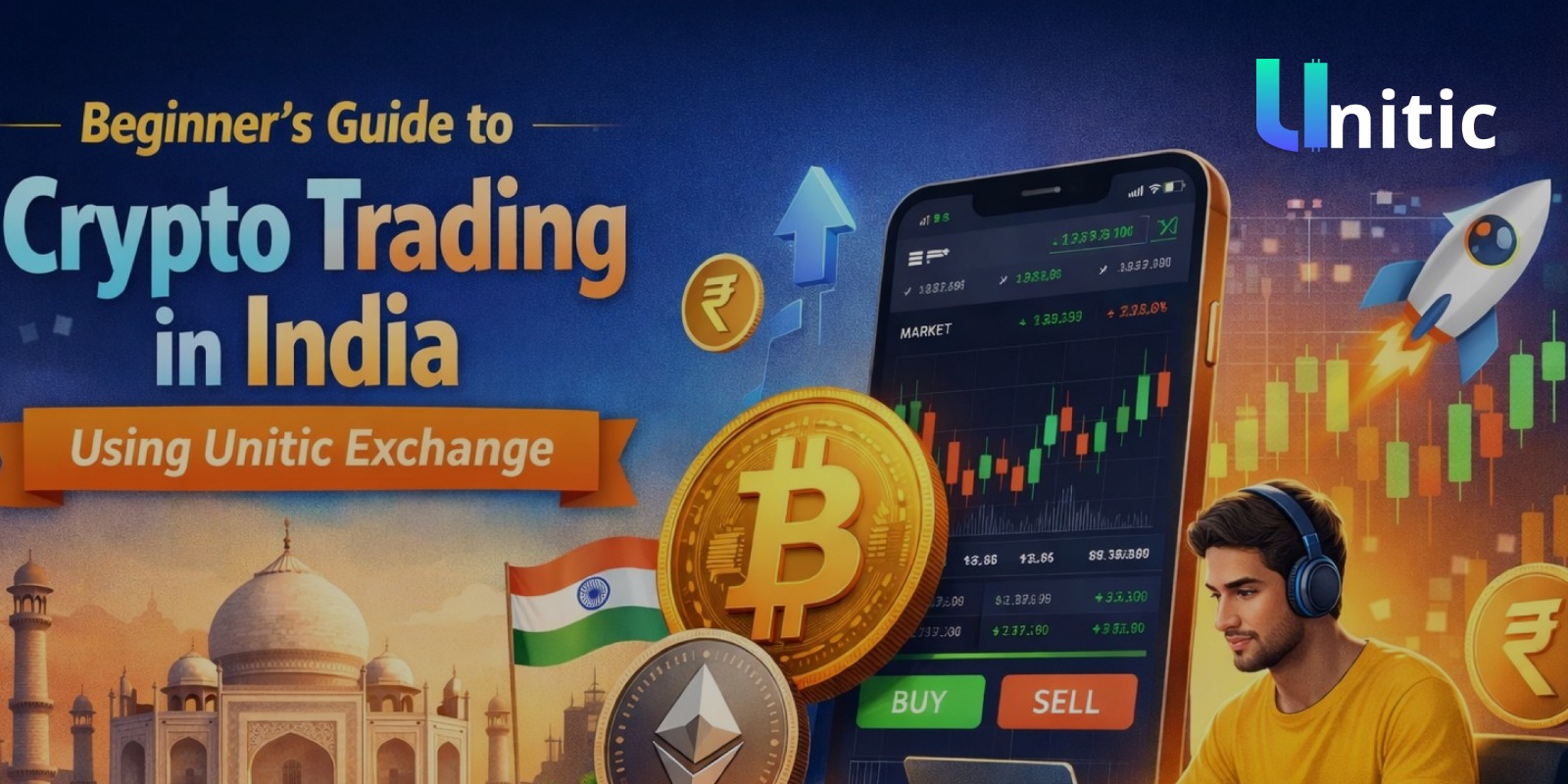
Beginner’s Guide to Crypto Trading in India Using Unitic Exchange
In recent years, the way Indians think about money and investments has changed dramatically. Beyond traditional options like gold, fixed deposits, and stocks, a new digital asset has captured nationwide attention—cryptocurrency. From young first-time investors to experienced traders and long-term wealth builders, crypto trading in India is becoming a preferred choice for those looking to participate in the future of finance. With easy access to trading platforms, increasing trust in blockchain technology, and clearer regulations, cryptocurrencies are no longer just a trend but a growing investment opportunity for Indians across the country.
For newcomers, stepping into crypto trading can feel confusing and intimidating. Price fluctuations, technical charts, changing regulations, tax rules and security risks often raise more questions than answers. Without proper guidance, beginners may hesitate to take the first step.
That’s why selecting a reliable exchange and following a clear, step-by-step approach is crucial. This beginner’s guide breaks down crypto trading in India in a simple, structured, and practical manner. It also shows how you can start trading safely and responsibly using Unitic Exchange, an Indian crypto trading platform designed to support both new and experienced traders with confidence.
What Is Crypto Trading?
Crypto trading is the process of buying and selling digital currencies such as Bitcoin (BTC), Ethereum (ETH), USDT, and other cryptocurrencies to earn profits from changes in their market prices. Simply put, traders aim to buy crypto at a lower price and sell it at a higher price—or benefit from price movements using different trading strategies.
Unlike traditional financial markets such as stocks or commodities, cryptocurrency markets operate 24 hours a day, 7 days a week. This means there are no opening or closing hours, allowing traders in India to trade at any time—whether during the day, late at night, or on weekends.
In crypto trading in India, most traders follow two common approaches:
- Crypto to INR trading, where cryptocurrencies are bought or sold using Indian Rupees (for example, BTC/INR or ETH/INR)
- Crypto to crypto trading, where one cryptocurrency is exchanged for another, such as BTC/USDT or ETH/USDT
Crypto trading attracts beginners and professionals alike because it offers flexibility, global market access, and multiple ways to participate—short-term trading, long-term holding, or gradual investing. However, since crypto prices can be highly volatile, understanding the basics, choosing a trusted exchange, and following risk-management practices are essential for trading safely and confidently.
Is Crypto Trading Legal in India?
Yes, crypto trading is legal in India, but it is not considered legal tender.
Key Legal Points:
- Cryptocurrencies are classified as Virtual Digital Assets (VDAs)
- Trading is allowed on compliant platforms
- Exchanges must follow KYC, AML, and PMLA guidelines
- Platforms must be compliant with Indian regulations and follow PMLA guidelines.
Unitic Exchange complies with these requirements, making it a lawful platform for crypto trading in India.
Understanding Crypto Trading in India
Before starting crypto trading in India, it’s important for beginners to understand a few key fundamentals. Having clarity on these basics helps you trade responsibly, avoid common mistakes, and stay compliant with Indian laws.
1. Cryptocurrencies Are Not Legal Tender in India
Cryptocurrencies like Bitcoin and Ethereum are not considered legal tender in India. This means they cannot be used as an official replacement for the Indian Rupee (INR) for everyday transactions or government payments. However, individuals are legally allowed to buy, sell, and hold cryptocurrencies as digital assets through compliant platforms.
2. High Market Volatility
The crypto market is known for its high price volatility. Prices can move sharply within minutes or hours due to global news, market sentiment, or large trades. While this volatility creates profit opportunities, it also carries significant risk—especially for beginners. Understanding market movements and investing only what you can afford to lose is essential.
3. Regulations Are Still Evolving
India does not yet have a single, dedicated cryptocurrency regulator. However, this does not mean crypto trading is unregulated. Traders and exchanges must follow KYC norms, tax rules, and anti-money laundering (AML) guidelines. Choosing a compliant exchange ensures safer trading and peace of mind.
By understanding these fundamentals, beginners can approach crypto trading in India with confidence, caution, and clarity—building a strong foundation before placing their first trade.
Why Beginners Should Choose Unitic Exchange
For anyone starting their journey in crypto trading in India, selecting the right exchange is one of the most important decisions. A reliable and compliant platform not only simplifies trading but also protects users from regulatory, security, and operational risks. This is where Unitic Exchange stands out as a beginner-friendly and trustworthy choice.
Why Unitic Exchange Stands Out
✔ Mandatory KYC & AML Compliance
All users follow a structured Know Your Customer (KYC) and Anti-Money Laundering (AML) process. This creates a safer trading environment and helps prevent fraud, making it ideal for beginners.
✔ Easy INR Deposits via Indian Banking Channels
Unitic supports INR deposits and withdrawals through Indian banking systems, allowing users to fund their accounts conveniently without dealing with complex payment methods.
✔ Secure Wallet Infrastructure
Security is a top priority. Unitic Exchange uses a robust wallet system designed to protect user funds and digital assets, helping beginners trade with peace of mind.
✔ Multiple Trading Options
Beginners can start with spot trading and gradually explore futures and OTC trading as they gain confidence and experience—all within one platform.
✔ Beginner-Friendly Interface
With a clean layout, simple navigation, and easy-to-understand features, Unitic Exchange is designed to help new traders buy and sell crypto without confusion.
By choosing Unitic Exchange, beginners in India can start crypto trading on a platform that combines compliance, security, and simplicity—making the learning curve smoother and safer from day one.
Step-by-Step Guide to Crypto Trading in India Using Unitic Exchange
To begin crypto trading in India using Unitic Exchange, you must register, complete mandatory KYC verification, and deposit Indian Rupees (INR) to fund your account.
Below is a detailed beginner-friendly walkthrough:
Step 1: Create an Account
Create an account on Unitic Exchange by visiting the official website or downloading the mobile application.
- Register using your email address and phone number
- Set a strong password
- Verify your email and mobile number
Step 2: Complete KYC and AML Verification
KYC is mandatory for crypto trading in India.
This mandatory step involves providing personal details and uploading government ID proof, such as an Aadhaar or PAN card, to comply with Indian Know Your Customer (KYC) and Anti-Money Laundering (AML) regulations.
Verification usually takes 1–48 hours.
Step 3: Deposit INR
Once your account is verified:
Link your bank account to the exchange to deposit Indian Rupees (INR) using methods bank transfers.
This enables you to buy crypto directly using INR.
Step 4: Choose a Cryptocurrency
Decide which cryptocurrency you want to trade. While popular options include Bitcoin (BTC) and Ethereum (ETH), Unitic Exchange offers a wide range of choices.
Beginners are advised to start with:
- Bitcoin (BTC)
- Ethereum (ETH)
- Stablecoins like USDT
Step 5: Execute Your Trade
Navigate to the trading section, select your desired crypto pair (e.g., BTC/INR), choose a buy order type, and execute the trade.
Order types include:
- Market order
- Limit order
Step 6: Monitor and Manage Your Trades
Keep an eye on market trends and manage your trades. You can hold your assets in the secure wallet provided by the exchange or sell them when you feel you might get the best outcome.
Step 7: Secure Your Assets
For added security, enable two-factor authentication (2FA) on your account.
This protects your account from unauthorized access.
Types of Crypto Trading in India
Crypto trading in India offers different trading methods to suit beginners, active traders, and high-volume investors. Understanding these options helps you choose the right approach based on your risk level and experience.
1. Spot Trading
Best for beginners
Spot trading involves buying and selling cryptocurrencies at real-time market prices. When you purchase crypto through spot trading, you directly own the asset and can hold it or sell it whenever you choose.
✔ Simple and easy to understand
✔ Ideal for long-term holding or basic trading
✔ Lower risk compared to advanced trading methods
Beginners often start with spot trading to learn how crypto markets move without unnecessary complexity.
2. Futures Trading
For experienced traders
Futures trading allows traders to buy or sell contracts based on the future price of a cryptocurrency. This means you can potentially profit from both rising and falling markets.
✔ Opportunity for higher returns
✔ Supports advanced strategies
⚠ Higher risk due to leverage and market volatility
Because of the higher risk involved, futures trading is recommended only after gaining sufficient market experience.
3. OTC (Over-the-Counter) Trading
Ideal for high-volume traders
OTC trading is designed for large-volume crypto transactions. Instead of using public order books, trades are executed directly with locked pricing.
✔ Price stability without market slippage
✔ Enhanced privacy
✔ Faster execution for bulk trades
OTC trading is commonly used by institutions, businesses, and high-net-worth individuals.
4. Signal Giver – Unitic’s Special Feature
Smart guidance for confident trading
One of Unitic Exchange’s standout features is its Signal Giver, designed to help traders make more informed decisions. Signal Giver provides market insights, trend signals, and potential trade indications based on market analysis.
✔ Helps beginners understand market direction
✔ Supports better entry and exit decisions
✔ Reduces guesswork and emotional trading
While signals are not guaranteed profits, they act as a valuable learning and decision-support tool—especially for beginners who are still understanding market behavior.
By offering spot, futures, OTC trading, and Signal Giver support, Unitic Exchange gives Indian traders the flexibility to start simple and grow confidently as their skills improve.
How to Choose the Right Cryptocurrency
When starting crypto trading in India, beginners should evaluate:
- Market capitalization
- Project utility
- Liquidity
- Long-term potential
Avoid investing purely based on hype.
Risk Management for Beginners
Crypto markets are volatile. Smart risk management includes:
- Investing only what you can afford to lose
- Diversifying assets
- Avoiding emotional trading
- Using stop-loss strategies
Security Best Practices for Indian Traders
- Enable 2FA
- Use strong passwords
- Avoid sharing login credentials
- Beware of phishing scams
- Use official exchange apps only
Important Considerations for Indian Traders
Regulation and Compliance
While crypto trading is legal in India, it is currently unregulated by a central body. Exchanges like Unitic must adhere to PMLA guidelines.
Taxation
Profits from crypto trading in India are subject to a flat 30% tax on gains, plus applicable surcharges and a 4% cess. Additionally, a 1% Tax Deducted at Source (TDS) applies to transactions above a certain threshold.
Market Volatility
The crypto market is highly volatile and involves substantial risk. Only invest what you can afford to lose, and conduct thorough research before making any decisions.
No Legal Tender Status
Cryptocurrencies are considered Virtual Digital Assets (VDAs), not legal tender or currency in India.
Common Mistakes Beginners Should Avoid
- Trading without knowledge
- Ignoring tax implications
- Over-leveraging
- Falling for fake investment schemes
- Panic buying or selling
Future of Crypto Trading in India
India continues to shape its digital asset framework. With increasing adoption, better compliance, and improved infrastructure, crypto trading in India is expected to mature further, especially through compliant exchanges like Unitic.
Final Thoughts
Crypto trading in India offers exciting opportunities—but only when approached responsibly. Beginners should focus on education, compliance, and security rather than quick profits.
Using a compliant platform like Unitic Exchange, following proper KYC, understanding taxation, and managing risk can help beginners build a safe and sustainable crypto trading journey.
FAQs
Beginners can start crypto trading in India by using a compliant exchange like Unitic Exchange and following these steps: 1. Register on Unitic Exchange using your email and mobile number 2. Complete mandatory KYC and AML verification 3. Deposit Indian Rupees (INR) through supported banking methods 4. Start with spot trading in popular cryptocurrencies such as Bitcoin (BTC), Ethereum (ETH), or USDT 5. Use simple order types like market or limit orders 6. Enable two-factor authentication (2FA) for account security 7. Monitor trades and manage risk carefully Beginners should start with small amounts and avoid leverage until they understand market behavior.
To learn crypto trading step by step, beginners in India can use Unitic Exchange as a practice platform: 1. Learn basic crypto concepts like blockchain, wallets, and volatility 2. Understand trading terms such as spot trading, order books, and price charts 3. Observe live markets on Unitic without trading initially 4. Start spot trading with small INR amounts 5. Track price movements and understand market trends 6. Learn risk management and portfolio allocation 7. Gradually explore advanced features such as futures or OTC trading Consistent learning and disciplined practice are essential for long-term success.
There is no legal way to avoid the 30% tax on crypto profits in India. As per Indian regulations: ⦁ Crypto gains are taxed at a flat 30% ⦁ A 1% TDS applies on applicable transactions ⦁ Losses from crypto trading cannot be adjusted against other income What Unitic users can do legally: ⦁ Maintain accurate transaction records ⦁ Track buy and sell prices using exchange history ⦁ Consult a qualified tax professional ⦁ Trade responsibly to minimize unnecessary taxable events Tax evasion is illegal and not recommended.
India does not officially recognize a “No. 1” crypto app. However, beginners should choose a platform like Unitic Exchange that offers: ⦁ Mandatory KYC and AML compliance ⦁ INR deposits and withdrawals ⦁ Secure wallet infrastructure ⦁ Beginner-friendly interface The best app depends on individual trading needs and risk tolerance.
The best crypto exchange in India should be: ⦁ Compliant with Indian regulations ⦁ Support INR trading pairs ⦁ Provide strong security measures ⦁ Offer reliable customer support Unitic Exchange meets these requirements and is suitable for beginners looking for a compliant and structured way to start crypto trading in India.





Your Crypto Gateway


Unitic Exchange
All rights reserved 2026