Crypto Copy Trading vs Manual Trading: Which Is Better for Beginners?
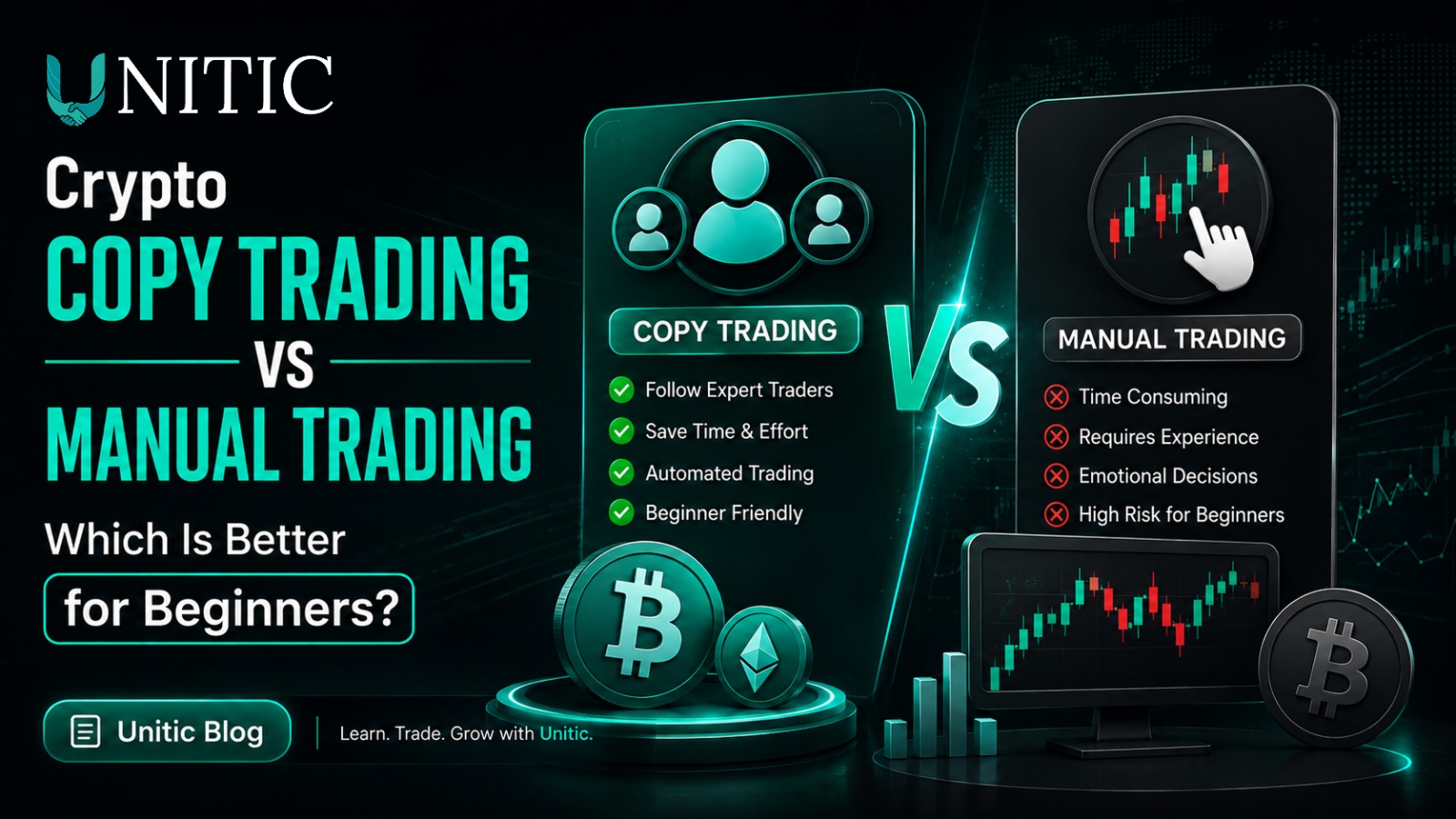
Getting started with cryptocurrency trading can feel overwhelming.
A beginner may encounter dozens of cryptocurrencies, multiple chart timeframes, technical indicators, market news, trading strategies, order types, and risk-management concepts before placing a first trade.
One of the earliest decisions is also one of the most important:
Should you trade manually, or should you use crypto copy trading?
Manual trading means making your own trading decisions. You decide what asset to trade, when to enter, how much capital to use, where to take profit, and when to exit.
Crypto copy trading takes a different approach. Instead of making every decision yourself, you select another trader or strategy and use a platform's copy-trading functionality to replicate that trader's positions according to the available settings.
Both approaches have advantages and disadvantages.
Manual trading offers maximum decision-making control and can provide a valuable learning experience, but it requires time, knowledge, discipline, and emotional control.
Copy trading can make active trading more accessible and reduce the need to manually execute every transaction, but you are relying on another trader's decisions and still face market risk.
This guide compares crypto copy trading vs manual trading from a beginner's perspective and explains how to decide which approach may be more appropriate for your goals and risk tolerance.
Important risk warning: Cryptocurrency trading is highly volatile and speculative. Neither manual trading nor copy trading guarantees profits. You can lose some or all of your trading capital, and leveraged products can increase the size and speed of losses.
What Is Crypto Copy Trading?
Crypto copy trading allows a user to replicate the trading activity of another trader.
The trader being copied is sometimes called a lead trader, strategy provider, or master trader. The person following the strategy is commonly called a follower or copy trader.
The basic process is:
Select a trader → Allocate capital → Configure available settings → Trades are replicated according to the platform's rules
What Is Manual Crypto Trading?
Manual crypto trading means you make the trading decisions yourself.
You decide:
- Which cryptocurrency to trade
- Whether to trade spot or derivatives
- When to enter
- When to exit
- How much capital to allocate
- Whether to use leverage
- Where to place a stop-loss
- Where to take profit
- How to manage an open position
Crypto Copy Trading vs Manual Trading: Quick Comparison
|
Factor |
Crypto Copy Trading |
Manual Trading |
|
Decision-making |
Follows another trader |
Trader makes decisions |
|
Beginner accessibility |
Generally easier to start |
Steeper learning curve |
|
Time required |
Potentially lower |
Usually higher |
|
Control |
Limited to available settings |
High |
|
Learning opportunity |
Observe experienced traders |
Learn through direct analysis and practice |
|
Emotional involvement |
Can be lower initially |
Often higher |
|
Strategy dependency |
Depends on selected trader |
Depends on your own strategy |
|
Execution |
Often automated or semi-automated |
Manually executed |
|
Risk |
Still significant |
Still significant |
|
Profit guarantee |
None |
None |
|
Leverage risk |
Depends on copied strategy |
Depends on user's decisions |
|
Monitoring |
Still required |
Usually requires active monitoring |
|
Customization |
Depends on platform |
Extensive |
The right choice depends on what you value most: convenience, control, learning, time, or independence.
Which Is Better for Beginners?
There is no universal answer.
For a complete beginner who has limited trading knowledge and wants to learn by observing experienced market participants, copy trading may be easier to understand initially.
For someone who wants to develop independent trading skills and is willing to invest time in learning, manual trading can provide a stronger foundation for long-term trading education.
There is also a third approach:
Learn manually while using copy trading cautiously.
A beginner could study markets independently while observing how selected traders operate, rather than treating copy trading as a replacement for learning.
The important point is to avoid assuming that either method is a shortcut to guaranteed profits.
Why Beginners Are Attracted to Crypto Copy Trading
Crypto markets operate 24/7, which can make manual monitoring difficult.
A beginner may have a job, school, business, or other responsibilities and may not have time to watch charts throughout the day.
Copy trading can potentially reduce the amount of time needed for trade execution.
Instead of constantly asking:
"Should I buy Bitcoin now?"
the user can select a trader and allow the platform to replicate that trader's activity according to the available settings.
This simplicity is one of copy trading's main attractions.
However, simplicity does not mean safety.
A simple interface can make it easy to allocate money to a strategy without fully understanding its risks.
Advantages of Crypto Copy Trading for Beginners
1. Lower Learning Barrier
Manual trading can require knowledge of:
- Technical analysis
- Chart patterns
- Market structure
- Risk management
- Order types
- Position sizing
- Trading psychology
Copy trading can reduce the number of decisions a beginner must make manually.
That can make the initial experience less intimidating.
2. Potentially Less Time-Consuming
Depending on the platform and strategy, copied trades can be executed automatically.
This means the user may not need to spend the entire day watching charts.
However, users should still monitor the strategy and their account.
Automated execution does not mean automated risk management.
3. Opportunity to Observe Experienced Traders
Copy trading can provide an educational perspective.
A beginner can observe:
- What assets a trader chooses
- How frequently they trade
- How long positions are held
- How they respond to market movements
- Whether they use leverage
- How they manage losses
This can help beginners understand that professional-style trading involves more than simply buying assets that are going up.
4. Strategy Diversification
If a platform supports multiple copied traders, users may be able to allocate capital among different strategies.
For example:
- One trader focuses on Bitcoin
- Another focuses on diversified spot trading
- Another uses a swing-trading approach
However, diversification must be evaluated carefully.
If all three traders use highly leveraged altcoin futures, the apparent diversification may be much smaller than it appears.
Disadvantages of Crypto Copy Trading for Beginners
1. You Depend on Another Trader
The biggest disadvantage is straightforward:
Someone else makes the trading decisions.
If that trader makes a poor decision, your account can be affected.
Even an experienced trader can experience:
- Losing streaks
- Drawdowns
- Strategy failures
- Poor execution
- Unexpected market losses
2. Past Performance Is Not a Guarantee
A trader may have excellent historical performance.
That does not mean the same results will continue.
Market conditions change.
A strategy that worked during a strong bull market may struggle during a prolonged downtrend or sideways market.
3. Execution Can Differ
Your results may not exactly match the lead trader's results.
Differences can occur because of:
- Execution timing
- Slippage
- Fees
- Liquidity
- Account size
- Position allocation
- Platform limitations
This is especially important during fast-moving markets.
4. Risk Can Be Hidden Behind High Returns
A trader generating very high returns may also be taking very high risks.
For example, aggressive leverage can magnify both gains and losses.
A beginner should not choose a trader simply because their return percentage is the highest.
Advantages of Manual Trading for Beginners
Manual trading has one major educational advantage:
You learn by making the decisions yourself.
When you analyze a market and decide whether to enter, you are forced to understand why you are taking the trade.
1. Complete Control
You decide everything.
If market conditions change, you can immediately change your plan.
You are not dependent on a lead trader's decisions.
2. Stronger Learning Experience
Manual trading encourages you to learn:
- Technical analysis
- Fundamental analysis
- Risk management
- Market psychology
- Position sizing
- Order execution
- Trade management
These skills can be valuable beyond a single trading strategy.
Disadvantages of Manual Trading for Beginners
1. Steep Learning Curve
Trading is not as simple as identifying whether a coin will rise or fall.
A beginner needs to understand:
- Market orders
- Limit orders
- Stop orders
- Fees
- Spread
- Slippage
- Leverage
- Liquidation
- Position sizing
- Risk/reward
- Market volatility
Learning these concepts takes time.
2. Emotional Decisions
Manual trading can expose beginners to strong emotions.
Fear
A trader may exit too early because the market moves against them.
Greed
A trader may increase a position after a profitable trade.
FOMO
A trader may enter after a major price move because they are afraid of missing out.
Revenge Trading
After a loss, a trader may take another trade simply to recover the money.
These behaviors can cause significant damage to a trading account.
3. Time Commitment
Manual trading can require significant time.
Depending on the strategy, traders may need to:
- Monitor charts
- Research markets
- Review news
- Identify setups
- Execute orders
- Manage positions
- Maintain trading records
This can be difficult for people with busy schedules.
Risk Management: The Most Important Difference
When comparing crypto copy trading vs manual trading, beginners often focus on convenience and profitability.
A more important question is:
How is risk managed?
In manual trading, you control your own risk.
In copy trading, risk is influenced by both your settings and the trader you follow.
Risk Management in Manual Trading
A manual trader can establish rules such as:
- Risk only a small percentage of capital on each trade.
- Use predetermined stop-loss levels.
- Avoid excessive leverage.
- Limit exposure to highly volatile assets.
- Stop trading after reaching a predefined daily loss limit.
The trader is responsible for following these rules.
This can be difficult because discipline is often tested during periods of volatility.
Risk Management in Copy Trading
Copy traders should evaluate:
- How much capital is allocated
- Maximum drawdown
- Trader leverage
- Position concentration
- Stop-loss availability
- Maximum position size
- Strategy volatility
- Ability to stop copying
If the platform provides risk controls, understand exactly how they work before relying on them.
Why Maximum Drawdown Matters
Imagine two traders.
Trader A
- Return: +60%
- Maximum drawdown: 8%
Trader B
- Return: +100%
- Maximum drawdown: 45%
Trader B has the higher return.
But Trader B also experienced a much deeper decline.
For a beginner, the second strategy may be psychologically and financially much harder to follow.
This demonstrates why risk-adjusted performance matters more than headline returns alone.
Copy Trading Does Not Mean "Set and Forget"
One of the biggest misconceptions about copy trading is that users can select a trader once and ignore their account indefinitely.
That is risky.
The trader may:
- Change strategy
- Increase leverage
- Start trading different assets
- Experience a major drawdown
- Change position sizes
- Stop trading
- Become less consistent
Market conditions can also change.
Therefore, copy traders should periodically review the strategy.
Manual Trading Does Not Mean "Trade All Day"
Manual trading also does not necessarily require constant chart monitoring.
Some manual strategies operate on higher timeframes.
For example, a swing trader may analyze daily charts and make only a few trades per month.
The amount of time required depends on the strategy.
This is an important distinction for beginners.
Manual trading can be structured around your schedule.
Crypto Copy Trading vs Manual Trading: Cost Comparison
Costs can affect profitability in both approaches.
Manual Trading Costs
Manual traders may encounter:
- Trading fees
- Spread
- Slippage
- Funding fees when using certain derivatives
- Withdrawal fees
- Other platform-specific costs
Frequent trading can increase the cumulative impact of fees.
Copy Trading Costs
Copy traders can face the same trading-related costs plus any additional copy-trading or strategy-related fees applicable to the platform.
Depending on the service, costs could potentially include:
- Trading fees
- Funding fees
- Spread
- Slippage
- Strategy-provider fees
- Profit-sharing fees
Always review the current fee schedule before committing capital.
Crypto Copy Trading vs Manual Trading: A Beginner Scenario
Imagine two beginners, Alex and Sam.
Alex Chooses Copy Trading
Alex has limited time and chooses a trader after reviewing historical performance, drawdown, trading frequency, and leverage.
Alex allocates only a portion of their trading capital.
Alex periodically reviews the strategy.
The approach is convenient, but Alex remains exposed to the trader's decisions and market risk.
Sam Chooses Manual Trading
Sam spends several weeks learning basic technical analysis and risk management.
Sam creates a simple strategy based on trend direction and support/resistance.
Sam starts with small positions and keeps a trading journal.
Sam spends more time analyzing markets but develops independent decision-making skills.
Neither approach guarantees success.
The difference is primarily how trading decisions are made.
Can Beginners Combine Both Approaches?
Yes, where a platform supports copy trading.
A beginner could use copy trading as an observation tool while learning manual analysis.
For example:
Copy-Trading Side
Follow a carefully researched strategy with a limited allocation.
Learning Side
Study:
- Why the trader entered
- What timeframe they use
- Where they place exits
- How they manage risk
- How they respond to losing trades
Then compare those observations with your own analysis.
Over time, you may discover which trading methods fit your personality and risk tolerance.
How Unitic Exchange Fits Into Your Crypto Trading Journey
Unitic Exchange is a cryptocurrency exchange offering access to crypto markets and trading products. Its platform provides spot and futures trading alongside market information and trading functionality.
For beginners considering copy trading or manual trading, the most important step is to understand the specific products and features currently available on the exchange.
Before using any copy-trading functionality, users should verify:
- Whether copy trading is currently available for their account and region
- Which markets can be copied
- How copied positions are calculated
- Applicable trading and strategy fees
- Whether leverage is involved
- Available risk controls
- Minimum allocation requirements
- How positions are closed
- How users can stop copying
- Applicable terms and risk disclosures
Visit Unitic Exchange for the latest information about its products and available trading features.
A Simple Beginner Checklist
Before choosing either approach:
- Learn how cryptocurrency markets work.
- Understand spot and futures trading.
- Learn how trading fees work.
- Understand leverage and liquidation.
- Establish your risk tolerance.
- Decide how much capital you can afford to lose.
- Avoid using essential living expenses for speculative trading.
- Research any trader you plan to copy.
- Review maximum drawdown.
- Review leverage and strategy.
- Avoid choosing a trader solely because of recent returns.
- Keep learning even if you use copy trading.
- Monitor your positions and account regularly.
The Biggest Mistakes Beginners Should Avoid
Mistake 1: Believing Copy Trading Is Risk-Free
It isn't.
Copy trading replicates trading decisions, including losing decisions.
Mistake 2: Starting Manual Trading With Excessive Leverage
Leverage can magnify losses and increase liquidation risk.
Beginners should understand these risks before using leveraged products.
Mistake 3: Investing Based on Social-Media Hype
A trader may appear successful online without providing sufficient information about their risk.
Always conduct independent research.
Mistake 4: Ignoring Drawdown
A strategy's return tells only part of the story.
Understand how much it has historically lost during difficult periods.
Mistake 5: Trading Without a Plan
Manual traders should define their entry, exit, and risk rules before placing trades.
Copy traders should define allocation and conditions for stopping the copied strategy.
Final Verdict: Crypto Copy Trading or Manual Trading?
So, which is better for beginners?
The answer depends on your objective.
Choose Copy Trading If:
- You have limited time.
- You want a simpler trading experience.
- You are interested in observing experienced traders.
- You understand that copied trades can lose money.
- You are willing to research traders carefully.
- You want to reduce manual trade execution.
Choose Manual Trading If:
- You want maximum control.
- You want to develop independent trading skills.
- You have time to learn.
- You enjoy market analysis.
- You are willing to build and test a strategy.
- You want to decide exactly when and how you trade.
Consider Combining Both If:
- You want to learn from experienced traders.
- You also want to develop your own skills.
- You can keep your copy-trading allocation within an appropriate risk limit.
- You are willing to monitor both approaches.
Ultimately, the best approach is not the one that promises the biggest return.
It is the approach that you understand, can manage, and can afford to lose money with if the market moves against you.
With services such as Unitic Exchange, traders can explore cryptocurrency markets and available trading products. Before placing trades, always review the latest platform features, fees, terms, and risk disclosures.
Disclaimer
This article is intended for educational and informational purposes only and does not constitute financial, investment, trading, legal, or professional advice. Cryptocurrency assets are highly volatile and speculative. Copy trading and manual trading both involve the possibility of substantial financial loss. Past performance is not indicative of future results. Before trading, conduct your own research, understand the relevant risks, review the applicable terms and fees of your chosen platform, and only use funds you can afford to lose.
Unitic Exchange | www.uniticexchange.com | Trade IQ | www.tradeiq.exchange
FAQs
It depends on the beginner's goals. Copy trading can be simpler and less time-intensive, while manual trading provides more control and a stronger hands-on learning experience. Neither approach guarantees profits.
Copy trading carries significant market risk. A beginner can lose money when the trader being copied loses money. Users should research strategies, understand drawdowns and leverage, and allocate only an amount consistent with their risk tolerance.
It is possible to make profits, but they are not guaranteed. Historical performance of a trader or strategy does not guarantee future results.
Manual trading has a learning curve. Beginners need to understand market mechanics, technical or fundamental analysis, order execution, risk management, fees, and trading psychology.
There is no universal answer. Profitability depends on the strategy, market conditions, execution, fees, risk management, and many other factors.







Your Crypto Gateway


Unitic Exchange
All rights reserved 2026