Crypto Trading Signals vs Trading Yourself: Which Works Better?
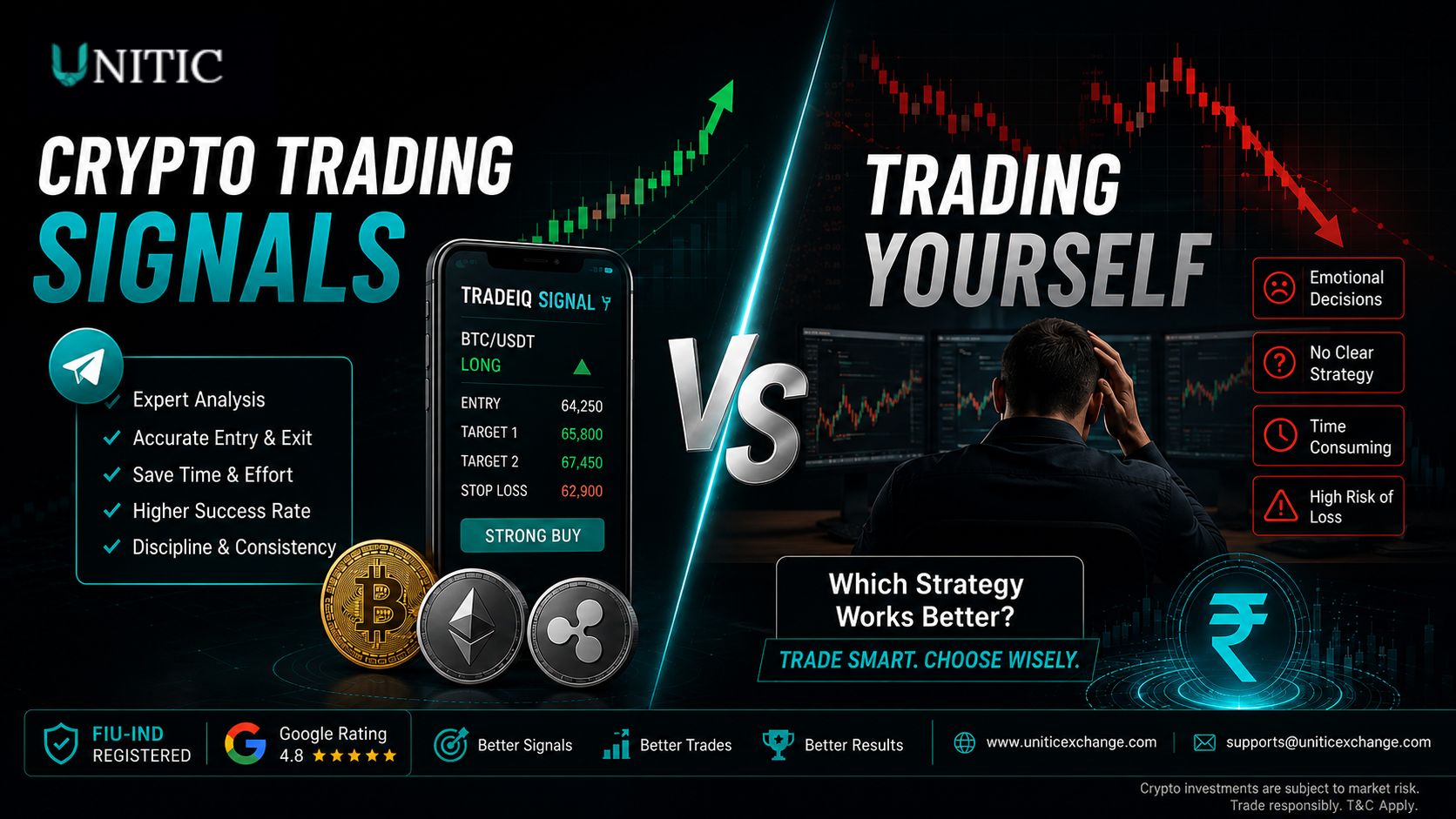
Every trader eventually asks the same question: should I follow someone else's calls, or learn to make my own? The honest answer is that both approaches carry real trade-offs — and understanding them is more useful than picking a side blindly.
Walk into any crypto trading community and you'll find two camps. One swears by crypto trading signals — alerts telling you when to enter, exit, and where to place a stop-loss, generated by someone else's analysis. The other insists that real skill only comes from trading yourself, chart by chart, decision by decision. Neither camp is entirely wrong, and neither is entirely right. The better question isn't "which strategy wins" — it's which approach fits your time, your risk tolerance, and what you're actually trying to get out of trading.
This guide breaks down how each approach works, where each one tends to fall short, how the psychology behind them differs, and how to think about the decision without falling for the oversimplified version of the debate that dominates most trading forums.
Why This Debate Matters More in Crypto Than in Other Markets
The signals-versus-self-directed debate exists in every market — forex, equities, commodities — but it carries extra weight in crypto for a few specific reasons. First, crypto markets trade continuously, with no closing bell and no weekend pause, which means opportunities (and risks) can appear at any hour. A trader relying entirely on their own analysis has to either monitor markets constantly or accept that they'll miss moves that happen while they're asleep or at work. Crypto trading signals, by contrast, can theoretically flag an opportunity at 3 a.m. and have it waiting by morning.
Second, crypto markets tend to be more volatile than many traditional asset classes, which means the cost of a poorly timed entry or a missing stop-loss can compound quickly. That volatility cuts both ways in the signals-versus-self-directed debate: it makes a good signal more valuable, because it can help a trader catch a move they might have otherwise missed, but it also makes a bad signal more dangerous, because a wrong call can move against a position faster than in calmer markets.
Third, the crypto space has a uniquely large and loosely regulated ecosystem of signal providers — individual analysts, paid Telegram groups, automated bots, and platform-native features — compared to more established markets where signal services tend to be more consolidated and, in many cases, more heavily scrutinized. That means the quality gap between the best and worst signal sources in crypto is often wider than a newer trader might expect, which makes the question of how to evaluate a signal provider more important here than almost anywhere else.
What Are Crypto Trading Signals?
A trading signal is essentially a recommendation — a message telling you to buy or sell a specific asset, usually with an entry price, a target, and a stop-loss level attached. Crypto trading signals can come from individual analysts, paid signal groups, algorithmic systems, or platform-based signal features built directly into an exchange.
The appeal is obvious: someone else has already done the chart analysis, so you can act on a recommendation without spending hours studying price action yourself. For a beginner, or for someone who simply doesn't have the time to monitor markets closely, that can feel like a shortcut worth taking.
Common Types of Trading Signals
Not all signals are built the same way, and understanding the difference matters when deciding how much weight to give any single alert:
- Manual signals from individual analysts, based on their own technical or fundamental read of the market. Quality here depends entirely on the skill and honesty of the person behind the call.
- Community or group-based signals, often shared in paid or free groups, where multiple contributors post ideas. These can vary wildly in quality within the same group, and it's not always obvious which contributor's calls are worth following.
- Algorithmic or automated signals, generated by a system scanning for specific technical patterns — such as a moving average crossover or a breakout from a defined range. These remove human emotion from the call itself, but they're only as good as the logic built into the system, and they can perform very differently depending on market conditions.
- Platform-based signal features, built directly into an exchange's interface to surface potential setups based on technical indicators. These can be a convenient starting point for research, but like any signal source, they shouldn't be treated as a guarantee.
Regardless of the source, every signal shares the same core limitation: it reflects someone — or something — else's read of the market, applied to your capital and your risk.
What Does Trading Yourself Actually Involve?
Trading yourself means doing your own technical and fundamental analysis, forming your own view on where a market is likely headed, and making every entry, exit, and risk-management decision based on that view. It requires building skills over time — reading price charts, understanding market structure, managing position size, and developing the discipline to follow your own plan even when a trade isn't going your way.
It's slower to develop as a skill set than simply following a signal, but it also means every decision — and every lesson learned from a mistake — is yours. That distinction matters more than it might seem at first, because the compounding effect of learning from your own trades, rather than outsourcing that learning entirely, tends to build a more durable long-term skill set.
What the Learning Curve Actually Looks Like
Traders who commit to trading themselves usually move through a few recognizable stages. Early on, the focus tends to be on absorbing the basics — how order types work, what a candlestick actually represents, how leverage and margin affect a position. From there, most traders start experimenting with specific tools: support and resistance, trend analysis, momentum indicators, or a mix of several. The stage that tends to separate traders who stick with self-directed trading from those who give up isn't technical knowledge at all — it's the emotional discipline to follow a plan consistently, especially after a string of losses.
This is also where the two approaches start to diverge in an important way. Someone following crypto trading signals can, in theory, skip much of this process and start executing trades almost immediately. Someone trading themselves has to go through it directly, which is slower — but it also means that by the time a self-directed trader has real experience, they've built pattern recognition and emotional resilience that a signal follower may never develop, simply because they never had to sit through the full cycle of decision-making themselves.
The Case for Trading Signals
Time efficiency. Signals let you participate in the market without spending hours each day on chart analysis, which matters for anyone with a full-time job or limited screen time.
Lower learning curve to get started. You don't need months of practice before placing your first trade, since the analysis has already been done for you.
Exposure to different strategies. Following signals from analysts with different styles can expose you to trading approaches you might not have discovered on your own, which can be a useful way to broaden your understanding of the market even if you eventually move toward trading independently.
Useful as a learning tool, not just an execution shortcut. Some traders use crypto trading signals not to blindly copy trades, but to study the reasoning behind them — comparing a signal's entry logic against their own read of the chart, and gradually building their own skills in the process.
Can help during periods of limited availability. Life circumstances change — a demanding work period, travel, or simply less time to dedicate to markets — and signals can offer a way to stay engaged with trading during those stretches without requiring the same level of ongoing attention that self-directed trading demands.
The Case Against Relying Solely on Signals
You're trusting someone else's risk tolerance, not your own. A signal provider's position sizing and stop-loss placement reflects their own account size and comfort with risk — which may not match yours at all. A stop-loss that makes sense for a trader running a large account with high risk tolerance may be far too wide for someone trading a smaller account who needs tighter risk control.
Quality varies enormously. Signal groups range from genuinely skilled analysts to accounts with no verifiable track record, and it's often difficult to tell the difference until real money is on the line. The barrier to starting a signal group or channel is essentially nonexistent, which means confidence in how a signal is presented has little correlation with its actual reliability.
Timing gaps matter. By the time a signal reaches you, the market may have already moved, especially in fast-moving crypto markets where prices can shift meaningfully within minutes. A signal that made sense at the moment it was generated can be a poor entry by the time it's actually acted on.
No real skill development. Following signals long-term without studying the reasoning behind them means you never build the ability to read markets independently — which leaves you permanently dependent on someone else being right, and vulnerable the moment that source disappears, changes quality, or turns out to have been unreliable all along.
Unrealistic promises are common in this space. Be especially cautious of any signal service promising guaranteed or extremely high returns in a short timeframe. Markets don't work that way, and claims like this are one of the clearest warning signs of a service that isn't acting in your interest.
Signals can encourage passive decision-making. Even when a signal turns out to be wrong, it's easy to rationalize the loss as bad luck rather than examining what happened — a habit that's much harder to fall into when you're the one who made every decision yourself.
The Case for Trading Yourself
Full ownership of your decisions. Every entry and exit reflects your own analysis, which means every win and loss teaches you something you can apply going forward.
Risk management tailored to you. You size positions and set stop-losses based on your own account, your own risk tolerance, and your own goals — not someone else's.
No dependency on a third party. Your ability to trade doesn't rely on a signal provider staying active, accurate, or trustworthy over time.
Deeper market understanding over time. Reading charts, tracking how price reacts around key levels, and following how markets respond to news builds an intuition that compounds the longer you stick with it.
Adaptability across changing conditions. A trader who understands market structure can adjust their approach as conditions shift — from trending to ranging, from low volatility to high volatility — in a way that following fixed signal recommendations doesn't naturally allow for.
Confidence built on understanding, not luck. When a self-directed trade works out, it's because the underlying analysis was sound, which builds a kind of confidence that following someone else's winning call simply can't replicate, since a winning signal doesn't necessarily mean the reasoning behind it was understood.
The Case Against Trading Entirely Alone
Steep learning curve. Developing real skill takes time, and early mistakes — which are almost inevitable — can be costly before the learning catches up.
Time commitment. Meaningful self-directed trading requires ongoing study and market monitoring, which isn't realistic for everyone's schedule, particularly for traders balancing full-time work or other commitments.
Emotional discipline is hard to build alone. Without any outside structure, it's easy to let emotion override a trading plan, especially during volatile swings — a mistake that's just as common among self-directed traders as it is among signal followers.
Isolation from other perspectives. Trading entirely alone, without any outside input, can mean missing blind spots in your own analysis that a second perspective might have caught — one reason many experienced self-directed traders still follow analysts or signal providers, not to copy trades, but to stress-test their own thinking.
The Psychology Behind Each Approach
Beyond the mechanics of each strategy, the psychological experience of trading signals versus trading yourself is genuinely different, and it's worth understanding before committing to either path.
Following signals can create a kind of psychological distance from a trade — since the decision wasn't fully your own, a loss can feel less personal, which sounds like an advantage but often isn't. That distance can make it easier to walk away from a losing streak without learning anything from it, because there's a built-in excuse: the signal was wrong, not the decision to act on it without independent verification.
Trading yourself creates the opposite dynamic. Every loss is fully your own, which can be harder to sit with emotionally, but it also creates a much stronger incentive to actually understand what went wrong. That direct feedback loop — decision, outcome, reflection — is part of what makes self-directed trading such an effective, if slower, way to build genuine skill over time.
There's also a confidence dimension worth considering. Signal followers can develop a kind of false confidence, believing they understand the market because they've had a string of profitable trades, when in reality the credit belongs to whoever generated the signals. That gap between perceived skill and actual skill can be dangerous, especially if a trader eventually increases their position sizes based on a confidence that isn't backed by their own analytical ability.
This psychological gap tends to surface most clearly during a losing streak. A trader who has been trading themselves and hits a rough patch usually has a body of prior reasoning to fall back on — they can look at their own journal, compare current losses against past patterns, and make an informed judgment about whether their process is still sound or needs adjusting. A trader who has been following signals exclusively doesn't have that same reference point. When a signal provider's calls stop working, it's often unclear whether the market has genuinely shifted, the provider's process has broken down, or the trader is simply misreading normal variance as a trend — and without independent analysis to lean on, that ambiguity can be paralyzing.
There's a related pattern worth naming directly: outcome bias. It's tempting to judge a trading approach purely by whether recent trades were profitable, rather than by whether the underlying process was sound. A signal follower who profits from a lucky call can walk away believing the signal source is reliable, when the outcome may have had little to do with the quality of the analysis behind it. The same trap catches self-directed traders too — a profitable trade based on flawed reasoning can reinforce bad habits just as easily as a losing trade based on sound reasoning can shake confidence in a good process. Recognizing outcome bias, and judging decisions by their reasoning rather than their result alone, is one of the more advanced skills that separates traders who improve steadily from those who plateau regardless of which approach they use.
How Market Conditions Change the Calculus
The signals-versus-self-directed comparison isn't static — how well each approach performs can shift meaningfully depending on the broader market environment.
In strongly trending markets, both approaches can perform reasonably well, since clear directional moves tend to be easier to identify, whether through a trader's own trend-following analysis or through signals built around momentum. The margin for error is often wider in these conditions, which can mask weaknesses in either approach that would show up more clearly elsewhere.
In choppy, range-bound markets, the gap between a well-developed independent process and a generic signal service tends to widen. Range-bound conditions require more nuanced reading of where a market is likely to reverse versus where it's likely to break out, and signals that don't account for the specific character of a ranging market can generate a higher rate of false entries. Traders with a strong grasp of support and resistance, and how price tends to behave within a range, often navigate these conditions more effectively through their own analysis than by following generic signal calls.
During periods of extreme volatility, timing becomes especially important, and the lag between when a signal is generated and when it's actually acted on can matter more than usual. A trader executing their own analysis in real time has an inherent speed advantage here, though that advantage only holds if their decision-making is sound to begin with — volatility punishes poor judgment regardless of its source.
Understanding how conditions affect each approach is itself a form of skill-building, and it's one more reason why treating signals purely as inputs — to be weighed against current market context — tends to produce better outcomes than following them mechanically regardless of the environment.
Which Approach Fits Different Types of Traders
There's no single right answer, but a trader's circumstances often point toward one approach being more practical than the other, at least as a starting point.
Traders with limited time. Signals can offer a way to stay engaged with the market without requiring hours of daily chart study — though even here, treating signals as a research input rather than a blind instruction remains important.
Complete beginners. A hybrid approach often works well early on: using signals to see real examples of technical setups in action, while gradually studying the reasoning behind each one, rather than jumping straight into either fully independent trading or fully passive signal-following.
Traders focused on long-term skill development. Self-directed trading, even if slower to show results, tends to build a more durable foundation — one that doesn't disappear if a signal provider goes quiet or turns out to be unreliable.
Active, experienced traders. Many traders at this stage use signals selectively, treating them as one additional data point among several, while relying primarily on their own established process for the majority of their decisions.
Traders who value flexibility over routine. Some traders don't fit neatly into a single category and prefer to shift their reliance on signals versus self-directed analysis depending on the season of life they're in — leaning more on signals during busy periods, and more on independent research when they have more time to dedicate to the market. This kind of flexibility isn't a compromise so much as a recognition that trading approaches don't need to be fixed forever to be effective.
How to Evaluate a Signal Provider Before Trusting It
If you do choose to incorporate crypto trading signals into your strategy, a few checks can help separate a genuinely useful source from a risky one:
- Ask for a verifiable track record, ideally one that shows both wins and losses over time, not just a highlight reel of successful calls.
- Check whether risk management is part of the signal. A credible signal includes a clear stop-loss and position-sizing guidance, not just an entry and a target.
- Be skeptical of urgency and hype. Legitimate analysis rarely needs to pressure you into acting immediately — pressure tactics are far more common among providers with something to hide than among those confident in their process.
- Watch for return promises that sound disconnected from market reality. No legitimate trader can guarantee consistent outsized returns over a short timeframe, and any provider claiming otherwise should be treated with significant caution.
- Look at consistency over time, not just a single good call. Anyone can get one trade right — a track record built over months tells you far more than a single lucky outcome.
- Notice whether the reasoning is explained. A signal provider willing to explain the logic behind a call — not just the call itself — is generally offering something closer to education than a black-box instruction to follow blindly.
Combining Signals With Your Own Analysis
For many traders, the most practical approach isn't choosing crypto trading signals or trading yourself exclusively, but using signals as a starting point that still passes through your own judgment before any capital moves. This might look like reviewing a signal's entry logic against your own chart read, checking whether the suggested stop-loss makes sense given current volatility, or simply using a signal as a prompt to research an asset you wouldn't have otherwise looked at.
This hybrid approach captures some of the time-saving benefit of signals while avoiding the biggest risk of relying on them exclusively: outsourcing your risk management entirely to someone else's judgment. Over time, traders who use signals this way — as an input rather than an instruction — tend to build faster toward genuine independent skill than those who either ignore signals completely or follow them without question.
Whichever approach you use — whether that's studying charts and executing your own trades on Unitic Exchange, or using signals as a starting point for further research — the fundamentals stay the same: understand what you're trading, size your risk sensibly, and never treat a shortcut as a substitute for understanding the market you're putting capital into.
Building a Personal Framework, Whichever Path You Choose
Regardless of where you land on the signals-versus-self-directed spectrum, a few habits tend to separate traders who improve over time from those who don't:
- Keep a trading journal. Recording every trade — the reasoning, the outcome, and what you'd do differently — is one of the fastest ways to spot patterns in your own decision-making, whether the ideas originated from a signal or your own analysis.
- Review losses as carefully as wins. It's tempting to move on quickly from a losing trade, but losses usually carry more useful information than wins do, since they reveal exactly where a plan or an assumption broke down.
- Set rules before you need them. Deciding your risk-per-trade, your maximum position size, and your rules for exiting a losing position ahead of time removes a layer of emotional decision-making in the moment, regardless of whether the trade idea came from a signal or your own research.
- Revisit your approach periodically. What works in a trending market may not work in a ranging one, and a strategy — signal-based or self-directed — that hasn't been reviewed in months may no longer fit current conditions.
- Separate the decision from the outcome. A good decision can still lose money, and a poor decision can still turn a profit. Judge your process by the quality of the reasoning behind it, not just by whether a particular trade worked out — this is true whether you're evaluating your own analysis or a signal you chose to follow.
- Start small when testing anything new. Whether it's a new signal provider or a new technical approach you're developing yourself, testing with a smaller position size before committing significant capital gives you room to evaluate quality without taking on outsized risk in the process.
Final Thoughts
There's no universal answer to whether crypto trading signals or trading yourself "works better" — it depends on how much time you can commit, how much you value building independent skill, and how carefully you vet whatever signals you choose to follow. What matters more than picking a side is approaching either path with the same discipline: manage risk deliberately, stay skeptical of promises that sound too good to be true, and treat every trade — signal-driven or self-directed — as a decision you understand fully before you make it.
The traders who tend to do best over the long run aren't necessarily the ones who picked one approach and stuck to it rigidly. They're the ones who understood the trade-offs of each, built habits — journaling, risk management, ongoing review — that work regardless of where a trade idea originates, and stayed honest with themselves about what was actually driving their results.
This article is for educational purposes only and is not financial advice. Trading involves risk, and no signal or strategy can guarantee results. Only trade with capital you can afford to lose.
Unitic Exchange | www.uniticexchange.com | Trade IQ | www.tradeiq.exchange
FAQs
Reliability varies enormously depending on the source. Some providers have consistent, verifiable track records, while others have no real accountability at all. The reliability of any individual signal depends entirely on the skill and honesty of whoever — or whatever system — generated it.
Not necessarily. Many beginners benefit from a hybrid approach — using signals as a way to see real setups in action while gradually building their own analytical skills, rather than jumping straight into either fully independent trading or blindly following signals.
Yes. No signal, regardless of the source, can guarantee an outcome. Markets involve risk regardless of who — or what — generated the underlying trade idea.
Look for a verifiable track record over time, clear risk-management guidance included with each call, and an absence of pressure tactics or unrealistic return promises. Providers who explain their reasoning, rather than issuing instructions without context, tend to be more transparent.
Some do, typically as one additional input alongside their own established process rather than as a primary decision-making tool. Using signals selectively, with full understanding of the reasoning behind them, is different from relying on them exclusively.


Your Crypto Gateway


Unitic Exchange
All rights reserved 2026