Perpetual DEXs Explained: How Decentralized Futures Trading Works
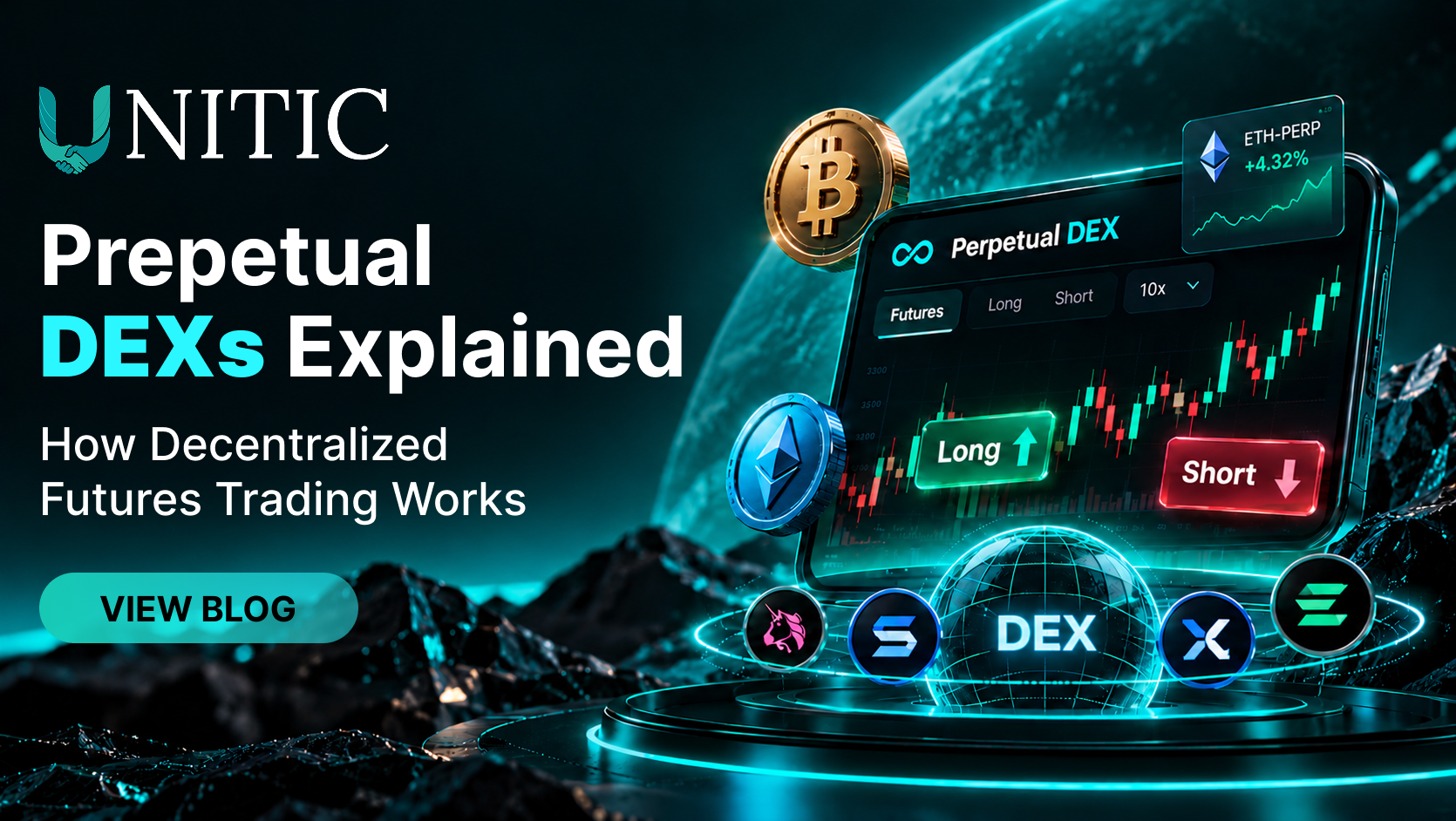
If you have spent time around crypto trading, you have almost certainly heard the word "perpetual" or "perp." Most major exchanges offer perpetual futures, and they make up a huge share of all crypto trading volume. More recently, a new version of this product has grown fast: the perpetual DEX, or decentralized perpetual exchange. Instead of trading futures through a company's app, you trade them directly from your own wallet, through smart contracts, with nobody holding your funds for you.
This guide explains what perpetual DEXs are, how they actually work under the hood, how they differ from the centralized futures you may already know, and what the trade-offs are. We will also look at where a centralized, India-focused platform like Unitic Exchange fits into this picture, and when a centralized approach can be the simpler, safer choice.
What Is a Perpetual Contract?
Before getting into the "decentralized" part, it helps to understand the "perpetual" part.
A perpetual contract, or "perp," is a type of futures contract that lets you speculate on the price of an asset, like Bitcoin or Ethereum, without needing to own that asset directly. You can go long if you think the price will rise, or short if you think it will fall.
The key difference from a traditional futures contract is right there in the name. Traditional futures have a fixed expiry date. On that date, the contract settles and the position closes, whether you want it to or not. A perpetual contract has no expiry date at all. You can, in theory, hold the same position for a day, a month, or years, as long as your account has enough margin to support it.
This single design choice, removing the expiry date, is what makes perpetuals so popular. There is no need to "roll over" a position into a new contract every few weeks. You simply open a trade and close it whenever you choose.
So What Makes a Perpetual DEX Different?
A perpetual DEX, short for perpetual decentralized exchange, is a platform that offers this same product, perpetual futures, but built on smart contracts instead of centralized company infrastructure. You connect a crypto wallet, deposit collateral, usually a stablecoin like USDC, and open your long or short position directly on-chain.
The core difference is custody. On a centralized futures exchange, you deposit funds and the platform holds them on your behalf. Your position exists as an entry in that company's internal ledger. On a perpetual DEX, your collateral sits in an auditable smart contract rather than on a company's balance sheet, and you interact with that contract directly from your own wallet.
Put simply: same underlying product, perpetual futures, but a different trust model for who holds your money while the trade is open.
The Building Blocks of a Perpetual DEX
Every perpetual DEX, regardless of which blockchain it runs on, relies on a handful of shared components working together. Understanding these pieces is the key to understanding how the whole system functions.
1. Smart Contracts
Smart contracts are self-executing code deployed on a blockchain. On a perpetual DEX, they are what actually open positions, track margin, process funding payments, and trigger liquidations. There is no customer support team manually approving your trade; the contract enforces the rules automatically, the same way every time.
2. Oracles
A perpetual DEX needs to know the current "real" price of an asset to calculate your profit or loss, decide whether you are close to liquidation, and determine funding payments. Since blockchains cannot see outside data on their own, they rely on oracles, services like Chainlink or Pyth Network, which feed accurate, frequently updated price data onto the blockchain. This is often called the "index price."
A bad or delayed price feed is a genuine point of weakness in this system, which is why most perpetual DEXs invest heavily in oracle reliability and use multiple price sources to reduce the chance of manipulation.
3. The Funding Rate
Because a perpetual contract has no expiry date, there needs to be some mechanism that keeps its price anchored close to the real, spot price of the underlying asset. That mechanism is the funding rate.
Here is how it works in practice:
- If the perpetual contract is trading above the spot price, it signals that there is more demand to go long than short. In this case, longs pay shorts a small periodic fee.
- If the perpetual contract is trading below spot, the reverse happens: shorts pay longs.
This payment happens repeatedly, often every hour or every few hours, depending on the platform. The 2026 trend among newer perp DEXs has moved toward more frequent, sometimes near-continuous, funding updates rather than the older fixed 8-hour interval.
The genius of this mechanism is that it nudges traders toward whichever side the market is underweight on. If too many people are long, funding payments make staying long more expensive, which naturally pulls the perpetual price back toward the spot without needing an expiry date to force that alignment.
4. Margin and Leverage
To open a position, you deposit collateral, known as margin. Leverage lets you control a larger position than your margin alone would allow. If you deposit $100 and use 10x leverage, you can open a position worth $1,000. This magnifies both your potential profit and your potential loss.
Leverage is a tool, not a free lunch. The same multiplier that can turn a 5% price move into a 50% gain on your margin can just as easily turn it into a 50% loss, or a full liquidation, in the other direction.
5. The Liquidation Engine
If a position's losses eat into its margin enough that it can no longer support the trade, the position must be closed automatically, before losses exceed the trader's deposited collateral. This is handled by the liquidation engine.
On most perpetual DEXs, this process is carried out by automated systems, sometimes called "keeper bots," that constantly monitor open positions against current prices. When a position crosses its liquidation threshold, the system closes it, using the deposited margin to cover the loss. Because this all happens through code rather than a person watching a screen, liquidations on a perpetual DEX can happen very quickly once the price trigger is hit.
How a Trade Actually Flows Through a Perpetual DEX
Put these pieces together, and a typical trade looks something like this:
- Connect your wallet. No account creation, no email verification. Your wallet is your login.
- Deposit collateral. Usually a stablecoin, transferred into the platform's smart contract.
- Choose your market and direction. Pick an asset, such as BTC or ETH, and decide whether to go long or short.
- Set your leverage and position size. Higher leverage means a smaller required deposit for the same position size, but a closer liquidation price.
- The position opens on-chain. The smart contract records your position, with the oracle's price feed used to track its value in real time.
- Funding payments are exchanged periodically. Depending on which side of the market you are on, you either pay or receive funding.
- You close the position whenever you choose, or the liquidation engine closes it automatically if your margin runs out.
Throughout this entire process, your collateral never leaves your control in the way it would on a centralized platform. You are interacting with code, not handing funds to a custodian.
Order Matching: Order Books vs. Liquidity Pools
Not all perpetual DEXs match trades the same way. Broadly, there are two models.
On-chain order books work similarly to a traditional exchange: buyers and sellers post orders at specific prices, and the system matches them. Some platforms run a fully on-chain order book; others keep order matching off-chain for speed, while still settling and custodying funds on-chain. This hybrid approach, off-chain order processing combined with on-chain settlement, is common because a fully on-chain order book can be slower and more expensive to operate at scale.
Liquidity pool models, sometimes built around an automated market maker design, let traders open positions against a shared pool of capital rather than against another individual trader. Liquidity providers deposit funds into this pool and earn a share of trading fees in return, while effectively taking the other side of trader positions as a group.
Neither model is strictly "better." Order books tend to offer tighter pricing and a more familiar trading experience for anyone used to centralized exchanges, while pool-based models can offer deep liquidity for less commonly traded assets without needing a dedicated market maker on every pair.
Perpetual DEX vs. Centralized Futures: A Side-by-Side Look
|
Centralized Futures Exchange |
Perpetual DEX |
|
|
Custody |
Exchange holds your funds |
You hold your funds via a wallet |
|
Account setup |
KYC, sign-up, verification |
Connect a wallet |
|
Execution |
Centralized matching engine |
Smart contracts, sometimes with off-chain matching |
|
Transparency |
Internal, not publicly auditable |
On-chain positions and liquidations are publicly visible |
|
Speed |
Typically very fast |
Fast, but can depend on blockchain conditions |
|
Support & recourse |
Customer support, account recovery |
Largely self-managed; limited recourse if you make an error |
|
Regulatory footing |
Often licensed and KYC-compliant |
Varies widely by jurisdiction and platform |
The honest way to frame this: a perpetual DEX trades convenience and support for self-custody and transparency. Which one suits you depends heavily on how comfortable you are managing your own wallet security, gas fees, and the absence of a support team to call if something goes wrong.
The Real Risks of Perpetual DEXs
Decentralization removes some risks and introduces others. It is worth being clear-eyed about both sides.
Smart contract risk. Code can have bugs. A flaw in a perpetual DEX's smart contracts could, in a worst case, lead to loss of funds. Reputable platforms undergo audits, but audits reduce risk, they do not eliminate it.
Oracle risk. If a price feed is delayed, manipulated, or temporarily wrong, it can trigger incorrect liquidations or let traders exploit a price gap before the oracle catches up.
No customer support safety net. If you send funds to the wrong address, mismanage your wallet, or make an error in a transaction, there is typically no support team who can reverse it. You are fully responsible for your own actions.
Liquidation speed. Because liquidation engines are automated and triggered by code, a sudden, sharp price move can liquidate positions very quickly, sometimes faster than a trader can react, especially with high leverage.
Gas and network fees. Every on-chain action, opening a position, adjusting margin, closing a trade, can involve a network fee. During periods of high blockchain congestion, these fees can spike.
Regulatory uncertainty. Because perpetual DEXs are often accessible from almost anywhere with just a wallet, the regulatory status of using them can be unclear and varies by country. This is an area worth understanding before you commit meaningful capital.
None of this means perpetual DEXs are inherently unsafe. It means the risks shift from "is this company trustworthy" to "is this code, and this market structure, trustworthy," which is a different kind of question that requires different due diligence.
Why Many Traders Still Prefer a Centralized Platform
Given the growth of perpetual DEXs, it is reasonable to ask why centralized futures trading remains so dominant. A few practical reasons stand out.
Simplicity. No wallet setup, no gas fees, no need to understand blockchain mechanics to place a trade.
Fiat on-ramps. Centralized exchanges let you deposit and withdraw in your local currency directly, through UPI, bank transfer, or similar rails, something most perpetual DEXs cannot offer directly.
Support when things go wrong. If you make a mistake, lock yourself out of an account, or have a dispute, there is a real support team you can contact.
Regulatory clarity, where it applies. A platform that is registered and compliant in your jurisdiction offers a clearer legal footing than a wallet-based protocol with no central operator.
Familiar, integrated tools. Features like trading signals, OTC desks for large trades, and curated market listings are easier to build and maintain on a centralized platform, where the operator controls the full user experience end to end.
This is exactly where a platform like Unitic Exchange fits in. Unitic Exchange is built as a high-performance, centralized crypto trading platform for Indian users, with security monitoring and a straightforward account-based experience, the kind of setup that removes the wallet-management and gas-fee learning curve that comes with perpetual DEXs.
For traders who want structure around their decisions rather than navigating raw on-chain execution, Unitic Exchange's trading signals give a more guided starting point than opening a position directly against an oracle feed and hoping you have sized it correctly. If you are deciding which assets to trade in the first place, the platform's markets page lays out the available pairs in one place, rather than requiring you to track liquidity across multiple on-chain pools. And for traders moving larger size, the kind of order that can move thin liquidity on a pool-based perpetual DEX, Unitic Exchange's OTC desk offers a way to execute big trades without the slippage that can come from pushing a large order through an automated market maker.
Perpetual DEX or Centralized Exchange: How to Decide
There is no universally "correct" answer here. A sensible way to think about it:
Choose a perpetual DEX if:
- You want to keep custody of your funds at all times.
- You are comfortable managing a wallet, gas fees, and on-chain transactions.
- You value public, auditable position and liquidation data.
- You are trading assets or markets not well-served by centralized platforms.
Choose a centralized platform like Unitic Exchange if:
- You want to deposit and withdraw directly in INR.
- You prefer account-based login over wallet management.
- You want support available if something goes wrong.
- You value curated tools, such as signals, organized markets, and an OTC desk for larger trades.
- You are newer to futures trading and want a more guided experience.
Some traders use both, keeping spot or signal-based trades on a centralized platform while experimenting with perpetual DEXs for specific markets or strategies. There is nothing wrong with that approach, as long as you understand the different risk profile each one carries.
Final Thoughts
Perpetual DEXs represent a genuinely different way of accessing futures trading: on-chain, self-custodial, and transparent by design. The core mechanics, funding rates, oracles, leverage, and automated liquidation, achieve the same goal as a centralized futures product, keeping the contract price anchored to the market and managing risk, but they do it through code rather than a company.
That said, "decentralized" does not automatically mean "better" for every trader. It means a different set of trade-offs: more control over your own funds, but more responsibility, less hand-holding, and a different category of technical risk. For traders who want a simpler, supported, INR-friendly entry point, with trading signals, curated markets, and an OTC desk for size, a centralized platform like Unitic Exchange remains a practical starting point, whether or not you also explore perpetual DEXs down the line.
Disclaimer: This article is for educational purposes only and is not financial advice. Trading futures, whether on a centralized platform or a perpetual DEX, involves significant risk, including the risk of losing more than your initial deposit when leverage is used. Please do your own research and consider your risk tolerance before trading.
FAQs
It means the contract has no expiry date. Unlike traditional futures, which settle on a fixed date, a perpetual contract can be held indefinitely as long as your margin supports it.
Most perpetual DEXs charge trading fees on opened and closed positions, similar to centralized exchanges. Liquidity providers on pool-based models also earn a share of fees for supplying the capital that trades are executed against.
It depends what you mean by "safe." A perpetual DEX removes the risk of a company mismanaging or losing your deposited funds, since you hold custody yourself. But it introduces smart contract risk, oracle risk, and the absence of customer support. Centralized exchanges carry counterparty risk, but offer support, fiat access, and often a clearer regulatory relationship.
The funding rate is a periodic payment exchanged between long and short traders to keep a perpetual contract's price anchored near the spot price. Whether you pay or receive it depends on which side of the market you are on and current market conditions; it is not a fixed cost charged to everyone.
With leverage, if the market moves sharply against your position faster than the liquidation engine can close it, it is possible to lose more than expected, though most systems are designed to liquidate before a position's losses exceed its margin. This is one reason conservative position sizing matters, on any futures platform.
Yes. A perpetual DEX requires a self-custody wallet to connect, deposit collateral, and sign transactions. There is no traditional username-and-password account the way there is on a centralized exchange.
No. Unitic Exchange is a centralized crypto trading platform built for Indian users, offering an account-based trading experience with features like trading signals, organized markets, and an OTC desk, rather than wallet-based, smart-contract execution.


Your Crypto Gateway


Unitic Exchange
All rights reserved 2026