How Crypto Futures Trading Works: Margin, Leverage, Liquidation & P&L Explained
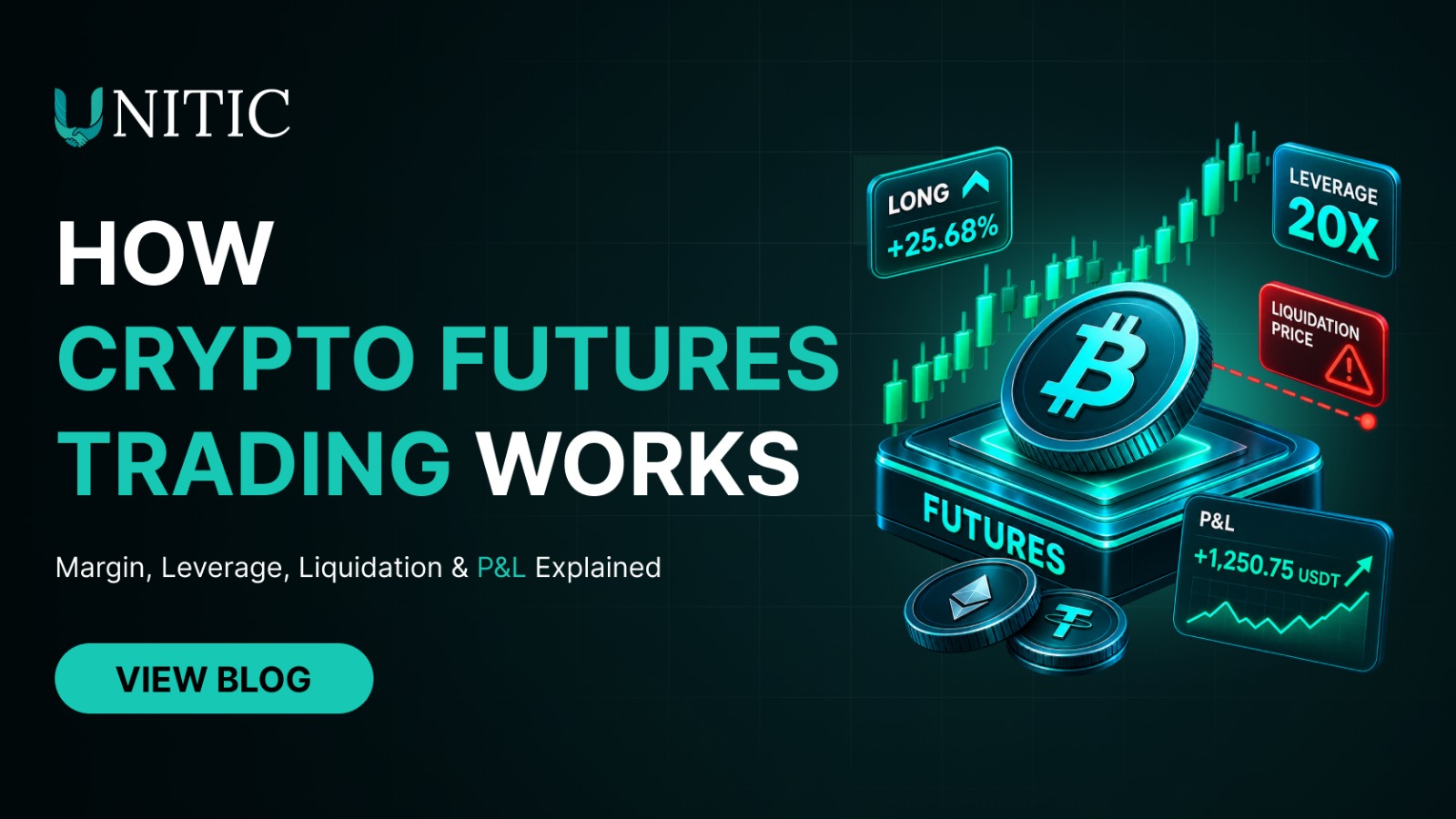
Cryptocurrency futures trading has become an important part of the digital-asset market. Unlike traditional spot trading, where traders generally buy or sell an asset directly, futures trading allows market participants to take positions based on the expected future price of an asset.
Futures traders can potentially benefit from both rising and falling markets by opening long or short positions. They can also use leverage, which allows them to control a larger position with a smaller amount of capital.
But leverage comes with significant risk.
A relatively small market movement can produce a substantial gain—or a substantial loss. If a position moves too far against a trader and the available margin is no longer sufficient to support it, the position can be liquidated.
Understanding margin, leverage, liquidation, and profit and loss (P&L) is therefore essential before trading crypto futures.
This guide explains how crypto futures trading works, breaks down the terminology beginners need to know, provides practical examples, and discusses how traders can approach futures risk management. It also explains how Unitic Exchange fits into the crypto trading ecosystem.
Risk warning: Crypto futures trading is highly speculative and can result in substantial losses. Leverage magnifies both profits and losses, and positions can be liquidated quickly during volatile markets. This article is for educational purposes and is not financial advice.
What Is Crypto Futures Trading?
Crypto futures trading involves trading contracts whose value is based on the price of an underlying cryptocurrency.
Instead of simply purchasing Bitcoin, for example, a trader can open a futures position based on the expected movement of Bitcoin's price.
There are two basic directions:
Long
A trader opens a long position when they expect the price to rise.
Short
A trader opens a short position when they expect the price to fall.
This ability to potentially profit from downward price movements is one of the major differences between futures and traditional spot trading.
However, a futures position does not mean that a trader can predict the market correctly. If the market moves against the position, the trader can lose money.
What Is Leverage in Crypto Futures?
Leverage allows a trader to control a position larger than the amount of capital they provide as margin.
Position Size = Margin × Leverage
The trader now controls a larger position with the same initial margin.
This can increase potential returns, but it also increases the potential loss.
What Is Margin?
Margin is the collateral used to support a leveraged futures position.
Think of margin as the capital backing your position.
There are two important margin concepts beginners should understand:
- Initial margin
- Maintenance margin
What Is Initial Margin?
Initial margin is the amount of collateral required to open a futures position.
A simplified formula is:
Initial Margin ≈ Position Value ÷ Leverage
What Is Maintenance Margin?
Maintenance margin is the minimum amount of equity that generally needs to remain in a futures position to keep it open.
If losses reduce the account or position equity below the required maintenance margin, the exchange may begin the liquidation process.
This is one of the most important concepts in futures trading.
A trader may have enough money to open a position but still face liquidation later if the market moves sufficiently against them.
What Is Liquidation?
Liquidation occurs when a futures position is forcibly closed because the trader no longer has enough margin to support the position under the platform's rules.
In simple terms:
Market moves against you → losses reduce available margin → maintenance-margin requirement is reached → position may be liquidated.
Liquidation is particularly important when using high leverage.
What Is Cross Margin?
Under a cross-margin system, eligible available account balance can potentially be used to support positions.
This can reduce the chance that an individual position is liquidated immediately, but it can also expose a larger portion of the account to losses.
The exact mechanics vary by exchange.
A trader using cross margin should understand how losses from one position can affect available account equity and other positions.
What Is Isolated Margin?
With isolated margin, a specific amount of margin is allocated to an individual position.
If that position is liquidated, the loss is generally limited to the margin allocated to that position, subject to the platform's rules and applicable costs.
Isolated margin can therefore make position-level risk easier to define.
However, it does not eliminate the risk of losing the allocated margin.
Cross Margin vs. Isolated Margin
|
Feature |
Cross Margin |
Isolated Margin |
|
Margin source |
Shared/eligible account equity |
Allocated to a specific position |
|
Risk exposure |
Can affect broader account equity |
More contained to the position |
|
Liquidation impact |
Potentially broader |
Generally limited to allocated margin |
|
Flexibility |
Higher |
More controlled |
|
Beginner consideration |
Requires understanding of account-level risk |
Easier to define position risk |
The exact behavior depends on the exchange and product.
Always review the platform's margin documentation before opening a leveraged position.
What Is Funding Rate?
Many perpetual futures contracts use a funding mechanism to help keep the contract price aligned with the underlying market.
Funding payments can be exchanged between long and short traders at scheduled intervals.
Depending on the funding rate and the direction of the position, a trader may:
- Pay funding
- Receive funding
Funding is separate from the trading fee.
A trader holding a position for an extended period should consider how funding may affect overall P&L.
Trading Fees and Futures P&L
A futures trade may involve transaction costs.
These can include:
- Maker fees
- Taker fees
- Funding payments
- Spread
- Slippage
- Other platform-specific charges
This is why traders should distinguish between gross P&L and net P&L.
Mark Price, Last Price, and Index Price
Futures platforms can display several different prices.
Understanding them is important.
Last Price
The most recent traded price on the futures market.
Index Price
A reference price derived from underlying or external spot-market prices, depending on the platform.
Mark Price
A calculated reference price commonly used for risk-management purposes, including unrealized P&L and liquidation calculations on many derivatives platforms.
The exact methodology varies between exchanges.
A trader should understand which price the platform uses for liquidation and P&L calculations.
Why Liquidation Price Is Not the Same as a Stop-Loss
A stop-loss is a risk-management order designed to close a position at a specified trigger.
Liquidation is a forced closure initiated by the exchange when margin requirements are no longer satisfied.
These are fundamentally different.
A trader may choose to close a position before liquidation by using a stop-loss or manually exiting.
Waiting for liquidation generally means allowing the market to move substantially against the position.
A disciplined trader typically plans risk before liquidation becomes a possibility.
Why High Leverage Can Be Dangerous
Consider two traders.
Trader A
- Capital: $1,000
- Leverage: 2x
- Position: $2,000
Trader B
- Capital: $1,000
- Leverage: 20x
- Position: $20,000
Both traders have the same starting capital.
But Trader B has ten times the market exposure.
A relatively small adverse move can therefore create a much larger loss relative to the margin.
This is why beginners should not assume that higher leverage is better.
What Is a Liquidation Cascade?
A liquidation cascade can occur when multiple leveraged positions are forcibly closed during a sharp market movement.
For example:
- Market begins falling rapidly.
- Leveraged long positions approach liquidation.
- Positions are forcibly closed.
- Forced selling adds additional pressure.
- Price falls further.
- More leveraged positions reach liquidation levels.
The same general concept can occur on the upside with heavily leveraged short positions.
Liquidation cascades can contribute to sudden volatility in crypto markets.
Why Crypto Futures Are More Complex Than Spot Trading
Spot trading is relatively straightforward:
Buy asset → Hold asset → Sell asset
Futures trading introduces additional concepts:
- Margin
- Leverage
- Liquidation
- Funding
- Maintenance margin
- Mark price
- Long/short positions
- Contract specifications
- Margin modes
This added flexibility comes with added complexity.
Beginners should understand the mechanics before using leverage.
How Professionals Approach Futures Risk
Experienced traders generally focus heavily on risk management.
Instead of asking:
"How much can I make?"
They may ask:
"How much can I lose if this trade is wrong?"
This change in perspective is important.
Position Sizing
Position size should be determined based on acceptable risk rather than maximum available leverage.
A trader may calculate:
Maximum acceptable loss → Stop-loss distance → Position size
This can help prevent oversized trades.
Stop-Loss Planning
A stop-loss should generally be based on the trade thesis and market structure rather than an arbitrary percentage.
For example, a trader might determine that their bullish setup becomes invalid if BTC breaks below a specific support level.
They can then calculate an appropriate position size based on the distance to that level.
Avoiding Excessive Leverage
Using lower leverage does not guarantee a profitable trade.
But it can reduce the amount of exposure relative to margin and provide more room for normal market fluctuations.
Crypto Futures Trading on Unitic Exchange
Unitic Exchange is a cryptocurrency exchange that provides access to crypto trading markets, including spot and futures products.
The platform's website highlights futures trading alongside market information and other cryptocurrency trading functionality.
For traders interested in crypto futures, it is important to review the latest information directly from Unitic Exchange before opening a leveraged position.
In particular, users should verify:
- Supported futures contracts
- Available leverage
- Margin requirements
- Cross and isolated margin availability
- Funding mechanisms
- Trading fees
- Liquidation methodology
- Mark-price methodology
- Minimum and maximum order sizes
- Risk controls
- Terms and conditions
Because exchange features and parameters can change, the platform's current documentation and trading interface should always take priority over general examples in an educational article.
A Beginner's Crypto Futures Checklist
Before opening a futures position, ask:
Market
- What asset am I trading?
- Is the market trending or ranging?
- What is the higher-timeframe trend?
Position
- Am I going long or short?
- What is my position size?
- What is my leverage?
Margin
- How much margin am I committing?
- Am I using isolated or cross margin?
- What is my maintenance-margin requirement?
Risk
- Where is my stop-loss?
- How much am I willing to lose?
- What is my liquidation price?
- Is liquidation unacceptably close to my entry?
Costs
- What are the trading fees?
- Could funding affect my position?
- Could slippage affect execution?
Exit
- Where will I take profit?
- What happens if the trade moves against me?
- Under what conditions will I close the position?
If you cannot answer these questions, you may not yet understand the trade well enough to open it.
Common Crypto Futures Trading Mistakes
1. Using Maximum Leverage
The maximum available leverage is not necessarily appropriate leverage.
Higher leverage creates greater exposure and can reduce the distance between entry and liquidation.
2. Ignoring Liquidation Price
A trader should know where liquidation could occur before opening a position.
Do not wait until the position is already under severe pressure.
3. Confusing Margin With Maximum Loss
Margin is collateral supporting the position.
The relationship between margin and potential loss depends on position structure, margin mode, leverage, fees, and liquidation mechanics.
Do not assume that depositing a specific amount automatically defines your maximum loss unless the platform's rules explicitly make it so.
4. Holding Leveraged Positions Without Considering Funding
Funding costs can accumulate over time.
A position that appears profitable before costs may perform differently after funding and trading fees.
5. Trading Without a Stop-Loss Plan
Without predefined risk controls, traders can allow a small losing position to become a much larger problem.
6. Increasing Leverage After a Loss
Trying to recover losses by taking larger and larger positions can create a dangerous cycle.
A losing trade should not automatically lead to greater risk.
7. Overtrading
Crypto markets operate around the clock.
The fact that markets are always open does not mean you need to trade constantly.
Quality setups are generally more important than the number of trades.
Crypto Futures Trading Strategies
Futures traders use many different strategies.
Trend Following
The trader attempts to identify an established trend and enter positions in its direction.
Breakout Trading
The trader looks for prices to break through a significant support or resistance level.
Pullback Trading
The trader waits for price to temporarily move against the trend before entering in the original trend direction.
Range Trading
The trader attempts to buy near support and sell or short near resistance when the market is moving sideways.
Hedging
Futures can also be used to hedge exposure to an underlying asset, although hedging strategies can be complex and should be understood before use.
No strategy guarantees profits.
Should Beginners Trade Crypto Futures?
Beginners should approach futures cautiously.
Before using leverage, consider learning:
- How spot trading works.
- How futures contracts work.
- What margin means.
- How leverage changes exposure.
- How liquidation works.
- How funding works.
- How P&L is calculated.
- How stop-loss orders work.
- How position sizing works.
- How fees affect returns.
It can be useful to practice the calculations and understand the trading interface before committing meaningful capital.
Why Position Size Matters More Than Leverage
Beginners often focus on choosing 5x, 10x, or 20x leverage.
A better starting point is often:
How large should my position be?
Leverage is simply a mechanism for obtaining that exposure with less upfront margin.
A trader using 2x leverage with a very large position can still take substantial risk.
A trader using 10x leverage with a very small position may have less absolute exposure.
Therefore, risk should be evaluated based on the overall position and potential loss—not leverage alone.
Final Thoughts
Crypto futures trading gives traders the ability to take long and short positions and use leverage to increase market exposure.
But these features come with additional complexity and risk.
The key concepts to understand are:
- Margin: Collateral supporting a futures position.
- Leverage: A mechanism that increases exposure relative to margin.
- Position size: The total value of the futures position.
- P&L: The profit or loss generated by the position.
- Maintenance margin: The minimum margin level required to keep a position open under the platform's rules.
- Liquidation: Forced closure when margin requirements are no longer satisfied.
- Funding: Periodic payments that can apply to perpetual futures contracts.
- Mark price: A reference price that may be used for risk and liquidation calculations.
The most important lesson is that leverage should never be viewed simply as a way to make more money.
It increases exposure.
That means it can also increase losses.
Unitic Exchange provides access to cryptocurrency trading products, including futures markets. Traders should review the exchange's current trading interface, fee schedule, contract specifications, margin requirements, and risk disclosures before opening any leveraged position.
Successful futures trading is not about predicting every market movement.
It is about understanding the product, managing risk, controlling position size, and accepting that some trades will lose.
Disclaimer
This article is for educational and informational purposes only and does not constitute financial, investment, trading, legal, or professional advice. Cryptocurrency futures and leveraged products are highly volatile and speculative. Trading can result in substantial losses, including liquidation of positions and loss of capital. Past performance does not guarantee future results. Before trading, carefully review the applicable platform terms, fees, contract specifications, margin requirements, and risk disclosures, and only trade with funds you can afford to lose.
FAQs
Crypto futures trading involves trading contracts based on the price of a cryptocurrency. Traders can generally take long or short positions and may use leverage, depending on the platform and product.
Leverage allows traders to control a larger position relative to the amount of margin they provide. For example, 5x leverage can provide approximately $5 of exposure for every $1 of margin, subject to platform rules.
Margin is collateral used to support a futures position. Initial margin is generally required to open the position, while maintenance margin is the minimum level required to keep it open under applicable rules.
Liquidation occurs when a leveraged position is forcibly closed because the trader's margin is insufficient to meet the platform's requirements.
The answer depends on the product, margin mode, account structure, fees, and platform rules. Traders should never assume that their potential loss is automatically limited to their initial margin without understanding the applicable terms.

Your Crypto Gateway


Unitic Exchange
All rights reserved 2026