How to Trade Gold on Unitic Exchange: The Complete Guide
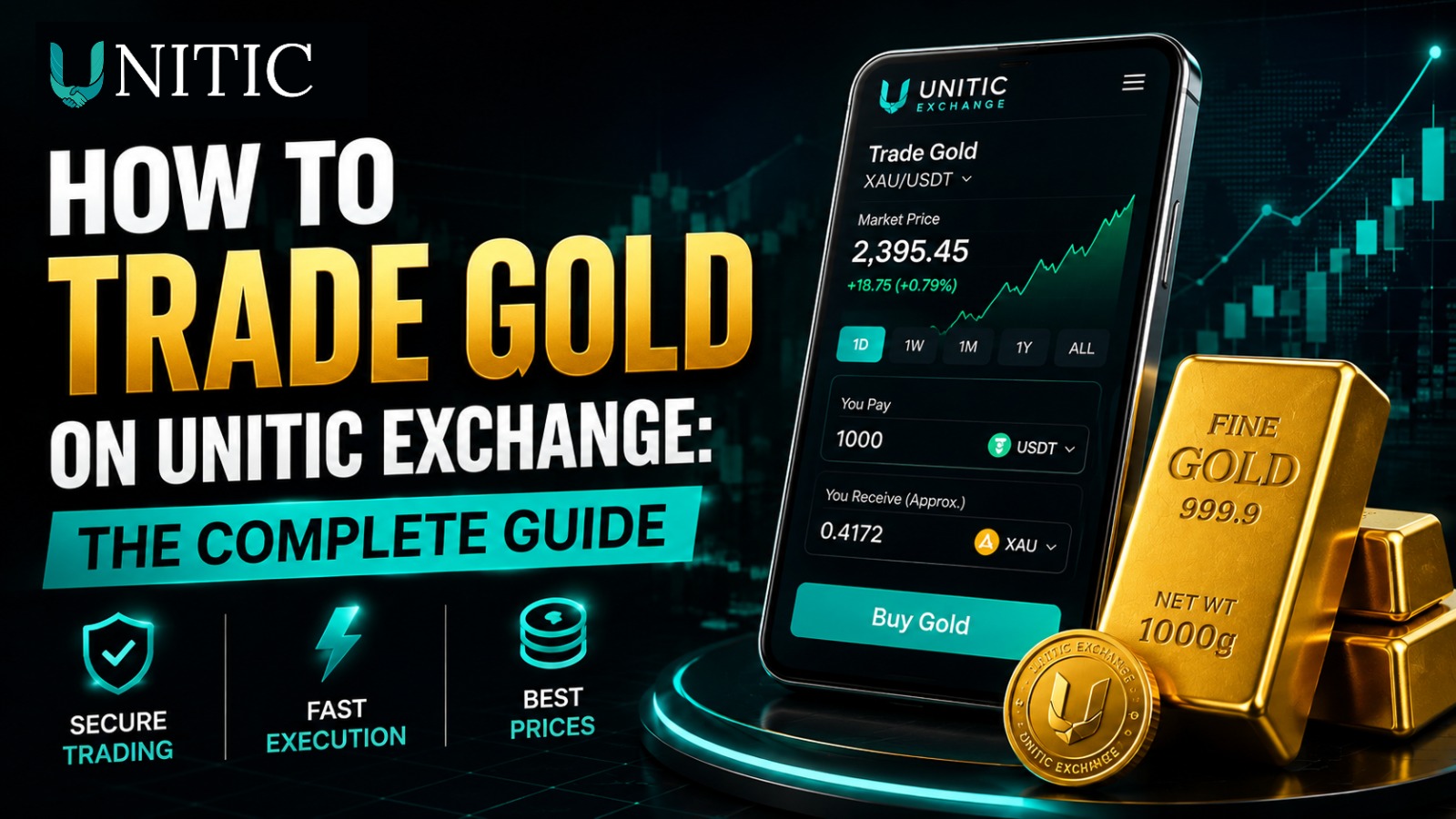
Gold has held a place in human financial systems for thousands of years, and it hasn't lost its relevance in the digital age — it's just changed form. Where investors once needed a safe deposit box or a commodities broker to gain exposure to gold, today a trader can open a position tracking gold's price in a matter of seconds, funded entirely in a stablecoin, from a phone. This guide is written for anyone approaching gold trading (XAUUSDT), and specifically trading gold on Unitic Exchange, for the first time — whether you're coming from a crypto background, a traditional investing background, or you're completely new to markets.
We'll walk through what gold trading actually looks like in this format, how to get set up, the mechanics you need to understand before risking real capital, and the habits that tend to separate traders who last from traders who don't. Along the way, we'll flag the specific details — fees, leverage limits, contract specifications — that you should always confirm directly on the Unitic Exchange platform itself, since these are the kinds of numbers that change and should never be taken from a blog post as gospel.
Table of Contents
- Why Gold, and Why Now
- Understanding XAUUSDT: How Gold Trading Works on a Crypto Exchange
- Getting Started: Setting Up Your Account
- Navigating the Unitic Exchange Trading Interface
- Order Types Every Gold Trader Should Know
- Understanding Leverage and Margin
- Funding Rates Explained
- What Moves the Gold Price
- Reading Gold Charts: A Beginner's Technical Toolkit
- Building a Risk Management Framework
- Common Mistakes New Gold Traders Make
- Building a Trading Plan and Journal
- Tax, Compliance, and Regulatory Basics
- Frequently Asked Questions
- Final Thoughts
1. Why Gold, and Why Now
Gold occupies a strange dual identity in financial markets. It's simultaneously one of the oldest stores of value known to civilization and one of the most actively traded instruments on modern derivatives markets. Central banks hold it in vaults as a reserve asset. Retail traders hold it in leveraged perpetual contracts that settle in minutes. Both are responding to the same underlying property: gold tends to hold or gain value when confidence in paper currency, government debt, or broader financial stability comes into question.
That property is exactly why gold shows up so often in conversations about inflation hedging, currency devaluation, and geopolitical risk. When a central bank signals it will keep printing money, or when a major economy shows signs of political instability, capital often rotates toward gold as a place to park value that isn't tied to any single government's balance sheet.
For traders — as opposed to long-term holders — gold's appeal is different. Gold is liquid, it's heavily analyzed by institutions (which means abundant data and commentary), and it tends to trend in identifiable ways tied to macroeconomic catalysts like interest rate decisions, employment data, and dollar strength. That combination of liquidity and macro sensitivity is what makes it a popular instrument for both short-term traders looking for volatility and longer-term traders looking for a directional hedge against other parts of their portfolio.
What's new is the access point. A decade ago, trading gold meant opening a commodities brokerage account, learning contract specifications on an exchange like COMEX, and operating within specific market hours. Today, perpetual contracts like XAUUSDT bring that same price exposure into the crypto trading ecosystem, where it sits alongside Bitcoin, Ethereum, and hundreds of other pairs — tradable 24/7, funded in a stablecoin, with no separate account required.
2. Understanding XAUUSDT: How Gold Trading(XAUUSDT) Works on a Crypto Exchange
Before placing a single trade, it's worth being precise about what you're actually trading.
XAUUSDT is a synthetic perpetual futures contract. The "XAU" refers to gold's ISO currency code (X for a non-national currency, AU for gold's chemical symbol), and "USDT" refers to Tether, the stablecoin the contract settles in. The contract is designed to track the real-time spot price of gold as closely as possible, without you ever touching or owning physical gold.
A few structural points that matter:
It's a derivative, not ownership. When you open a XAUUSDT position, you're entering a contract whose value is derived from gold's price movement. You don't receive a gold bar, a gold-backed token, or any claim on physical metal. If the price goes up and you're long, your position's value increases in USDT terms — and vice versa.
It's "perpetual" because it never expires. Traditional futures contracts (like COMEX gold futures) have a fixed expiration date, after which the contract settles and traders have to roll their position into a new contract if they want continued exposure. Perpetual contracts remove that expiry entirely, which is part of why they've become so popular — you can hold a position indefinitely without worrying about rollover mechanics.
Price convergence is maintained through funding rates. Since there's no expiry date to force the contract price back in line with the spot price, exchanges use a funding rate mechanism instead (covered in detail in Section 7). This is arguably the single most important mechanic new traders overlook.
Leverage is typically available. Most exchanges offering XAUUSDT allow traders to open positions larger than their deposited collateral, using leverage. This is a tool that can work for you or against you with equal speed, and it's the primary reason gold — often described as a "safe haven" asset — can still produce fast, painful losses for leveraged traders.
Understanding this distinction matters because a lot of the language around gold ("safe haven," "stable store of value") describes the underlying asset's long-term behavior, not the risk profile of a leveraged derivative tracking it. Those are two very different things, and conflating them is one of the most common — and costly — mistakes new traders make.
3. Getting Started: Setting Up Your Account
Getting from zero to your first gold trade involves a handful of steps that are fairly standard across regulated exchanges, Unitic Exchange included.
Step 1: Create your account. This typically requires an email address or phone number, plus a secure password. Enable two-factor authentication immediately — this is not optional if you're going to be holding funds on any exchange.
Step 2: Complete KYC verification. Know Your Customer verification usually involves submitting a government-issued ID and sometimes a proof of address. This step exists to comply with financial regulations and to protect both you and the platform from fraud. Expect this to take anywhere from a few minutes to a day or two depending on verification volume.
Step 3: Fund your account. Since XAUUSDT settles in USDT, you'll need USDT in your trading wallet before you can open a position. You can typically do this by depositing INR (or your local currency) and converting it, or by transferring existing USDT holdings from another wallet or exchange.
Step 4: Enable the relevant trading section. On most exchanges, spot trading and futures/derivatives trading are separated into different sections of the app, sometimes requiring a separate risk acknowledgment or quiz before futures trading is unlocked. Locate the futures or derivatives section and confirm XAUUSDT (it may also be labeled "GOLD/USDT" or similar) is listed there.
Step 5: Familiarize yourself with the interface before trading with real size. Many exchanges offer a demo or paper-trading mode. If Unitic Exchange offers this, use it. There is no substitute for understanding exactly how an order ticket behaves before you're using real capital.
A note on security: never share your account credentials, never approve a transaction you don't fully understand, and always double-check you're on the correct, official domain before entering login details — phishing sites that mimic exchange login pages are common across the industry
.
4. Navigating the Unitic Exchange Trading Interface
Once your account is funded, the trading interface itself will generally include a few consistent components, regardless of which specific exchange you're using:
- Price chart, typically with adjustable timeframes (1-minute up to weekly or monthly) and basic technical indicator overlays.
- Order book, showing live bid and ask prices at various levels — useful for gauging short-term liquidity and potential support/resistance from resting orders.
- Order entry panel, where you select order type, position size, leverage, and direction (long or short).
- Position and order management panel, showing your open positions, unrealized profit/loss, margin used, and liquidation price.
- Account/wallet summary, showing available balance, margin in use, and overall equity.
Before opening any position, locate two things specifically: the contract specification for XAUUSDT (minimum order size, tick size, maximum leverage) and your liquidation price calculator or preview, which most platforms display before you confirm an order. Both of these should be checked fresh each time you trade, since leverage limits and fee structures can be adjusted by the exchange.
5. Order Types Every Gold Trader Should Know
Understanding the order types available to you is foundational — using the wrong order type at the wrong time is a common way new traders get worse fills or unwanted liquidations.
Market order. Executes immediately at the best available current price. Useful when speed matters more than price precision, but during fast-moving markets you may experience slippage — getting filled at a worse price than what you saw when you clicked.
Limit order. Executes only at a specified price or better. Useful for entering or exiting a position at a precise level, though there's no guarantee the market will reach your price, meaning the order might never fill.
Stop-loss order. Automatically closes your position if the price moves against you to a specified level, capping your loss on that trade. This should be considered close to mandatory on any leveraged position — trading without one is one of the fastest ways to turn a manageable loss into an account-ending one.
Take-profit order. Automatically closes your position once it reaches a specified profit target, locking in gains without requiring you to watch the screen continuously.
Trailing stop. A dynamic stop-loss that moves with the price in your favor, locking in gains as a trade moves your direction while still protecting against a reversal.
Reduce-only orders. Some platforms offer an order flag that ensures the order can only reduce or close an existing position, never accidentally open a new one in the opposite direction. Useful when managing exits precisely.
A practical habit: before entering any trade, decide your stop-loss level and your take-profit level before you click confirm — not after you're already in the position and emotionally invested in the outcome.
6. Understanding Leverage and Margin
Leverage is the mechanism that allows you to control a position larger than your account balance would otherwise permit. If you use 10x leverage, for example, $100 of margin controls a $1,000 notional position. This magnifies both gains and losses proportionally — a 5% favorable move becomes a 50% gain on your margin, but a 5% adverse move becomes a 50% loss.
A few core concepts to understand thoroughly before using leverage:
Initial margin is the amount of collateral required to open a position at a given leverage level.
Maintenance margin is the minimum amount of equity you must maintain in the position to keep it open. If your account equity falls below this threshold due to an adverse price move, the exchange will begin to liquidate the position.
Liquidation price is the specific price level at which your position will be automatically closed by the exchange to prevent your losses from exceeding your margin. This number should always be visible before you confirm a trade, and it moves closer to your entry price the higher your leverage.
Cross margin vs. isolated margin. Isolated margin limits your risk on a specific position to the margin allocated to that position alone. Cross margin uses your entire account balance as collateral across positions, which can prevent a single position from being liquidated prematurely but also exposes your entire account balance to a single losing trade. New traders are generally better served starting with an isolated margin, since it creates a hard ceiling on how much a single mistake can cost.
The single most important leverage-related habit: choose your leverage based on where your stop-loss needs to sit, not based on the maximum leverage the platform allows you to use. Using maximum available leverage on every trade is one of the fastest routes to an empty account, regardless of how good your directional read on gold happens to be.
7. Funding Rates Explained
Since perpetual contracts have no expiration date to force the contract price back toward the spot price, exchanges use a funding rate mechanism to keep the two aligned.
Here's how it typically works: at fixed intervals (commonly every 8 hours, though this varies by platform), a small payment is exchanged directly between traders holding long positions and traders holding short positions. If the perpetual contract's price is trading above the spot price — usually a sign that more traders want to be long than short — longs pay shorts a small percentage. If it's trading below spot, shorts pay longs.
Why this matters practically: if you're holding a leveraged position over several funding intervals, these payments compound and can meaningfully affect your net return, even if the underlying price hasn't moved much. A position that looks flat on the price chart might still be quietly bleeding funding payments if you're on the "wrong" side of a persistent funding imbalance.
This is one of the most overlooked details by new traders moving from spot trading (where funding doesn't exist) into perpetual futures. Before holding any position longer than a few hours, check the current funding rate and funding schedule on Unitic Exchange's XAUUSDT contract page, and factor it into your expected cost of holding the trade.
8. What Moves the Gold Price
Gold's price is influenced by a distinct set of macroeconomic and market-structure factors. Understanding these doesn't guarantee predicting price direction, but it does help you interpret why the market is moving the way it is — which matters for risk management even more than for entry timing.
Interest rate expectations. Gold doesn't pay interest or dividends, so its opportunity cost rises when interest rates (or expectations of future rate hikes) rise, since investors can earn more from holding interest-bearing assets instead. Conversely, when central banks signal rate cuts or a pause in tightening, gold often benefits.
U.S. dollar strength. Gold is globally priced in U.S. dollars, so a stronger dollar tends to make gold more expensive for holders of other currencies, which can dampen demand, and vice versa. Watching the dollar index alongside gold is a common practice among experienced traders.
Inflation data. Gold has a long-standing (though not perfectly consistent) reputation as an inflation hedge. Higher-than-expected inflation prints can trigger gold buying as investors seek to preserve purchasing power.
Geopolitical risk. Wars, sanctions, elections, and diplomatic crises tend to increase demand for gold as a "safe haven" asset — one perceived as insulated from any single country's political or economic troubles.
Central bank buying. Central banks around the world hold significant gold reserves, and shifts in their buying or selling activity can influence longer-term price trends, particularly around trends like de-dollarization discussions among some emerging economies.
Real yields. The yield on inflation-protected government bonds (real yields) has a historically strong inverse relationship with gold prices — when real yields fall, gold tends to become more attractive relative to fixed-income alternatives.
Market positioning and sentiment. Data on how heavily institutional traders are positioned long or short (available through reports like the CFTC's Commitment of Traders) can offer clues about whether a trend has room to extend or is becoming crowded and vulnerable to a reversal.
None of these factors move gold in isolation — they interact, sometimes reinforcing each other and sometimes pulling in opposite directions. Part of developing as a gold trader is learning to weigh which factor is dominating market attention at a given time.
9. Reading Gold Charts: A Beginner's Technical Toolkit
While fundamental factors drive gold's longer-term direction, most short-to-medium-term trading decisions are made using price charts. A few foundational tools worth learning first:
Support and resistance. Price levels where gold has historically reversed or paused are often watched closely by traders, since a large number of market participants have orders clustered around these levels, which can become somewhat self-fulfilling.
Trendlines. Drawing a line connecting a series of higher lows (in an uptrend) or lower highs (in a downtrend) helps visualize the prevailing direction and can highlight when a trend is beginning to break down.
Moving averages. Simple or exponential moving averages smooth out short-term noise and help identify the broader trend direction. Commonly watched periods include the 50-day and 200-day moving averages, and crossovers between shorter and longer averages are often used as trend signals.
Relative Strength Index (RSI). A momentum oscillator that measures the speed and magnitude of recent price changes, commonly used to identify potentially overbought or oversold conditions.
Volume. Even though gold perpetuals trade on a specific exchange rather than a single unified global market, volume patterns on that exchange can still offer insight into the conviction behind a move — a breakout on high volume tends to carry more weight than one on thin volume.
Key economic release calendars. Gold traders commonly track scheduled releases like U.S. Non-Farm Payrolls, Consumer Price Index (CPI) data, and Federal Reserve policy announcements, since these tend to produce outsized volatility in gold prices around their release times.
Technical analysis is a tool for organizing probability, not a guarantee of outcome. Traders who rely on it successfully tend to combine it with strict risk management rather than treating any single signal as a certainty.
10. Building a Risk Management Framework
If there's one section of this guide worth reading twice, it's this one. Across markets and across asset classes, the traders who last are consistently the ones who prioritize protecting their capital over maximizing any single trade's potential upside.
Define your risk per trade before you enter. A common professional guideline is risking no more than 1–2% of total account equity on any single trade. This means that even a string of losing trades doesn't meaningfully threaten your ability to keep trading.
Always know your liquidation price before confirming an order. This should be a non-negotiable step in your process, not an afterthought you check after the position is already open.
Use stop-losses consistently, not selectively. It's tempting to skip a stop-loss on a trade you feel especially confident about — those are often exactly the trades that produce the largest losses, because conviction can make traders slower to admit they're wrong.
Size positions based on distance to your stop, not based on maximum available leverage. If your analysis suggests a stop-loss needs to sit a certain distance from your entry to give the trade room to work, your position size (and leverage) should be calculated backward from that distance and your risk-per-trade limit — not from how much leverage the platform allows.
Treat funding rates as a real, ongoing cost. Especially for positions held over multiple days, funding payments are a genuine drag on returns that should be factored into your overall risk-reward calculation, not ignored as a rounding error.
Diversify your risk exposure. Concentrating your entire account in a single leveraged gold position, however confident you are in the trade thesis, removes any margin for error if your analysis turns out wrong or an unexpected news event moves the market sharply against you.
Avoid revenge trading. After a loss, the instinct to immediately re-enter the market to "win back" the loss is one of the most common ways traders compound a single bad trade into a much larger drawdown. Stepping away, even briefly, after a loss is a discipline worth building deliberately.
Reassess risk during high-volatility events. Scheduled events like central bank rate decisions or major economic data releases can produce sharp, fast moves in gold. Many experienced traders reduce position size or step aside entirely around these releases, rather than holding full leveraged exposure into an event with binary, unpredictable outcomes.
11. Common Mistakes New Gold Traders Make
Confusing gold's reputation with the risk of a leveraged position on gold. Gold as a long-term holding and a leveraged gold derivative are very different risk profiles, and treating the latter with the same caution level as the former is a frequent, costly error.
Overleveraging. Using maximum available leverage because it's available, rather than because the trade setup justifies it.
Ignoring funding rates on longer-held positions. Treating funding payments as negligible when they compound meaningfully over time.
Trading without a plan. Entering positions reactively based on a headline or a feeling, without a predefined entry, stop-loss, and target.
Averaging down without a plan. Adding to a losing position hoping for a reversal, without a predetermined limit on how much additional capital will be committed.
Overtrading around news events. Jumping into a position immediately after a major data release, when volatility and spreads are often at their most unfavorable.
Neglecting to review past trades. Skipping the process of reviewing closed trades for lessons, which means repeating the same mistakes without recognizing the pattern.
Underestimating the emotional side of leveraged trading. Watching a leveraged position swing significantly in either direction produces real psychological pressure, and underestimating that pressure before it's tested with real capital is common among newer traders.
12. Building a Trading Plan and Journal
A trading plan doesn't need to be complicated to be effective, but it should be written down rather than kept purely in your head. At minimum, a workable plan should define:
- What conditions you're looking for before entering a trade (technical setup, fundamental catalyst, or a combination).
- How you'll size each position, tied to your account's risk-per-trade limit.
- Where your stop-loss and take-profit levels will sit, decided before entry.
- How you'll handle a trade that moves in your favor (trailing the stop, taking partial profits, letting it run to target).
- Rules for when you won't trade at all — for example, avoiding new positions in the minutes immediately around a major scheduled economic release.
A trading journal — a simple log of every trade, including entry and exit price, position size, reasoning, and outcome — is one of the most consistently recommended habits among experienced traders across every asset class, gold included. Reviewing that journal periodically tends to surface patterns (a tendency to cut winners early, a tendency to skip stop-losses on "high conviction" trades) far faster than relying on memory alone.
13. Tax, Compliance, and Regulatory Basics
Trading gold derivatives, like trading any financial instrument, typically has tax implications that vary significantly by jurisdiction. In India specifically, gains from trading derivatives are generally treated differently from long-term capital gains on physical gold or gold ETFs, and reporting requirements can differ based on how the income is classified.
A few general practices worth following regardless of jurisdiction:
- Keep detailed records of every trade — entry and exit prices, dates, fees paid, and realized profit or loss — since this documentation is typically required for accurate tax reporting.
- Consult a qualified tax professional familiar with derivatives and cryptocurrency-adjacent trading in your specific jurisdiction, since rules in this area continue to evolve and vary meaningfully by country.
- Verify the exchange's regulatory status in your jurisdiction, and confirm what compliance and reporting obligations apply to your account.
- Understand withdrawal and KYC requirements fully before depositing significant capital, since these processes exist specifically to satisfy regulatory obligations and can affect how quickly you're able to access your funds.
This section is general information, not tax or legal advice — your specific obligations will depend on your residency, local regulations, and how your trading activity is classified.
14. Final Thoughts
Gold has earned its place in financial markets over thousands of years, and the way traders access it keeps evolving — from vaults, to brokerage accounts, to a perpetual contract you can open from your phone in seconds. What hasn't changed is the discipline required to trade it well. XAUUSDT gives you fast, flexible access to gold's price movement, but the leverage and derivative structure that make it convenient are exactly what demand careful risk management.
Before you place your first trade on Unitic Exchange, take the time to understand the mechanics covered here: how leverage and liquidation actually work, what funding rates will cost you over time, what tends to move gold's price, and — most importantly — how you'll manage risk on every single trade, not just the ones that feel obvious. A trading plan you follow consistently will do more for your long-term results than any single prediction about where gold is headed next.
This article is for educational purposes only and does not constitute financial, investment, or tax advice. Trading leveraged derivatives carries a high risk of loss and may not be suitable for all investors. Always verify current contract terms, fees, leverage limits, and regulatory requirements directly with Unitic Exchange, and consult a qualified financial or tax professional before trading. Only trade with capital you can afford to lose.
FAQs
No. XAUUSDT is a synthetic perpetual contract that tracks gold's spot price and settles in USDT. You're trading price exposure through a derivative, not acquiring or storing physical bullion.
Perpetual contracts on crypto exchanges typically trade continuously, including weekends, unlike traditional gold futures markets that have set trading hours and pause over weekends. Always confirm current trading hours and any scheduled maintenance windows directly on the platform, since this can vary.
Minimum order sizes and margin requirements vary by exchange and change over time. Check the current contract specifications for XAUUSDT directly on Unitic Exchange before funding your account, rather than relying on a fixed figure.
No. Gold's long-term reputation for relative stability describes the underlying asset, not the risk profile of a leveraged derivative tracking it. A leveraged XAUUSDT position carries the same liquidation risk as any other leveraged instrument, regardless of gold's reputation.
The funding rate is a periodic payment exchanged between long and short position holders — commonly every 8 hours — to keep the perpetual contract's price aligned with gold's actual spot price. It matters because it's a real, ongoing cost (or occasional benefit) that compounds over the life of a held position.




Your Crypto Gateway


Unitic Exchange
All rights reserved 2026