The Future of Tokenization: How Blockchain Could Change Traditional Finance | Unitic Exchange
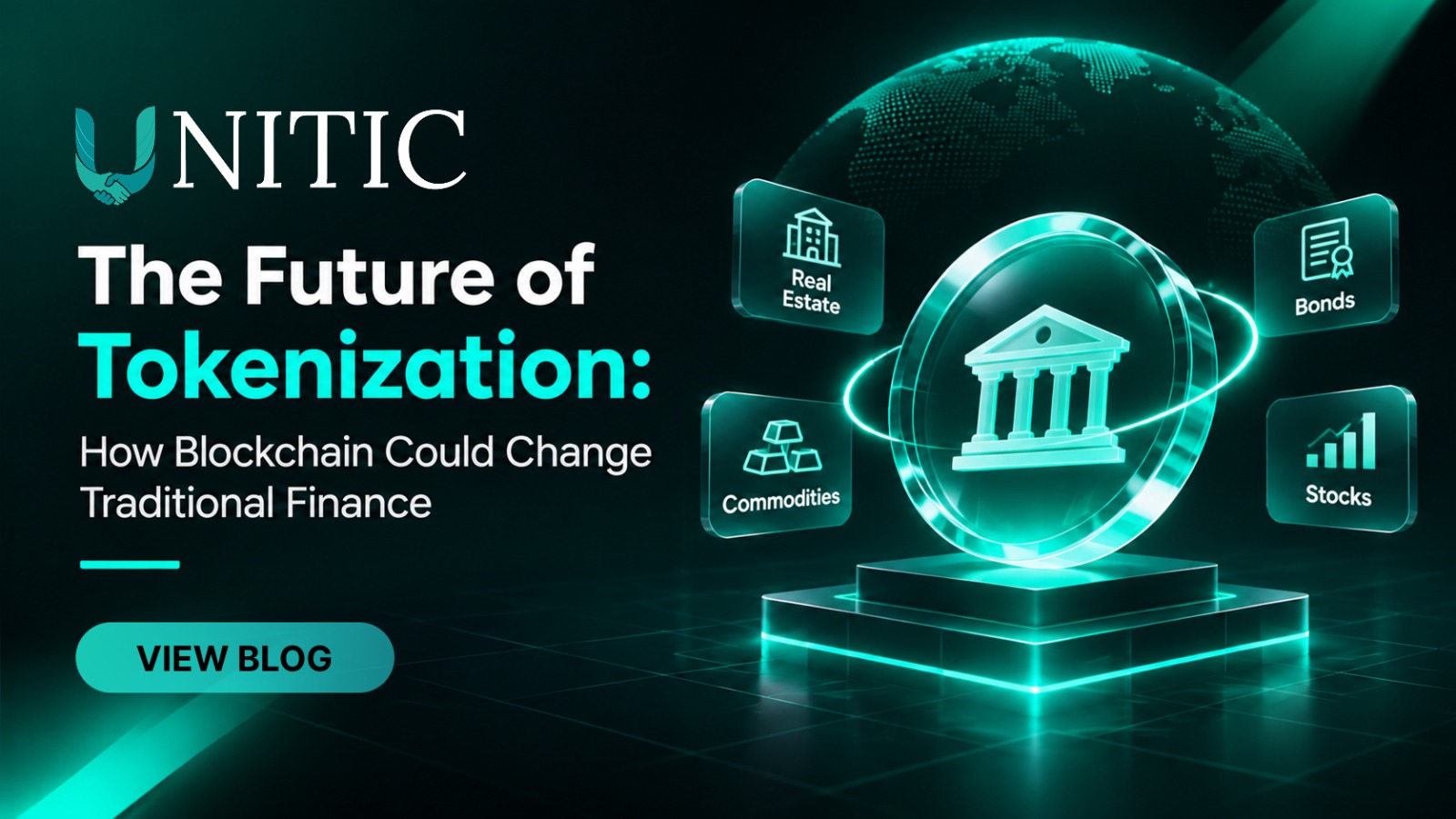
For centuries, traditional finance has relied on intermediaries—banks, brokers, custodians, clearing houses, registrars, and settlement networks—to move value between people and institutions. These systems work, but they are often slow, expensive, fragmented, and dependent on multiple manual processes.
Blockchain introduces a different model. By representing ownership digitally on a secure, transparent ledger, blockchain can make assets easier to divide, transfer, verify, and trade. This process is called tokenization.
Tokenization is already influencing how people think about money, securities, real estate, commodities, funds, and even carbon credits. Instead of waiting days for settlement or relying on paper-based ownership records, tokenized assets can be transferred programmatically with a transparent record of ownership.
This article explains what tokenization means, how it could change traditional finance, the opportunities and risks involved, and how platforms such as Unitic Exchange fit into the broader shift toward digital assets and blockchain-based financial infrastructure.
What Is Tokenization?
Tokenization is the process of converting ownership rights or value from a real-world asset into a digital token on a blockchain.
A token can represent many types of value:
- A share of a company or fund.
- A portion of real estate.
- A bond or debt instrument.
- Gold, oil, or other commodities.
- Carbon credits.
- Loyalty points.
- Trade invoices or receivables.
- Stablecoins backed by reserves.
- Digital collectibles and intellectual-property rights.
The key idea is simple: blockchain creates a digital representation of ownership that can be transferred, verified, and tracked more efficiently than many traditional systems.
Why Traditional Finance Needs Change
Traditional finance has delivered enormous value, but it still faces long-standing challenges.
Slow Settlement Cycles
Many securities transactions do not settle instantly. Depending on the market and asset type, settlement can take one or more business days. During that time, capital may be locked, counterparty risk can increase, and operational teams must reconcile records across multiple systems.
High Intermediary Costs
Buying, selling, transferring, and holding assets often requires multiple intermediaries. Each participant may charge fees for custody, clearing, settlement, compliance, administration, or record-keeping.
Limited Access
Some high-value assets—such as private equity, commercial real estate, infrastructure projects, and fine art—are traditionally available only to institutional investors or wealthy individuals. Retail investors often have limited access to these markets.
Fragmented Records
Ownership records may be stored across different databases, custodians, registrars, and legal systems. This creates reconciliation work and increases the chance of errors, delays, or disputes.
Limited Liquidity
Assets such as real estate, private funds, and collectibles can be difficult to sell quickly. Even when a buyer exists, the transfer process may take weeks or months.
Tokenization does not automatically solve every problem, but it offers a framework to reduce friction in many of these areas.
How Blockchain Changes the Model
Blockchain is a distributed ledger technology. Instead of storing ownership records in one central database, transactions can be recorded across a network of computers. Depending on the blockchain design, records can be transparent, cryptographically secured, and difficult to alter without consensus.
This creates several advantages for financial markets.
Transparent Ownership Records
A tokenized asset can have a clear digital ownership trail. Instead of relying only on paper certificates or separate private databases, ownership can be recorded on-chain.
Programmable Transfers
Smart contracts can automate parts of the financial process. For example, a smart contract could automatically distribute dividends to token holders, enforce transfer restrictions, or release collateral when conditions are met.
Faster Settlement
In theory, tokenized assets can settle in minutes or seconds rather than days. This can reduce counterparty risk and free up capital more quickly.
Fractional Ownership
Tokenization makes it easier to divide high-value assets into smaller units. This can broaden access to assets that were previously difficult for retail investors to reach.
24/7 Market Access
Crypto markets operate around the clock. Tokenized assets could eventually allow investors to trade or transfer value outside traditional banking hours, although regulation and market infrastructure will still matter.
Real-World Assets and Tokenization
The most important category in this space is Real-World Assets, often called RWAs.
RWAs are physical or traditional financial assets represented on-chain through tokens. Examples include:
- Government bonds.
- Corporate bonds.
- Real estate.
- Private credit.
- Commodities.
- Trade finance assets.
- Carbon credits.
- Funds and ETFs.
- Precious metals.
The appeal is that tokenization can bring traditional assets into digital markets while preserving legal ownership structures where properly structured.
For example, a tokenized government bond could allow investors to hold exposure to fixed-income assets in digital form. A tokenized real-estate fund could allow investors to own fractional shares of a property portfolio. A tokenized commodity fund could provide exposure to gold without requiring physical delivery.
How Tokenization Could Change Traditional Finance
1. Faster and More Efficient Settlement
Traditional settlement often involves multiple institutions, messaging systems, and reconciliation processes. Tokenized assets can use blockchain infrastructure to update ownership records more directly.
This could reduce:
- Settlement delays.
- Manual reconciliation.
- Operational errors.
- Counterparty exposure.
- Capital locked during settlement periods.
Faster settlement would not eliminate risk, but it could reduce the time during which trades remain unsettled.
2. Broader Access to Investment Products
Tokenization can make assets divisible. Instead of needing a large amount of capital to invest in commercial real estate or private credit, investors may be able to buy smaller tokenized portions.
This could open access to:
- Real-estate investment portfolios.
- Private-market funds.
- Infrastructure projects.
- Commodities.
- Fixed-income products.
However, access will still depend on regulation, investor eligibility, jurisdiction, and platform compliance.
3. Lower Costs Through Automation
Smart contracts can automate tasks that traditionally require manual processing.
Examples include:
- Interest payments.
- Dividend distribution.
- Transfer restrictions.
- Compliance checks.
- Collateral management.
- Redemption processes.
Automation does not remove the need for legal, accounting, or compliance teams, but it can reduce repetitive administrative work.
4. Improved Transparency
Blockchain records can provide a clear history of transfers and ownership changes. This can improve auditability and reduce disputes over who owns what at a particular point in time.
Transparency does not mean every transaction must be public. Permissioned blockchains and privacy-preserving designs can allow institutions to maintain confidentiality while still benefiting from shared records.
5. New Liquidity Models
Tokenization may create more liquid markets for traditionally illiquid assets.
For example, a commercial building may be difficult to sell quickly in the traditional market. If it is represented by tokenized shares, investors may be able to trade those tokens on a compliant digital marketplace.
This does not guarantee liquidity. A token is only liquid if there are buyers and sellers, proper market infrastructure, and regulatory clarity. But tokenization creates the technical foundation for new liquidity models.
6. Programmable Finance
Tokenized assets can interact with smart contracts. This enables new financial products such as:
- Automated dividend distribution.
- Collateralized lending.
- On-chain fund management.
- Automated compliance.
- Instant settlement.
- Tokenized collateral markets.
This is sometimes called programmable finance because financial rules can be encoded directly into the asset or platform.
Tokenized Money and Stablecoins
Stablecoins are one of the earliest and most widely used examples of tokenized value.
A stablecoin is a digital token designed to maintain a stable value, often pegged to a fiat currency such as the US dollar. USDT is one of the most widely used examples.
Stablecoins can be used for:
- Trading crypto pairs.
- Moving value between exchanges.
- Settling payments.
- Accessing decentralized finance.
- Managing trading capital.
- Providing liquidity to markets.
On Unitic Exchange, traders can access crypto markets and trading products built around digital assets. For traders who want to convert funds or manage stablecoin exposure, the Unitic USDT OTC Desk provides a dedicated service for USDT-related transactions.
Stablecoins are important because they act as a bridge between traditional money and blockchain-based markets. They allow users to hold dollar-like value in digital form while participating in crypto trading infrastructure.
Tokenization and Crypto Exchanges
Crypto exchanges are likely to play an important role in the tokenization economy.
Traditional exchanges match buyers and sellers, provide market data, and facilitate settlement. Crypto exchanges perform similar functions for digital assets, but they also support blockchain-native features such as wallets, on-chain transfers, stablecoins, and smart-contract-based products.
Unitic Exchange is positioned as a crypto platform offering spot trading, futures trading, OTC services, earn products, and market access across digital assets. The platform highlights more than 300 spot pairs, 500+ futures pairs, and 99.9% uptime, showing how modern exchanges are building infrastructure for high-frequency and global digital-asset trading.
As tokenization expands, exchanges may evolve from crypto-only platforms into broader digital-asset marketplaces where users can access both crypto-native assets and tokenized traditional assets.
How Unitic Exchange Fits Into This Shift
Unitic Exchange provides tools that align with the broader movement toward digital finance.
Spot Trading
Spot trading allows users to buy and sell cryptocurrencies at current market prices. This is the foundation of digital-asset investing.
Unitic offers access to spot markets with real-time charts, advanced order types, and a wide range of trading pairs.
For users who want to explore live market prices and trading pairs, the Unitic Markets page provides an overview of available crypto markets.
Futures Trading
Futures trading allows users to take directional positions using perpetual contracts. Unitic supports USDT-margined perpetual futures with leverage options and risk-management tools.
For traders who want to trade Bitcoin futures directly, the BTCUSDT Futures Trading page provides access to the BTCUSDT perpetual market.
Futures are not suitable for every investor. Leverage can increase both potential profits and potential losses, so risk management is essential.
OTC Desk
Large transactions can create liquidity challenges on public order books. An OTC desk allows buyers and sellers to execute larger trades through a dedicated desk rather than placing all orders directly into the open market.
Unitic’s USDT OTC Desk is designed for users who need dedicated support for USDT transactions.
As tokenization grows, OTC services may become increasingly important for institutions and high-volume traders moving between traditional capital and digital assets.
Earn Products
Tokenization may eventually expand the range of yield-based products available to investors. Unitic already offers Earn products, including flexible staking, savings, and yield-focused options.
These products show how digital-asset platforms are building financial services beyond simple buy-and-sell trading.
Education and Market Insights
Tokenization is complex. Investors need education about custody, regulation, smart-contract risk, market structure, and asset backing.
Unitic’s blog provides crypto guides, market insights, and educational content for traders and investors.
What Assets Could Be Tokenized?
Real Estate
Real estate is one of the most discussed tokenization use cases.
A property could be represented by tokens that represent fractional ownership. Investors could buy smaller portions of a building or property portfolio instead of purchasing an entire asset.
Potential benefits include:
- Lower entry barriers.
- Easier portfolio diversification.
- Faster transfer of ownership records.
- Potential liquidity improvements.
Challenges include legal ownership, local property laws, tenant management, valuation, and regulatory approval.
Bonds and Fixed Income
Government and corporate bonds could be tokenized to improve issuance, settlement, and distribution.
Tokenized bonds could potentially offer:
- Automated coupon payments.
- Faster settlement.
- Broader investor access.
- Transparent ownership records.
- Programmable maturity and redemption.
Funds and ETFs
Investment funds could be tokenized to allow digital ownership shares. This could make fund subscriptions, redemptions, and transfers more efficient.
Tokenized funds may also support automated reporting and compliance workflows.
Commodities
Gold, silver, oil, and other commodities could be tokenized to represent ownership or exposure without requiring physical delivery.
For example, a token could represent one gram of gold held by a custodian. Investors could trade the token while the physical asset remains securely stored.
Carbon Credits
Carbon credits are another major tokenization opportunity. Blockchain can help track issuance, ownership, retirement, and verification of carbon credits.
This could reduce double-counting and improve transparency in environmental markets.
Private Credit and Trade Finance
Private credit, invoices, receivables, and trade-finance assets could be tokenized to improve access and liquidity.
These markets are often fragmented and dependent on manual documentation. Tokenization could streamline record-keeping and create new investment opportunities.
The Role of Smart Contracts
Smart contracts are self-executing programs stored on a blockchain. They can automate actions when predefined conditions are met.
In tokenized finance, smart contracts could be used to:
- Distribute interest payments.
- Enforce lock-up periods.
- Restrict transfers to eligible investors.
- Automate collateral management.
- Execute redemption requests.
- Record ownership changes.
- Trigger compliance checks.
For example, a tokenized bond could automatically pay interest to token holders on a scheduled date. A tokenized real-estate fund could automatically distribute rental income to investors.
However, smart contracts are only as reliable as their design. Bugs, exploits, poor governance, and incorrect assumptions can create serious risks.
Benefits for Investors
Lower Entry Barriers
Tokenization can divide expensive assets into smaller units. This may allow investors to access markets that previously required large capital commitments.
Diversification
Investors could build portfolios across real estate, bonds, commodities, private credit, and digital assets using tokenized products.
Transparency
Blockchain records can improve visibility into ownership and transaction history.
Potential Liquidity
Tokenized assets may be easier to trade than traditional illiquid assets, depending on market demand and platform infrastructure.
Global Access
Digital assets can be accessed from anywhere with an internet connection, subject to local regulations.
Faster Transactions
Blockchain-based transfers can potentially reduce settlement time compared with traditional processes.
Risks of Tokenization
Tokenization is promising, but it is not risk-free.
Regulatory Risk
Tokenized securities may fall under securities laws, financial regulations, KYC rules, AML requirements, and investor-protection rules. Regulations differ across countries and may change over time.
Smart-Contract Risk
A smart contract may contain bugs, vulnerabilities, or design flaws. Even audited contracts can face risks.
Custody Risk
Investors must know who controls the underlying asset, how it is stored, and what happens if the custodian fails.
Liquidity Risk
A tokenized asset is not automatically liquid. If there are few buyers and sellers, investors may not be able to exit quickly.
Counterparty Risk
If a token represents an off-chain asset, investors rely on the issuer, custodian, auditor, and legal structure behind that asset.
Market Risk
Tokenized assets can still lose value. Real estate can fall in price, bonds can default, commodities can decline, and crypto markets can be volatile.
Technology Risk
Blockchain networks can experience congestion, outages, or security incidents. Users must also protect wallets, private keys, and account credentials.
Regulation Will Decide the Pace
Technology alone cannot transform finance. Regulation, legal recognition, investor protection, and institutional adoption will determine how quickly tokenization develops.
Key regulatory questions include:
- Is the token a security?
- Who can invest in it?
- Who is responsible for investor protection?
- How is custody handled?
- How are transfers restricted?
- How are taxes applied?
- How are disputes resolved?
- Which jurisdictions allow tokenized issuance?
Countries and financial institutions are actively exploring these questions. As frameworks mature, tokenization may move from experimental pilots to mainstream financial infrastructure.
Institutional Adoption
Banks, asset managers, exchanges, custodians, and payment companies are already exploring blockchain-based settlement and tokenized assets.
Institutional adoption could accelerate tokenization because institutions bring:
- Large capital pools.
- Regulatory expertise.
- Custody infrastructure.
- Compliance systems.
- Client networks.
- Liquidity.
However, institutions also require reliability, legal clarity, auditability, and risk controls. This means tokenization may initially develop through permissioned systems and regulated platforms before expanding into more open markets.
The Future of Tokenized Finance
The future of tokenization is likely to involve a hybrid model.
Traditional finance will not disappear overnight. Banks, brokers, custodians, and regulators will continue to play important roles. But blockchain may become the underlying infrastructure that connects these systems more efficiently.
Possible future developments include:
- Tokenized government bonds.
- Tokenized real-estate funds.
- Blockchain-based settlement networks.
- Tokenized collateral markets.
- Digital identity and compliance tools.
- On-chain fund administration.
- Cross-border payment systems.
- Tokenized commodities.
- Regulated digital-asset exchanges.
- Institutional-grade stablecoin infrastructure.
In this future, investors may hold a portfolio containing traditional assets, tokenized assets, stablecoins, and cryptocurrencies—all managed through digital platforms.
How Traders Can Prepare
Learn the Basics
Understand the difference between:
- Cryptocurrencies.
- Stablecoins.
- Tokenized securities.
- Tokenized commodities.
- Tokenized real estate.
- NFTs.
- DeFi tokens.
Understand Risk
Before investing in any tokenized product, ask:
- What asset backs this token?
- Who holds the underlying asset?
- What legal rights do token holders have?
- Is the token regulated?
- How liquid is the market?
- What are the fees?
- What happens if the issuer fails?
- Is the smart contract audited?
Use Reputable Platforms
Choose platforms with clear products, transparent information, security practices, and accessible support.
Unitic Exchange provides spot trading, futures trading, OTC services, Earn products, and market insights in one platform.
Practice Risk Management
Whether trading crypto or tokenized assets, risk management remains essential.
- Use stop-losses.
- Avoid excessive leverage.
- Do not invest more than you can afford to lose.
- Diversify carefully.
- Keep a trading journal.
- Avoid emotional decisions.
Why Tokenization Matters
Tokenization is not simply about putting assets on a blockchain. It is about improving the way ownership, value, and financial rights are recorded and transferred.
If implemented responsibly, tokenization could make finance more accessible, efficient, transparent, and global. It could reduce friction in markets that have relied on manual processes for decades.
At the same time, tokenization introduces new risks. Investors must understand regulation, custody, smart contracts, liquidity, and asset backing before participating.
Final Thoughts
The future of tokenization could reshape traditional finance by connecting real-world assets with blockchain-based infrastructure. Real estate, bonds, funds, commodities, carbon credits, and private credit may eventually become easier to divide, trade, and manage through digital tokens.
Stablecoins are already showing how digital value can move across markets. Crypto exchanges are building the trading infrastructure that could support this transition. Platforms such as Unitic Exchange offer spot markets, futures trading, OTC services, and educational resources for users navigating the digital-asset economy.
Tokenization will not replace traditional finance overnight. But it has the potential to make financial markets faster, more inclusive, and more programmable. The institutions and platforms that combine strong compliance, secure custody, deep liquidity, and user education will be best positioned to lead this transformation.
For traders and investors, the opportunity is not just to buy tokens. It is to understand how ownership, settlement, and value transfer are changing—and to participate responsibly as the financial system evolves.
Disclaimer
Crypto assets and tokenized financial products involve significant risk, including the potential loss of your entire invested capital. This blog is for educational and informational purposes only and does not constitute financial, investment, legal, or tax advice. Always conduct your own research and consult a qualified professional before making investment decisions. Past performance is not indicative of future results. Never invest funds you cannot afford to lose.
FAQs
Tokenization is the process of representing ownership rights or value from a real-world asset as a digital token on a blockchain.
Yes. Real estate can be divided into digital tokens representing fractional ownership, subject to legal and regulatory requirements.
No. Cryptocurrencies such as Bitcoin are native digital assets, while tokenized assets represent ownership or exposure to an underlying asset such as real estate, bonds, or commodities.
A tokenized bond is a bond represented as a digital token on a blockchain. It may support automated interest payments, digital ownership records, and faster settlement.
Yes. Stablecoins are digital tokens designed to maintain a stable value, often pegged to fiat currency. They are one of the most widely used examples of tokenized value.

Your Crypto Gateway


Unitic Exchange
All rights reserved 2026