Tokenized Stocks vs Traditional Stocks: What Investors Need to Know
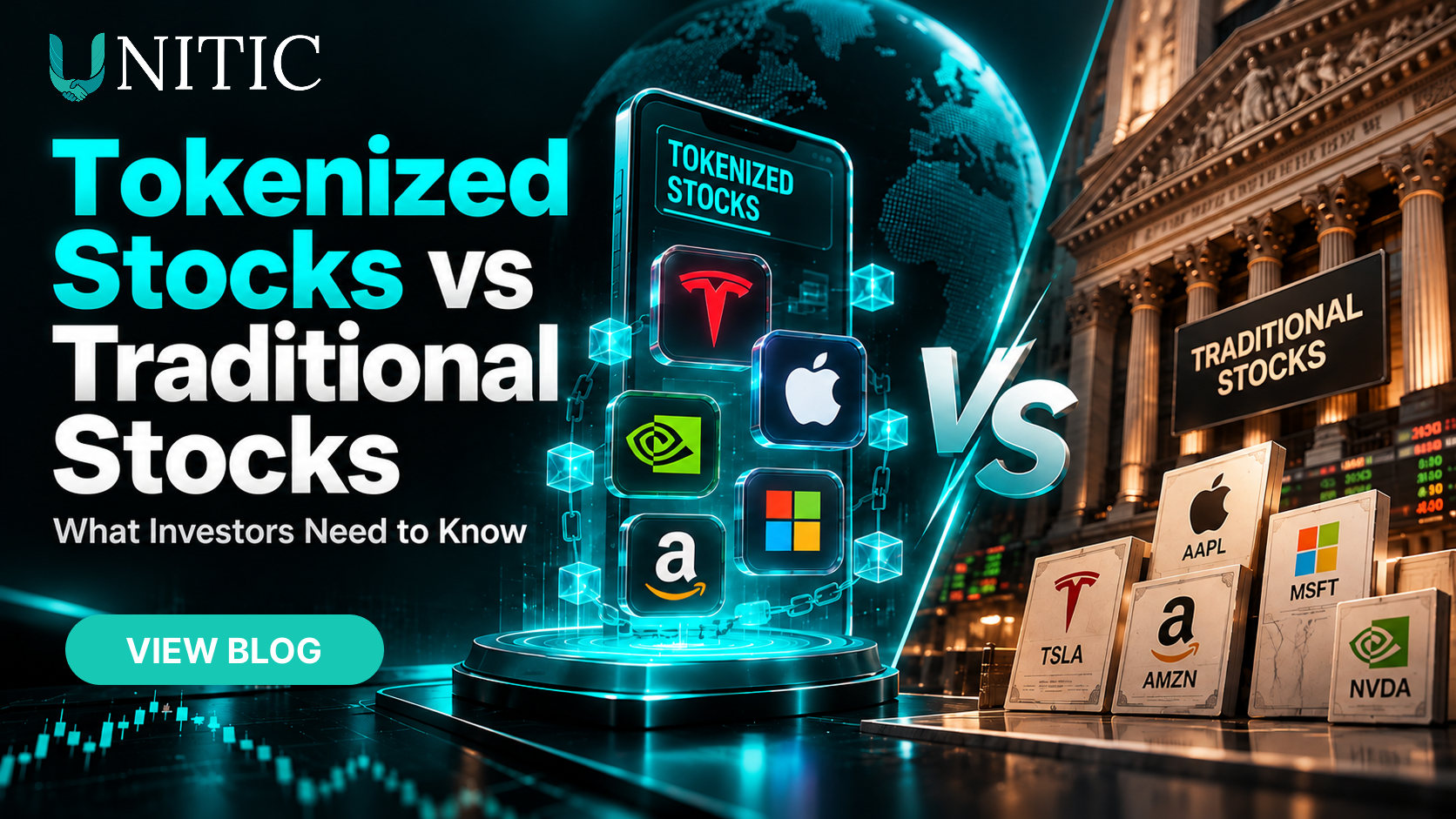
Tokenized stocks are changing how investors think about ownership, market access, and trading hours. Instead of buying a share through a conventional brokerage account, an investor can hold a blockchain-based representation of that share and trade it through digital-asset infrastructure.
But tokenization does not automatically make a stock better, safer, or more profitable. Traditional stocks still offer established legal protections, deep liquidity, regulated custody, and direct shareholder rights. Tokenized stocks can offer faster settlement, around-the-clock access, programmability, and global reach—but they also introduce smart-contract, custody, counterparty, and regulatory risks.
In this guide, we will compare tokenized stocks vs traditional stocks in plain language. You will learn how each works, where they differ, what benefits and risks matter most, and how crypto traders can use platforms such as Unitic Exchange to stay informed and manage digital-asset exposure responsibly.
What Are Traditional Stocks?
A traditional stock represents partial ownership in a company. When you buy one share of a publicly listed company, you generally receive an ownership interest recorded by the company’s transfer agent or registrar.
Traditional stocks are bought and sold through stock exchanges and regulated brokerage firms. In the United States, major examples include the New York Stock Exchange and Nasdaq. In India, investors commonly use the National Stock Exchange and Bombay Stock Exchange.
Key Features of Traditional Stocks
Traditional equities usually provide:
- Ownership rights: Depending on the share class, shareholders may receive voting rights, dividend rights, and access to company information.
- Regulated markets: Trades occur through licensed brokers, exchanges, clearinghouses, and custodians.
- Established settlement systems: Most markets use mature clearing and settlement processes.
- Investor protections: Disclosure rules, market-surveillance systems, and investor-protection frameworks apply.
- Corporate actions: Dividends, stock splits, mergers, rights issues, and buybacks are handled through established corporate-action processes.
A traditional stock is not just a price ticker. It is a legal claim tied to a company’s capital structure, shareholder register, and applicable securities laws.
What Are Tokenized Stocks?
A tokenized stock is a digital token that represents exposure to a stock or, in some cases, actual ownership of that stock. The token is recorded on a blockchain and can be transferred, traded, or held in a compatible digital wallet.
There is an important distinction here:
- Issuer-backed tokenized equity: The company or an authorized party tokenizes the share, and the token is intended to carry the same rights and privileges as the underlying security.
- Custodial tokenized stock: A third party holds the underlying share and issues a token representing a claim on that holding.
- Synthetic stock token: The token tracks a stock’s price without conveying direct ownership, voting rights, or a claim on the issuer.
This distinction matters enormously. A token with Apple’s ticker symbol is not necessarily the same thing as an Apple share. It may be a custodial entitlement, a derivative-like product, or a synthetic price-tracking asset.
The U.S. Securities and Exchange Commission has clarified that tokenized securities are securities and remain subject to federal securities laws and investor protections. Tokenization changes the technology used to record or transfer an asset; it does not remove the legal nature of the underlying instrument.
Why Tokenized Stocks Are Growing
Tokenized stocks have gained attention because blockchain technology can improve parts of the traditional market infrastructure. Traditional equity markets are efficient, but they still involve intermediaries, market-hour restrictions, settlement delays, and geographic limitations.
Tokenization can address several friction points:
- Faster transfer and settlement: Blockchain records can update ownership or transfer records more quickly than legacy systems.
- Programmable ownership: Smart contracts can automate dividend distribution, corporate actions, compliance checks, or transfer restrictions.
- Global accessibility: Investors in different countries may gain access to assets that were previously difficult to reach.
- Fractional ownership: High-priced shares can potentially be divided into smaller digital units.
- Around-the-clock market interest: Crypto-native investors are accustomed to 24/7 markets and may expect similar access for equities.
The market is moving quickly. In September 2026, the SEC created a temporary regulatory pathway for certain tokenized representations of publicly traded U.S. stocks, allowing qualifying Tokenized Securities Venues to facilitate on-chain trading under specific conditions.
However, this is not a signal that every “stock token” is regulated, issuer-approved, or equivalent to a traditional share. Investors still need to examine the product structure carefully.
Tokenized Stocks vs Traditional Stocks: Core Differences
|
Factor |
Traditional Stocks |
Tokenized Stocks |
|
Ownership record |
Maintained through registrars, brokers, and centralized market infrastructure |
Recorded on a blockchain, often through a token contract or custodial arrangement |
|
Trading hours |
Usually limited to exchange hours |
May offer extended or 24/7 trading, depending on venue and product design |
|
Settlement |
Often follows established clearing and settlement cycles |
Can settle faster, sometimes near-instantly, depending on the platform |
|
Shareholder rights |
May include voting, dividends, information rights, and corporate-action participation |
Varies widely; some tokens carry full rights, while others offer only price exposure |
|
Custody |
Held through brokers, banks, or registered custodians |
Held in digital wallets or through crypto custodians |
|
Liquidity |
Generally deep for large-cap stocks |
Can be limited, fragmented, or dependent on the token issuer and venue |
|
Regulation |
Mature and well-established |
Evolving; depends on jurisdiction, token structure, and platform |
|
Counterparty risk |
Brokerage and clearing risks exist but are heavily regulated |
Adds issuer, custodian, smart-contract, and platform risks |
|
Accessibility |
May require local brokerage access and market-hours availability |
Potentially broader global access through compatible platforms |
|
Transparency |
Public disclosures and exchange data |
On-chain activity can be transparent, but backing and legal rights may not be |
The most important takeaway is this: a tokenized stock is not automatically a traditional stock on a blockchain. The legal rights attached to the token determine what the investor actually owns.
How Tokenized Stocks Work
To understand tokenized stocks, it helps to break the process into simple stages.
1. The Underlying Asset
A tokenized stock begins with an underlying equity security, such as a publicly listed company share or an exchange-traded product.
2. Token Issuance
The token may be issued by:
- The company itself or an authorized party.
- A regulated financial institution acting as a custodian.
- A third-party platform that creates a token linked to shares it holds.
- A synthetic-product issuer that creates price-tracking exposure.
3. Blockchain Recording
The token is created on a blockchain network. Its ownership record is updated when it is transferred between wallets.
4. Trading Venue
Investors may buy or sell the token through a crypto exchange, tokenized-securities venue, decentralized platform, or broker-integrated marketplace.
5. Redemption or Rights Exercise
Depending on the structure, the holder may be able to redeem the token for the underlying share, receive dividends, vote in shareholder meetings, or simply track price exposure.
The critical question is always: what legally happens when you hold the token?
Types of Tokenized Stock Products
Not all tokenized stocks are built the same way. Investors should identify the product type before investing.
Issuer-Sponsored Tokenized Shares
These are tokenized versions of shares issued or authorized by the underlying company. In the strongest version, the blockchain record is integrated into the official shareholder register.
These products are most likely to resemble traditional shares because they may preserve shareholder rights such as voting and dividends.
Custodial Tokenized Shares
In this model, a custodian holds the real shares and issues tokens that represent a claim on those shares. The investor may have economic exposure, but the token is not necessarily recorded directly on the company’s shareholder register.
This creates an additional layer of counterparty risk. If the custodian fails, the investor’s ability to recover the underlying asset may depend on legal agreements, segregation of assets, and bankruptcy protections.
Synthetic Stock Tokens
Synthetic tokens track the price of a stock without giving the holder direct ownership. They may use derivatives, pooled reserves, or algorithmic mechanisms.
These products can be useful for speculation or hedging, but they usually do not provide voting rights, dividends, or direct claims on the company.
The SEC has drawn a clear line between issuer-sponsored tokenized securities and third-party products. Only issuer-sponsored tokenized securities that integrate blockchain records into the official shareholder register can represent true equity ownership; third-party tokens may instead represent custodial entitlements or synthetic exposure.
Benefits of Tokenized Stocks
1. Potential 24/7 Access
Traditional stock markets operate during set trading hours. Tokenized markets can potentially operate continuously, allowing investors to react to news outside conventional market hours.
This is appealing for global investors who want to manage exposure when their local stock market is closed. However, extended trading does not guarantee deep liquidity or fair pricing during low-volume periods.
2. Faster Settlement
Traditional settlement can involve multiple intermediaries and processing cycles. Blockchain-based transfers can potentially settle in minutes or seconds.
Faster settlement may reduce operational delays and improve capital efficiency, especially for active traders.
3. Fractional Ownership
Tokenization can divide an expensive share into smaller units. This may make high-priced equities more accessible to smaller investors.
For example, instead of needing the full price of one share, an investor could theoretically buy a fraction represented by a token. The practical availability of fractional ownership depends on the platform, regulations, and product design.
4. Global Market Access
Investors in regions with limited access to certain foreign equities may find tokenized markets more accessible. Blockchain-based platforms can reduce some geographic and operational barriers.
Still, local securities laws, tax rules, KYC requirements, and platform restrictions still apply.
5. Programmability
Smart contracts can automate processes that traditionally require manual administration:
- Dividend payments
- Corporate-action notifications
- Transfer restrictions
- Compliance checks
- Escrow-like settlement
- Token locking or vesting
This can reduce administrative costs and improve transparency when implemented correctly.
6. On-Chain Transparency
Public blockchains allow anyone to inspect token transfers, wallet balances, and transaction history. This can improve transparency around token movement.
However, on-chain transparency does not always prove that a token is fully backed by real shares. Investors must still verify audits, custody arrangements, legal documents, and issuer disclosures.
Benefits of Traditional Stocks
Despite the excitement around tokenization, traditional stocks remain the default choice for most long-term investors.
1. Established Legal Protection
Traditional equities operate within mature legal systems. Investors benefit from established rules covering disclosure, market manipulation, shareholder rights, corporate governance, and investor compensation in some jurisdictions.
2. Deep Liquidity
Large-cap stocks often have enormous daily trading volume. This usually means tighter bid-ask spreads, better price discovery, and easier entry or exit for large orders.
Tokenized versions may not have the same liquidity, especially during off-hours or on smaller platforms.
3. Direct Shareholder Rights
Traditional shareholders may receive dividends, vote on corporate matters, attend shareholder meetings, and participate in rights issues.
These rights are not guaranteed for every tokenized product.
4. Mature Custody and Brokerage Infrastructure
Traditional brokers, banks, clearinghouses, and custodians have decades of operational experience. This reduces certain operational risks, although it does not eliminate them.
5. Clear Tax and Reporting Frameworks
Most countries have established tax treatment for traditional stock investments. Investors generally know how capital gains, dividends, and brokerage statements are handled.
Tokenized assets may create more complex tax questions, especially when tokens are traded across borders or converted into cryptocurrencies.
Risks of Tokenized Stocks
Tokenized stocks offer innovation, but they also introduce risks that traditional investors may not be used to.
1. Legal and Regulatory Uncertainty
The rules for tokenized securities are still developing. A product that is legal in one country may be restricted or unavailable in another.
In the United States, the SEC has stated that tokenized securities remain securities and are subject to existing investor-protection rules. Recent regulatory developments create a conditional pathway for certain tokenized U.S. stocks, but the framework is temporary and limited.
2. Counterparty Risk
If a token is backed by shares held by a custodian, the investor depends on that custodian. If the custodian becomes insolvent, mismanages assets, or suffers a security breach, token holders could be affected.
3. Smart-Contract Risk
Tokenized stocks rely on code. Bugs, exploits, flawed logic, or poorly designed contracts can result in lost funds, frozen tokens, or incorrect ownership records.
Even audited smart contracts can fail if the audit misses a vulnerability or if the contract is upgraded unsafely.
4. Custody Risk
Self-custody gives investors control, but it also makes them responsible for private keys, wallet security, and backup practices. Losing access to a wallet can mean losing access to the token.
Custodial wallets reduce key-management risk but introduce platform risk.
5. Liquidity Risk
A tokenized stock may have the same name as a popular company but far less trading volume than the underlying equity. Low liquidity can cause wide spreads, price slippage, and difficulty exiting positions.
6. Price Disconnects
Tokenized stocks can trade at a premium or discount to the underlying share, especially when the traditional market is closed.
If arbitrage mechanisms are weak, the token price may not accurately reflect the real stock price.
7. Misleading Marketing
Some platforms market “stock tokens” in ways that imply direct ownership when the product is actually synthetic or custodial. Investors should read the terms carefully.
Ask these questions:
- Does the token represent legal ownership?
- Who holds the underlying shares?
- Are dividends paid?
- Can holders vote?
- What happens if the platform shuts down?
- Is the token redeemable for the underlying share?
- Which regulator oversees the product?
Risks of Traditional Stocks
Traditional stocks are not risk-free either.
1. Market Risk
Stock prices can fall because of earnings misses, recessions, interest-rate changes, geopolitical events, or sector-specific problems.
2. Company Risk
A company can lose market share, face lawsuits, mismanage capital, or become obsolete. Even established firms can decline sharply.
3. Liquidity Risk
While large-cap stocks are usually liquid, small-cap stocks can have low trading volume and wide spreads.
4. Trading-Hour Limitations
Major news can break outside market hours. Investors may have to wait until the next session to react, or use limited pre-market and after-hours trading options.
5. Operational and Broker Risk
Brokerage outages, account restrictions, settlement errors, and custody issues can still occur.
6. Currency Risk
Investors buying foreign stocks may face exchange-rate movements in addition to stock-price movements.
Tokenized Stocks vs Traditional Stocks: Which Is Better?
There is no universal answer. The better option depends on the investor’s goals, time horizon, risk tolerance, jurisdiction, and need for liquidity.
Tokenized Stocks May Suit Investors Who:
- Want exposure to global equities through digital-asset infrastructure.
- Value faster settlement and programmable financial products.
- Are comfortable managing crypto wallets and private keys.
- Understand the difference between ownership, custodial claims, and synthetic exposure.
- Who wants to test blockchain-based market infrastructure.
- Who already trade crypto and want a familiar user experience.
Traditional Stocks May Suit Investors Who:
- Prioritize long-term wealth building.
- Need strong legal protections and established shareholder rights.
- Prefer regulated brokers and mature custody.
- Who wants deep liquidity and reliable price discovery.
- Are investing retirement capital or large sums.
- Do not want to manage wallet security or smart-contract risk.
For most conservative investors, traditional stocks remain the simpler and more proven option. For crypto-native investors, tokenized stocks can be an interesting evolution—but only when the product structure is transparent and legally sound.
Regulation: The Most Important Difference
Regulation is where the comparison becomes serious.
Traditional equities operate under long-standing securities laws. Tokenized equities may use new technology, but regulators have made clear that blockchain does not create a regulatory escape hatch.
The SEC’s position is that tokenized securities are securities and remain subject to federal securities laws and investor protections. Its market-structure recommendations also emphasize that existing investor-protection rules should not be weakened simply to accommodate tokenization.
In September 2026, the SEC introduced a temporary Innovation Exemption for certain tokenized National Market System securities. Qualifying Tokenized Securities Venues can facilitate on-chain trading under conditions involving transparency, technology safeguards, public notice, transaction data, and coordination around trading halts.
The exemption runs through September 17, 2031 and applies only to eligible tokenized securities that provide the same rights and privileges as the underlying security.
For investors, this means:
- Do not assume every tokenized stock is approved by a regulator.
- Do not assume a token gives you voting rights.
- Do not assume the token is backed one-to-one by real shares.
- Do not assume the platform can operate legally in your country.
- Always read the token’s legal documentation.
How to Evaluate a Tokenized Stock
Before buying any tokenized equity, use a structured checklist.
1. Identify the Legal Structure
Determine whether the token is:
- An issuer-backed equity token.
- A custodial claim.
- A synthetic price-tracking product.
- A derivative or security-based swap.
This is the single most important question.
2. Verify the Issuer
Look for:
- Company registration details.
- Regulatory licenses.
- Published terms and conditions.
- Clear disclosures about the underlying asset.
- Independent audits or attestations.
3. Check Custody Arrangements
Find out who holds the underlying shares, how they are segregated, and what happens if the custodian fails.
4. Review Shareholder Rights
Confirm whether the token provides:
- Dividends
- Voting rights
- Corporate-action participation
- Redemption rights
- Information rights
If these rights are absent, the product may be a price-tracking instrument rather than true equity ownership.
5. Analyze Liquidity
Check:
- Daily trading volume
- Bid-ask spread
- Order-book depth
- Number of active trading pairs
- Redemption or minting mechanisms
A token with low liquidity can be difficult to sell during market stress.
6. Assess Platform Security
Look for:
- Two-factor authentication
- Withdrawal controls
- Cold-storage practices
- Proof-of-reserves or transparency reports
- Security audits
- Incident-history disclosure
7. Understand Fees
Compare:
- Trading fees
- Deposit and withdrawal fees
- Conversion fees
- Network fees
- Custody fees
- Redemption fees
Low headline fees can hide higher total costs.
8. Check Tax Treatment
Tokenized stocks may be treated differently from traditional shares depending on your country. Consult a qualified tax professional before making large or repeated trades.
Tokenized Stocks and Crypto Traders
Crypto traders often understand volatility, leverage, liquidity, and market psychology better than traditional equity investors. That experience can be useful, but it can also create overconfidence.
A tokenized stock is not just another volatile altcoin. If it represents a real equity security, it is subject to securities rules, corporate actions, disclosure requirements, and market-structure considerations.
Crypto traders should approach tokenized stocks with the same discipline they use for digital assets:
- Define position size before entering.
- Use stop-loss levels where appropriate.
- Avoid excessive leverage.
- Track funding, spreads, and liquidity.
- Separate long-term investments from short-term trades.
- Do not chase tokens simply because they carry a familiar company name.
This is where a platform with market data, trading tools, and risk-focused education becomes valuable.
How Unitic Exchange Fits Into a Modern Trading Strategy
Unitic Exchange is a crypto trading platform that provides spot trading, futures trading, market data, OTC services, and trading signals. While tokenized equities are a separate and highly regulated product category, crypto traders can use Unitic Exchange to strengthen the broader skills needed for digital-asset markets: market analysis, risk control, liquidity awareness, and disciplined execution.
Track Crypto Markets With Unitic Exchange
Before exploring tokenized assets, traders need a clear view of market conditions. The Unitic Exchange Markets page lets users track prices, trends, and top movers across spot and futures trading pairs.
You can explore live market data here:
For traders comparing tokenized stocks with crypto assets, market monitoring is essential. Price trends, trading volume, volatility, and liquidity all affect execution quality.
Use Trading Signals to Build Discipline
Tokenized stocks may introduce new assets, but the core trading principles remain the same: entry timing, risk management, profit targets, and emotional control.
Unitic Exchange offers TradeIQ, its expert trading-signal service for spot and futures markets. The platform states that its signals include entry zones, stop-loss protection, and three take-profit targets, with coverage across spot and futures markets.
Signals should never replace personal research, but they can help traders learn how professionals structure trades. A good signal includes more than a buy price—it includes invalidation levels, profit targets, and risk-reward context.
Manage Larger Crypto Positions Through OTC
Large orders can move prices in thin markets. This is true in crypto, tokenized assets, and traditional equities alike.
Unitic Exchange provides an OTC desk for high-volume traders who want competitive rates for buying or selling USDT. The service is designed to help traders execute larger transactions while reducing slippage and avoiding broadcasting large orders into the open market.
Learn more here:
For investors moving between fiat, stablecoins, and digital assets, OTC execution can be useful when trade size is too large for a standard order book. It can also help reduce the market impact of a large conversion.
A Practical Investment Framework
Instead of asking, “Are tokenized stocks better than traditional stocks?” ask, “Which structure fits my goal?”
For Long-Term Wealth Building
Traditional stocks are usually more suitable.
They offer established shareholder rights, regulated custody, mature market infrastructure, and decades of investor-protection precedent.
For Short-Term Trading
The answer depends on liquidity and access.
Traditional large-cap stocks often provide superior liquidity during exchange hours. Tokenized stocks may offer extended trading access, but traders must check spreads, volume, and price tracking.
For Global Access
Tokenized stocks can be appealing, especially for investors seeking exposure to foreign equities. However, legal access and tax treatment must be confirmed locally.
For Portfolio Diversification
Both can play a role, but they should not be treated as identical assets.
A traditional share and a synthetic token tracking that share may have similar price movement, but they can have completely different legal rights and risk profiles.
For Crypto-Native Investors
Tokenized stocks may feel familiar because they use wallets, blockchain transfers, and digital trading platforms. Still, investors should not treat them like memecoins or high-beta altcoins.
Example: Buying a Tokenized Stock vs a Traditional Stock
Imagine an investor wants exposure to a U.S. technology company.
Traditional Route
- The investor opens a brokerage account.
- Completes KYC and funds the account.
- Places an order during market hours.
- The broker executes the trade.
- The share is held in the brokerage account.
- Dividends and voting rights, if applicable, are handled through the brokerage and company systems.
Tokenized Route
- The investor opens an account on a tokenized-securities platform.
- Completes KYC and funds the account with fiat or crypto.
- Buys the tokenized stock.
- The token is delivered to a platform wallet or external wallet.
- The investor checks whether the token includes dividends, voting rights, and redemption rights.
- If the token is synthetic, the investor may only have price exposure.
The second route may be faster and more accessible, but it requires more due diligence.
Common Mistakes Investors Make
1. Assuming the Token Is the Share
A token using a company’s name or ticker does not automatically represent ownership of that company.
2. Ignoring Custody Risk
Investors often focus on price and forget to ask who controls the underlying asset.
3. Trading Illiquid Tokens
Low liquidity can turn a small price move into a large execution loss.
4. Overleveraging
Leverage magnifies both gains and losses. High leverage is especially dangerous in volatile or thinly traded markets.
5. Ignoring Taxes
Tokenized assets may create taxable events when bought, sold, swapped, or redeemed.
6. Chasing Hype
A familiar company name does not make a token a good investment. Evaluate the underlying business, valuation, product structure, and market conditions.
7. Neglecting Security
Use strong passwords, two-factor authentication, withdrawal whitelists where available, and separate wallets for long-term holdings and active trading.
The Future of Tokenized Equities
Tokenization is likely to become a major theme in global finance. The technology can make asset transfers faster, more programmable, and more accessible. But adoption will depend on regulation, custody standards, liquidity, and investor trust.
The SEC’s recent framework suggests regulators are willing to test tokenized equity trading under controlled conditions rather than ban the concept outright. The temporary exemption for qualifying Tokenized Securities Venues creates a structured experiment for on-chain trading of eligible U.S.-listed securities.
At the same time, regulators remain focused on investor protection. The SEC has emphasized that tokenization should not reduce the protections investors receive under existing securities laws.
The likely future is not “tokenized stocks replace traditional stocks.” It is more likely to be hybrid markets, where traditional equity infrastructure and blockchain-based settlement coexist.
Final Thoughts
Tokenized stocks and traditional stocks can provide exposure to the same underlying companies, but they are not automatically the same investment.
Traditional stocks offer proven legal protections, shareholder rights, deep liquidity, and mature market infrastructure. Tokenized stocks offer innovation, potential 24/7 access, faster settlement, fractional ownership, and programmable finance—but they also bring custody, smart-contract, liquidity, and regulatory risks.
Before investing, always identify whether a token represents true equity ownership, a custodial claim, or synthetic price exposure. Read the legal documents, verify the issuer and custodian, check liquidity, and understand your local tax and regulatory environment.
For crypto traders who want to strengthen their broader market skills, Unitic Exchange provides useful tools across the digital-asset ecosystem:
- Execute larger USDT conversions with reduced market impact through the Unitic Exchange OTC Desk.
The smartest investors will not choose between tradition and innovation blindly. They will understand both systems, respect the risks, and use the right tool for the right purpose.



Your Crypto Gateway


Unitic Exchange
All rights reserved 2026