What Is DeFi? How DeFi Works, Its Uses, and Risks
What’s New in DeFi?
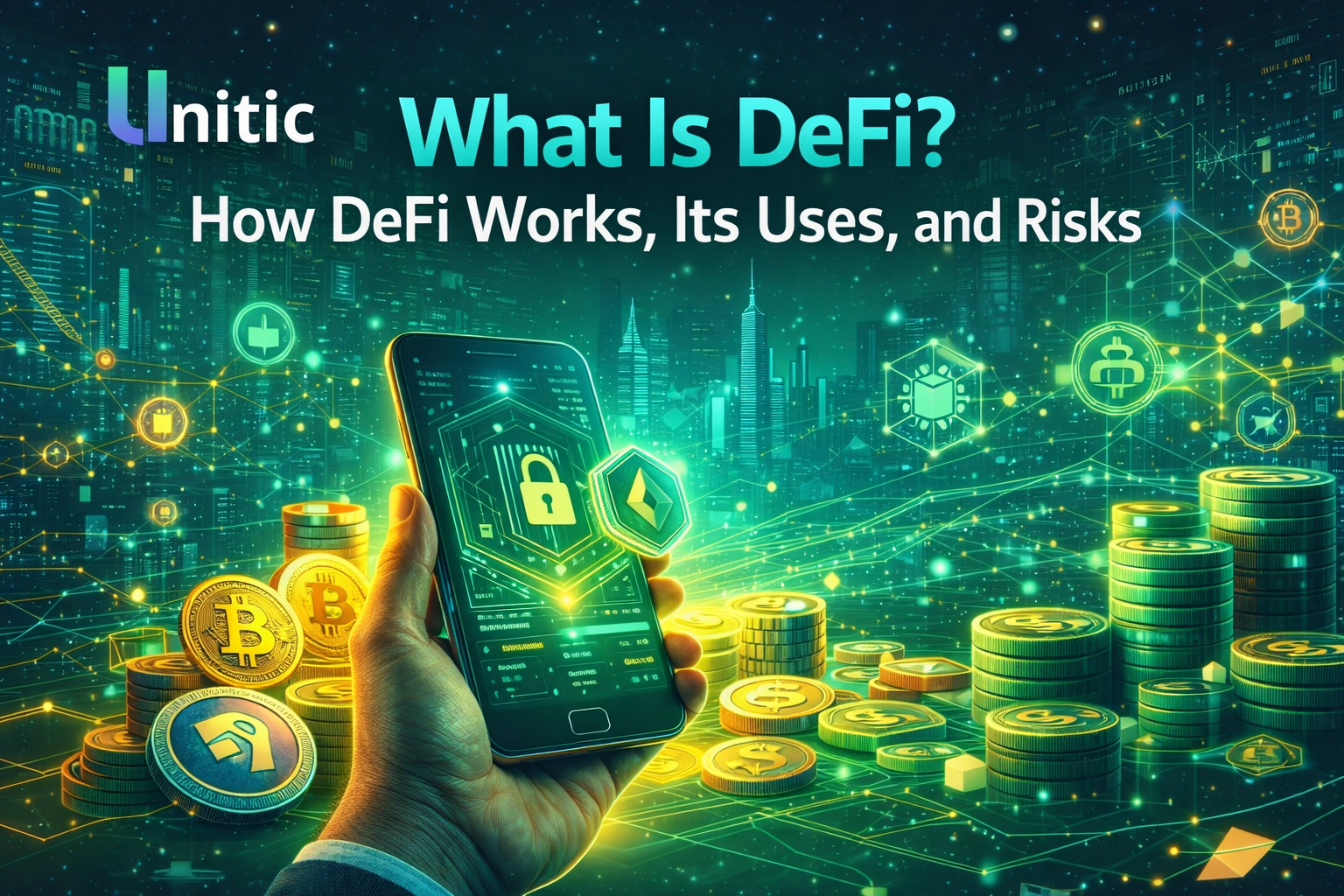
You may have come across the term DeFi and assumed it sounds like something out of a futuristic sci-fi movie. Or perhaps you encountered it while exploring how the cryptocurrency ecosystem really works. In reality, DeFi—short for Decentralized Finance—is rapidly becoming a serious alternative to traditional financial systems.
Decentralized Finance refers to a blockchain-based financial ecosystem that enables services such as lending, borrowing, trading, staking, and even insurance without relying on centralized intermediaries like banks or financial institutions. Instead, DeFi platforms operate using smart contracts, which are automated programs that execute transactions securely and transparently between users.
The core goal of DeFi is to create an open, permissionless, and globally accessible financial system, where users maintain full control over their assets. While this model unlocks powerful opportunities, it also introduces risks such as smart-contract vulnerabilities, hacking threats, and the responsibility of managing one’s own funds.
DeFi vs Traditional Banking
In a traditional banking system, customers deposit money into savings accounts and earn a small amount of interest. Banks then lend those deposits to borrowers at higher interest rates, keeping the difference as profit.
DeFi changes this model entirely. Instead of a bank acting as a middleman, users can lend their funds directly to borrowers through decentralized protocols. As a result, lenders often earn higher returns, since the interest paid by borrowers goes directly to them rather than being shared with a centralized institution.
This peer-to-peer structure is one of the defining features that makes DeFi fundamentally different from conventional finance.
Key Takeaways
- Decentralized Finance (DeFi) aims to remove third-party intermediaries from financial transactions.
- It relies on blockchain technology, cryptocurrencies, and smart contracts to enable peer-to-peer financial services.
- While DeFi offers transparency and higher earning potential, it is still evolving and remains vulnerable to hacks, exploits, and coding flaws.
Users must take full responsibility for security and asset management.
Core Components of DeFi
Blockchain Technology
Blockchain serves as the backbone of DeFi. It acts as a transparent, immutable digital ledger that permanently records every transaction and makes data publicly verifiable.
Smart Contracts
Smart contracts are self-executing programs that automatically enforce agreements. For example, they can release collateral, calculate interest, or liquidate loans without human intervention.
Decentralized Applications (dApps)
dApps are web or mobile interfaces that allow users to interact with DeFi protocols easily, without needing technical blockchain knowledge.
Stablecoins
Stablecoins are cryptocurrencies pegged to stable assets like fiat currencies. They reduce volatility and make DeFi more practical for everyday financial use.
Key Benefits and Applications of DeFi in 2026
By 2026, DeFi has grown beyond experimentation and matured into a functional ecosystem integrated with multiple financial services:
Lending and Borrowing
Platforms such as Aave and Compound allow users to earn interest on deposited crypto or take loans by providing collateral.
Decentralized Exchanges (DEXs)
DEXs like Uniswap enable direct crypto trading from user wallets, eliminating the need for centralized exchanges.
Yield Farming and Staking
Users can generate passive income by supplying liquidity to pools or staking assets through protocols like Lido, helping secure blockchain networks.
Real-World Asset (RWA) Tokenization
One of the biggest DeFi trends in 2026 is the tokenization of traditional assets—such as government bonds, invoices, and real estate—bringing real-world value on-chain.
Popular Uses of DeFi Technology
Decentralized Finance was initially created to improve access to basic financial services for people who were underserved or excluded from traditional banking systems. Over time, however, DeFi has grown far beyond this original goal. Today, it supports a wide range of financial and digital activities, forming a diverse ecosystem that continues to expand across multiple sectors.
Decentralized Exchanges (DEXs)
Decentralized exchanges are the most widely used applications within the DeFi ecosystem. Unlike centralized exchanges, DEXs allow users to trade cryptocurrencies directly from their wallets without relying on a central authority to hold or manage funds.
Transactions on DEXs are executed through smart contracts, ensuring transparency and reducing the risk of custodial failures. Users retain full control over their assets, while trades are settled on-chain. This permissionless nature makes DEXs accessible to anyone with an internet connection and a crypto wallet, regardless of geographic location.
Popular DEXs also offer features such as automated market making (AMM), liquidity pools, and low entry barriers for new traders, making decentralized trading one of the strongest pillars of DeFi.
Liquidity Provision
Liquidity is essential for efficient trading, and DeFi addresses this through liquidity pools. In this model, users known as liquidity providers deposit pairs of digital assets into smart contract–controlled pools.
These pools supply the liquidity needed for decentralized exchanges to function smoothly. In return, liquidity providers earn a portion of the transaction fees generated by traders using the pool. This creates a passive income opportunity while supporting the overall health of the DeFi ecosystem.
However, liquidity provision also comes with risks, such as impermanent loss and market volatility, which users must understand before participating.
Lending and Yield Farming
Lending is one of the core use cases of DeFi. Through decentralized lending platforms, users can deposit their assets into pools and earn interest as others borrow those funds. Borrowers typically provide crypto collateral, and interest rates are dynamically set by supply and demand.
Yield farming expands on this concept by allowing users to move assets across multiple protocols to maximize returns. Participants may earn interest, platform rewards, or governance tokens in exchange for providing liquidity or capital.
Some platforms also offer flash loans, a unique DeFi innovation. Flash loans require no collateral but must be borrowed and repaid within a single blockchain transaction. While powerful, they are primarily used by advanced users and developers due to their technical complexity and associated risks.
Gambling and Prediction Markets
DeFi has also enabled decentralized gambling and prediction markets. These platforms allow users to place bets on a wide variety of outcomes, including financial markets, sporting events, elections, and other real-world scenarios.
Prediction markets operate using smart contracts, which automatically settle outcomes based on verified data sources, often called oracles. This ensures fairness, transparency, and resistance to manipulation.
Because these platforms are decentralized, they often operate without geographic restrictions, attracting global participation. However, users should remain cautious, as gambling carries inherent financial risks.
Non-Fungible Tokens (NFTs)
Non-fungible tokens represent unique digital assets such as artwork, collectibles, music, or in-game items. While the NFT market has cooled from its peak, it remains an important part of the DeFi ecosystem.
DeFi marketplaces enable users to buy, sell, stake, and even use NFTs as collateral for loans. This integration of NFTs with financial tools has created new use cases beyond simple ownership, including fractional ownership and NFT-backed lending.
For collectors and niche investors, NFTs continue to offer opportunities for digital ownership, creative expression, and participation in decentralized economies.
Is Decentralized Finance Worth It?
DeFi can be highly rewarding—but it is not for everyone. The industry is still evolving, and price volatility, security risks, and hype-driven markets make it a speculative space.
If you are investing money you can afford to lose, DeFi may offer strong returns. However, if your goal is long-term financial stability or retirement planning, DeFi and cryptocurrencies should be approached with caution due to their unpredictable nature.
Concerns and Challenges in DeFi
Despite its innovation, DeFi faces serious challenges:
- Security Risks: Smart-contract bugs and poorly audited protocols can be exploited by hackers.
- Lack of Regulation: DeFi operates globally without clear regulatory oversight.
- Legal Uncertainty: Questions remain about jurisdiction, enforcement, and accountability in cross-border DeFi transactions.
For example:
- Who investigates financial crimes in decentralized systems?
- Which authority enforces the rules?
- How can regulations be applied to borderless protocols?
These questions remain largely unresolved.
Bottom Line
Decentralized Finance represents a powerful shift in how financial systems can operate—offering transparency, accessibility, and control to users worldwide. However, it also attracts fraud, scams, and high-risk behavior due to its complexity and lack of regulation.
As with any emerging technology, success in DeFi depends on education, careful research, and responsible risk management. Understand what you are investing in before participating, and never invest more than you can afford to lose.
FAQs
DeFi (Decentralized Finance) is a blockchain-based financial system that removes intermediaries like banks and brokers. It works using smart contracts—self-executing programs on blockchains (mainly Ethereum)—that automatically handle transactions such as lending, borrowing, trading, and earning interest without human involvement.
DeFi is used for: Lending & Borrowing crypto assets Decentralized Trading (DEXs) Earning Interest & Yield Farming Stablecoins & Payments Insurance and Asset Management All activities happen peer-to-peer, giving users full control over their funds.
DeFi comes with several risks, including: Smart Contract Bugs or Hacks High Market Volatility Rug Pulls and Scam Projects Lack of Regulation User Error (lost private keys, wrong transactions) Users should research projects carefully and never invest more than they can afford to lose.
There is no single “DeFi coin.” DeFi is an ecosystem made up of many tokens like UNI, AAVE, COMP, and MKR, each with its own price in USD. The value of a DeFi token depends on market demand, utility, and overall crypto market conditions.
A DeFi app (dApp) is a decentralized application built on a blockchain that allows users to access financial services without intermediaries. Popular DeFi apps include Uniswap, Aave, Compound, and MakerDAO, which can be accessed through crypto wallets like MetaMask or Trust Wallet.



Your Crypto Gateway


Unitic Exchange
All rights reserved 2026