Zcash (ZEC) Explained: How Does This Privacy Cryptocurrency Work?
Most public blockchains are designed to be transparent. Bitcoin, for example, records every transaction on a public ledger, which means anyone can view wallet addresses, transaction amounts, and transaction history. While wallet addresses do not directly reveal a person’s name, repeated use of the same address can make it possible to link activity over time.
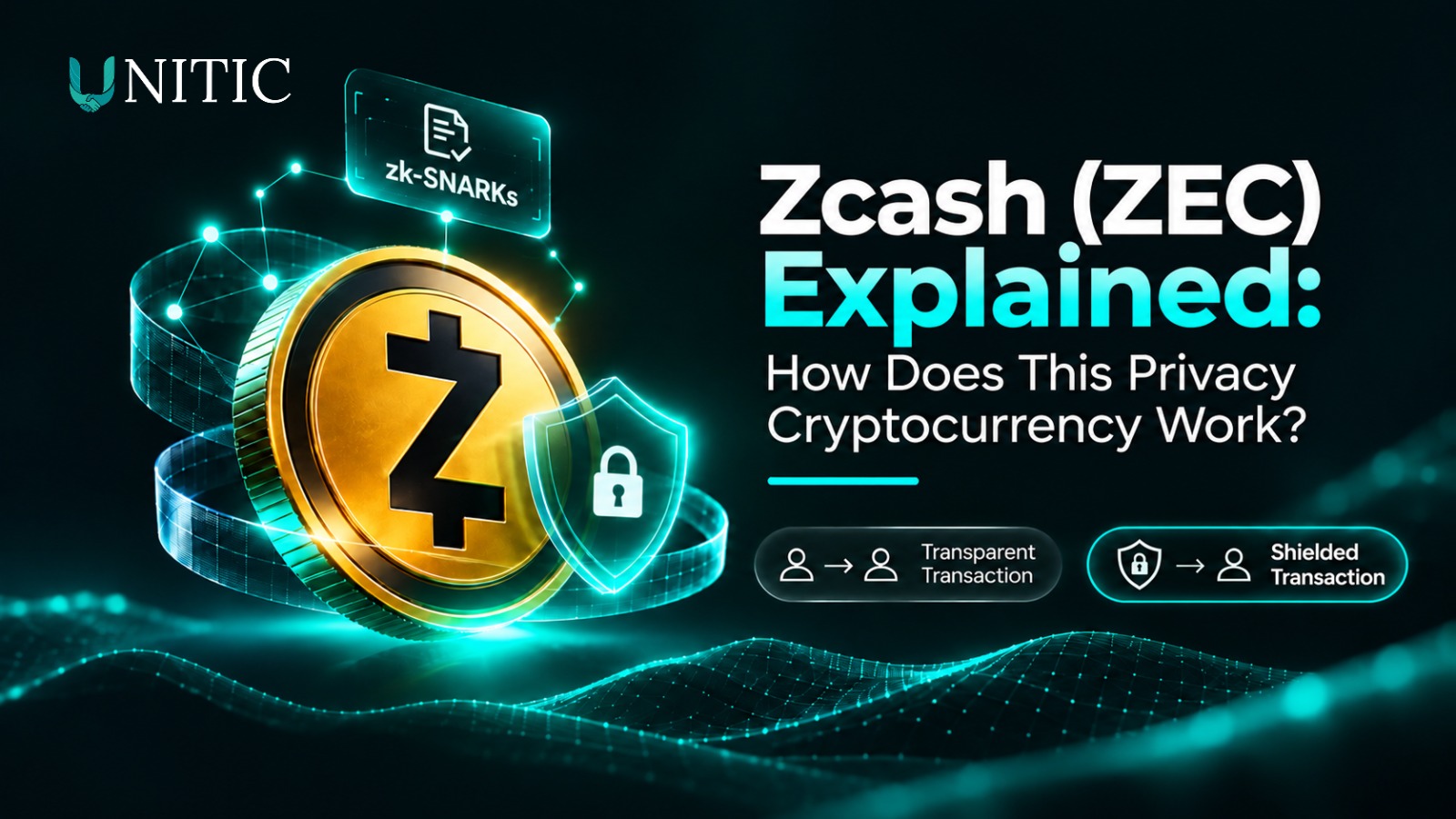
Zcash, often called ZEC, takes a different approach. It is a privacy-focused cryptocurrency that lets users choose between transparent and shielded transactions. Instead of forcing every transaction to be publicly visible, Zcash gives users more control over what information they reveal.
In this guide, we explain what Zcash is, how its privacy technology works, how ZEC differs from Bitcoin, what risks it carries, and how traders can approach privacy-focused assets responsibly. Unitic Exchange provides access to crypto markets and trading tools, so understanding assets such as ZEC is important before making any trading decision.
What Is Zcash (ZEC)?
Zcash is a decentralized, open-source cryptocurrency built on its own blockchain. It was launched in 2016 and is designed to provide optional privacy for transactions through advanced cryptographic technology.
Unlike a standard transparent blockchain, where transaction details are visible to everyone, Zcash allows users to send transactions in two main ways:
- Transparent transactions, which are publicly visible.
- Shielded transactions, which use zero-knowledge cryptography to conceal transaction details.
The native asset of the Zcash network is ZEC. Users can hold ZEC, send it, receive it, or use it in supported wallets and exchanges.
Zcash is often described as a privacy coin, but that description needs context. Zcash does not automatically make every transaction private. Instead, it provides optional privacy features that users can choose to use.
Why Privacy Matters in Crypto
Many people assume that cryptocurrency is anonymous. In reality, most public blockchains are pseudonymous rather than anonymous.
For example, Bitcoin transactions do not show your name directly. However, every transaction is recorded publicly. If a wallet address is linked to your identity through an exchange, payment record, social media post, or other source, your transaction history may become traceable.
Privacy matters for several reasons:
- Protecting personal financial information.
- Reducing exposure to targeted scams.
- Preventing businesses from tracking customer purchases.
- Supporting financial confidentiality.
- Reducing the risk of address clustering and behavioral profiling.
- Helping users maintain control over their transaction data.
Privacy does not mean illegal activity. Ordinary users may want privacy for the same reasons they value privacy in banking, messaging, or online browsing.
How Zcash Differs From Bitcoin
Bitcoin and Zcash both use blockchain technology, but their privacy models are very different.
|
Feature |
Bitcoin |
Zcash |
|
Primary design goal |
Decentralized digital money |
Optional transaction privacy |
|
Transaction visibility |
Public |
Transparent or shielded |
|
Address types |
Standard Bitcoin addresses |
Transparent and shielded addresses |
|
Privacy technology |
Basic pseudonymity |
zk-SNARK-based shielded transactions |
|
Default privacy |
No |
Optional |
|
Main asset |
BTC |
ZEC |
|
Typical use |
Payments, store of value, trading |
Privacy-focused transfers and payments |
Bitcoin is transparent by design. Anyone can see the amount transferred, the sending address, and the receiving address. Zcash allows users to choose whether they want that information to remain private.
Transparent vs Shielded Transactions
Zcash supports two types of addresses and transactions.
Transparent Transactions
Transparent Zcash transactions work similarly to Bitcoin transactions. The sender address, recipient address, and transaction amount are visible on the public blockchain.
Transparent addresses are often called t-addresses.
They may be useful when:
- A user wants public verification.
- A service requires transparent transactions.
- A user does not need privacy.
- Compatibility with certain exchanges or wallets is required.
Shielded Transactions
Shielded transactions use cryptography to hide sensitive details. Instead of publicly revealing the sender, recipient, and amount, the transaction is validated through zero-knowledge proofs.
Shielded addresses are often called z-addresses.
They may be useful when:
- A user wants stronger transaction privacy.
- The sender and receiver both support shielded transactions.
- Financial confidentiality is important.
- The user wants to avoid public address-linking.
The important point is that Zcash privacy is optional. A user can choose transparent or shielded transactions depending on their needs.
What Are zk-SNARKs?
The technology behind Zcash’s shielded transactions is called zk-SNARKs, which stands for Zero-Knowledge Succinct Non-Interactive Argument of Knowledge.
That sounds complicated, but the idea is simple.
A zero-knowledge proof lets one party prove that something is true without revealing the underlying information.
For example, imagine you need to prove that you have enough money to make a payment, without revealing your full bank balance. A zero-knowledge proof can confirm that the payment is valid without exposing your entire balance.
In Zcash, zk-SNARKs can prove that a transaction is valid without revealing:
- The sender’s address.
- The recipient’s address.
- The transaction amount.
This allows the Zcash network to verify that funds are not created from nothing, while keeping sensitive transaction details private.
How a Zcash Shielded Transaction Works
A simplified version of a shielded Zcash transaction works like this:
- The sender creates a shielded transaction.
- The transaction details are encrypted or hidden.
- A zero-knowledge proof is generated.
- The Zcash network verifies the proof.
- If the proof is valid, the transaction is accepted.
- The recipient receives the funds without the transaction details being publicly exposed.
The network still needs to ensure that the transaction is valid. It must confirm that the sender has enough funds and that the same funds are not spent twice.
zk-SNARKs make this possible by allowing the network to verify correctness without seeing the private details.
Zcash Address Types
Zcash supports different address formats.
Transparent Address
A transparent address is publicly visible. Transactions sent to or from this address can be viewed on the blockchain.
Shielded Address
A shielded address uses privacy technology to conceal transaction details. Transactions between shielded addresses can provide stronger privacy.
Unified Address
Newer Zcash wallets may support unified addresses, which can help users receive different types of Zcash transactions more easily.
Before sending ZEC, always confirm which address type your wallet and the receiving platform support. Sending ZEC to an unsupported address type can result in complications or loss of funds.
ZEC Tokenomics
ZEC is the native cryptocurrency of the Zcash network. It is used to pay transaction fees and transfer value across the Zcash blockchain.
Like Bitcoin, Zcash has a fixed maximum supply. This means there is a limit to how many ZEC coins can ever exist.
Zcash uses a mining-based issuance model, although its consensus and reward structure have evolved over time. Miners help secure the network and receive block rewards for validating blocks.
The fixed supply is one reason some traders view ZEC as a scarce digital asset. However, scarcity alone does not guarantee price growth. Demand, liquidity, regulation, market sentiment, and adoption all affect ZEC’s value.
Zcash Mining and Network Security
Zcash uses proof-of-work mining. Miners use computing power to validate transactions and add new blocks to the blockchain.
The mining process helps secure the network by making it difficult for a single party to alter transaction history. As more miners participate, the network becomes more resistant to attacks.
However, mining also consumes electricity and hardware resources. This is similar to Bitcoin’s proof-of-work model.
Zcash has undergone protocol upgrades over time to improve privacy, scalability, and usability. As with any blockchain project, users should follow official sources for the latest network information.
Why Traders Watch ZEC
ZEC can attract trader attention for several reasons:
- It is one of the most well-known privacy-focused cryptocurrencies.
- Its privacy technology is technically distinctive.
- It has a limited maximum supply.
- Market sentiment around privacy coins can change quickly.
- Regulatory news can affect privacy-focused assets.
- ZEC may move differently from Bitcoin during certain market conditions.
However, privacy-focused cryptocurrencies can also face higher uncertainty. Regulatory scrutiny, exchange delistings, liquidity changes, and market sentiment can all affect price movement.
Traders should never treat ZEC as a guaranteed investment. It should be approached with the same discipline as any other volatile crypto asset.
ZEC Price Volatility
Like most cryptocurrencies, ZEC can experience sharp price movements. A coin that rises quickly can also fall quickly.
Factors that may affect ZEC price include:
- Overall Bitcoin and crypto market direction.
- Investor interest in privacy coins.
- Exchange listings and liquidity.
- Regulatory announcements.
- Zcash network upgrades.
- Mining activity and hash rate changes.
- Market-wide risk appetite.
- Macroeconomic conditions.
- Whale activity and trading volume.
Before trading ZEC, check live market data, trading volume, liquidity, and recent price action. You can explore available crypto markets on Unitic Exchange Markets.
How to Buy ZEC on Unitic Exchange
Unitic Exchange is a crypto trading platform designed to provide spot trading, futures trading, OTC services, and market tools in one place. The platform highlights support for hundreds of spot and futures pairs, real-time charts, advanced orders, and risk-management features.
To explore ZEC trading, users can:
- Create an account on Unitic Exchange.
- Complete the required account setup and security steps.
- Deposit supported assets or use available funding options.
- Search for ZEC in the available markets.
- Review the ZEC/USDT or other available trading pair.
- Analyze price action, volume, and market depth.
- Place a spot order or use futures tools if suitable for your strategy.
- Apply stop-loss and take-profit levels before entering a trade.
Unitic Exchange offers spot trading, futures trading, Earn products, and TradeIQ market insights.
Spot Trading ZEC on Unitic
Spot trading means buying or selling ZEC at the current market price. When you buy ZEC on the spot, you own the asset directly.
Spot trading is generally more suitable for beginners because it does not involve leverage.
For example, if you believe ZEC may rise in value, you can buy ZEC using USDT. If the price rises, your ZEC holdings increase in value. If the price falls, your holdings decrease in value.
Unitic Exchange provides spot trading with real-time charts and advanced order types.
Futures Trading ZEC on Unitic
Futures trading allows traders to speculate on price movements using contracts rather than directly owning the underlying asset.
Unitic Exchange offers futures trading with USDT-M perpetual contracts and leverage of up to 125x on major cryptocurrencies.
Leverage can increase potential profits, but it also increases potential losses. A small price movement can liquidate a highly leveraged position.
For example, 10x leverage means that a 10% unfavorable price movement can wipe out the margin used for that position, depending on liquidation rules and fees.
Futures should only be used by traders who understand:
- Margin requirements.
- Liquidation price.
- Funding rates.
- Isolated versus cross margin.
- Stop-loss placement.
- Position sizing.
- Market volatility.
If you want to explore BTC futures trading, you can access the BTC/USDT futures market.
OTC Trading on Unitic
For larger transactions, Unitic Exchange provides an OTC desk. OTC stands for over-the-counter trading, where buyers and sellers can execute trades directly rather than placing orders on a public order book.
OTC trading may be useful for:
- Large crypto purchases.
- Large crypto sales.
- Reducing public market impact.
- Accessing personalized trading support.
- Managing larger transactions more privately.
You can learn more about Unitic’s OTC desk here: Unitic USDT OTC Desk.
How to Trade ZEC Responsibly
Trading ZEC requires more than simply buying when the price rises. A responsible trader follows a plan.
1. Define Your Goal
Ask yourself why you are trading ZEC.
- Are you looking for short-term trading opportunities?
- Are you building a long-term crypto portfolio?
- Are you testing a trading strategy?
- Are you diversifying across different crypto sectors?
Your goal should determine your time frame, position size, and risk level.
2. Use Risk Management
Never risk more than you can afford to lose. Many traders use a rule of risking only 1–2% of their trading capital per trade.
Set a stop-loss before entering the trade. Do not move it further away just because the price is moving against you.
3. Avoid Emotional Trading
Fear and greed are common reasons traders lose money.
Do not buy just because ZEC is pumping. Do not sell in panic just because the price drops. Follow your trading plan.
4. Track Your Trades
Keep a trading journal. Record:
- Entry price.
- Exit price.
- Stop-loss level.
- Take-profit level.
- Trade reason.
- Profit or loss.
- Lessons learned.
Over time, this helps you identify what works and what does not.
5. Start Small
If you are new to ZEC or privacy coins, begin with a small position. Increase exposure only after you understand the market and your strategy.
Zcash Risks Every Trader Should Know
Zcash has potential benefits, but it also carries risks.
Regulatory Risk
Privacy-focused cryptocurrencies may attract regulatory attention in different countries. Rules can change, and exchanges may update their listing policies.
Liquidity Risk
ZEC may have lower liquidity than major assets such as Bitcoin or Ethereum. Lower liquidity can lead to wider spreads and more volatile price movements.
Technical Risk
Blockchain networks can face bugs, upgrades, security issues, or compatibility problems. Always use trusted wallets and official sources.
Exchange Risk
Not every exchange supports ZEC deposits, withdrawals, or shielded transactions. Always verify supported networks and address types before transferring funds.
Market Risk
ZEC can fall sharply during broader crypto market downturns. Privacy coins may also react differently to market news.
Custody Risk
If you lose access to your private keys or seed phrase, you may lose access to your funds. Never share your seed phrase, private key, OTP, or password with anyone.
Zcash Myths and Misconceptions
Myth 1: Zcash Is Completely Anonymous
Zcash provides strong privacy tools, but users should not assume complete anonymity. User behavior, wallet management, exchange activity, and metadata can still affect privacy.
Myth 2: All ZEC Transactions Are Private
No. Zcash supports both transparent and shielded transactions. Privacy depends on the transaction type and wallet support.
Myth 3: Privacy Coins Are Only for Illegal Activity
Privacy is a legitimate financial need. People may value privacy for personal security, business confidentiality, or protection from financial surveillance.
Myth 4: ZEC Will Always Follow Bitcoin
ZEC may correlate with Bitcoin during broad market moves, but it can also move independently based on its own news, liquidity, and market sentiment.
Myth 5: Privacy Means No Regulation
Privacy does not remove regulatory obligations. Users should always follow the laws and rules that apply in their country.
How Zcash Fits Into a Crypto Portfolio
ZEC should not automatically be treated as a core holding. It may be considered as part of a broader crypto strategy, depending on your risk tolerance and investment goals.
A balanced approach may include:
- Major assets such as Bitcoin and Ethereum.
- Established altcoins with strong liquidity.
- Sector-specific assets such as privacy coins, DeFi tokens, or AI-related tokens.
- Stablecoins for trading capital and risk management.
- Cash reserves outside crypto.
Diversification does not eliminate risk, but it can reduce dependence on a single asset.
ZEC Trading Strategies
Different traders use different methods. Here are a few common approaches.
Swing Trading
Swing traders hold positions for days or weeks. They may look for support and resistance levels, trend changes, and higher-timeframe confirmation.
Day Trading
Day traders open and close positions within a day. They focus on intraday price action, volume, volatility, and short-term setups.
Scalping
Scalpers make many small trades to capture minor price movements. This requires fast execution, discipline, and strict risk management.
Range Trading
Range traders identify support and resistance zones. They buy near support and sell near resistance, while using stop-losses in case the range breaks.
Trend Following
Trend traders look for sustained price direction. They may enter after a breakout or trend confirmation and exit when the trend weakens.
No strategy works in every market condition. Test your approach and use risk management consistently.
How to Analyze ZEC Before Trading
Before buying or selling ZEC, review the following:
Price Chart
Look at support, resistance, trend direction, and recent price action.
Trading Volume
Higher volume can confirm stronger market interest. Low volume may indicate weak momentum.
Market Depth
Check the order book and liquidity. Thin liquidity can make it harder to enter or exit positions.
Bitcoin Correlation
Many altcoins follow Bitcoin’s direction. Watch BTC price action before taking altcoin trades.
News and Updates
Follow Zcash network updates, exchange announcements, regulatory developments, and market sentiment.
Risk-Reward Ratio
Only take trades where the potential reward justifies the risk.
ZEC vs Other Privacy Coins
Zcash is not the only privacy-focused cryptocurrency. Other projects include Monero, Dash, and Secret Network, although each uses different technology and has a different privacy model.
|
Project |
Main Focus |
Privacy Approach |
|
Zcash |
Optional privacy |
zk-SNARK-based shielded transactions |
|
Monero |
Default privacy |
Ring signatures, stealth addresses, RingCT |
|
Dash |
Payments and optional privacy |
PrivateSend-style features |
|
Secret Network |
Privacy-focused smart contracts |
Encrypted smart contract data |
Zcash’s key distinction is its optional privacy model. Users can choose between transparent and shielded transactions.
Zcash and Financial Privacy
Financial privacy is becoming more important as digital payments expand. Traditional financial systems already collect large amounts of personal and transaction data.
Zcash aims to give users more control over their financial information. Its technology allows users to transact without exposing every detail publicly.
However, privacy technology must be balanced with legal compliance. Exchanges, wallets, and users must follow applicable regulations in their jurisdictions.
Unitic Exchange and Crypto Trading
Unitic Exchange positions itself as a global crypto exchange offering spot trading, futures trading, OTC services, and Earn products. The platform highlights 300+ spot pairs, 500+ futures pairs, 99.9% uptime, and 24/7 support.
For traders interested in ZEC, Unitic provides tools that can support market analysis and trade execution.
Spot Trading
Unitic offers spot trading with deep liquidity, competitive fees, real-time charts, and advanced orders.
Futures Trading
Unitic provides USDT-M perpetual futures with leverage of up to 125x on major cryptocurrencies.
TradeIQ Insights
Unitic also offers TradeIQ, which provides expert trading signals, market insights, real-time alerts, and performance tracking.
Blog and Education
For ongoing crypto education, market insights, and trading guides, visit the Unitic Exchange Blog.
How to Use Unitic Exchange Safely
Security should always come first.
Use Strong Authentication
Enable two-factor authentication and use a strong, unique password.
Verify the Official Website
Only use the official Unitic Exchange domain: www.uniticexchange.com. Unitic warns users to verify the website URL before logging in or making transactions.
Never Share Sensitive Information
Unitic states that it will never contact users to request passwords, OTPs, private keys, or account details.
Use Risk Management
Do not invest more than you can afford to lose. Crypto assets are volatile and speculative.
Keep Records
Save transaction history, withdrawal records, and trading notes for personal record-keeping.
ZEC Trading Checklist
Before entering a ZEC trade, ask yourself:
- Do I understand what Zcash is?
- Do I know the difference between transparent and shielded transactions?
- Have I checked the current ZEC market and liquidity?
- Have I defined my entry, stop-loss, and take-profit levels?
- Am I using proper position sizing?
- Am I avoiding emotional decisions?
- Have I reviewed Bitcoin and overall market conditions?
- Am I following applicable local regulations?
- Am I using the official Unitic Exchange website?
- Am I only risking money I can afford to lose?
If you cannot answer these questions clearly, wait and do more research.
Conclusion
Zcash (ZEC) is one of the most recognized privacy-focused cryptocurrencies because it offers optional shielded transactions using zk-SNARK technology. Instead of forcing all transactions to be public, Zcash gives users a choice between transparency and privacy.
For traders, ZEC can be an interesting asset to study, but it is not risk-free. Privacy coins can face liquidity challenges, regulatory uncertainty, and sharp market volatility. Before trading ZEC, users should understand the technology, use proper risk management, and avoid emotional decisions.
Unitic Exchange provides a platform for exploring crypto markets through spot trading, futures trading, OTC services, and market insights. Whether you are researching ZEC or trading major assets such as Bitcoin, always use the official Unitic Exchange website and follow responsible trading practices.
You can explore markets through Unitic Exchange Markets, trade BTC futures through the BTC/USDT futures market, access larger transactions through the Unitic USDT OTC Desk, and continue learning through the Unitic Exchange Blog.
Disclaimer
Crypto assets and NFTs are highly volatile and speculative in nature, with prices subject to sudden and significant fluctuations due to market demand, regulatory developments, technological changes, liquidity conditions, and external global factors. Investments in these digital assets carry a high level of risk, including the potential loss of your entire invested capital, and may not be suitable for all investors.
Past performance is not indicative of future results, and there is no guarantee of returns or capital protection. Users are strongly advised to conduct thorough research, assess their financial situation, risk tolerance, and investment objectives before participating, and to trade cautiously by investing only funds they can afford to lose without impacting their financial stability.
Unitic Exchange operates exclusively through its official domain, www.uniticexchange.com. Users must always verify the website URL carefully before logging in or making any transactions. Unitic Exchange will never contact users via phone calls, messages, or emails to request sensitive information such as passwords, OTPs, private keys, or account details.
FAQs
No. Zcash provides privacy tools, but users should not assume complete anonymity. Privacy depends on wallet use, transaction type, and user behavior.
Bitcoin transactions are public by default. Zcash allows users to choose between transparent and shielded transactions.
Zcash uses zk-SNARKs to validate shielded transactions without revealing the sender, recipient, or transaction amount.
Availability depends on the current market listings and supported trading pairs. Check the Unitic Markets page for the latest available assets.
Futures trading may be available depending on the platform and market listing. Unitic offers futures trading with leverage up to 125x on major cryptocurrencies.

Your Crypto Gateway


Unitic Exchange
All rights reserved 2026