The Best Crypto Signals | TradeIQ by Unitic
Finding reliable crypto trading signals is one of the most common — and most frustrating — challenges traders face. The market is flooded with Telegram groups promising guaranteed profits, anonymous "gurus" with no verifiable history, and signal services that vanish the moment their calls start losing. Cutting through that noise to find a signal provider that's transparent, structured, and genuinely useful takes real diligence.
TradeIQ, a trading intelligence platform built by Unitic, is designed to address exactly that gap. Rather than positioning itself as a black box of "buy here, sell there" alerts, TradeIQ is built around structured strategies, clearly defined risk parameters, and performance tracking that traders can actually review. This guide walks through how TradeIQ works, what makes its approach to crypto signals different, and how to evaluate whether it fits into your own trading process.
You can explore TradeIQ directly at tradeiq.exchange.
Why the Crypto Signals Space Has a Trust Problem
Before getting into what TradeIQ offers, it's worth understanding why so many traders approach crypto signals with skepticism in the first place — because that context is exactly what shapes what a genuinely useful signals provider needs to get right.
The barrier to entry for starting a "signals" account on Telegram or social media is essentially zero. Anyone can post a chart with an arrow on it and call it a signal. That low barrier has led to a market flooded with providers who have no real track record, no consistent methodology, and in some cases, no genuine interest in the trader's outcome at all — some services exist primarily to drive engagement or referrals rather than to deliver useful trading ideas. Add to that the well-documented pattern of providers who quietly stop posting once a string of losing calls damages their credibility, and it's easy to see why "crypto signals" as a category has earned a mixed reputation among experienced traders.
This is precisely the gap that a structured, transparent platform is built to close — not by promising better outcomes than any signal realistically can, but by making the entire process more accountable: visible historical performance, clearly defined risk on every signal, and a platform with an actual identity and infrastructure behind it, rather than an anonymous account that could disappear overnight.
What Are Crypto Trading Signals, and Why Do They Matter?
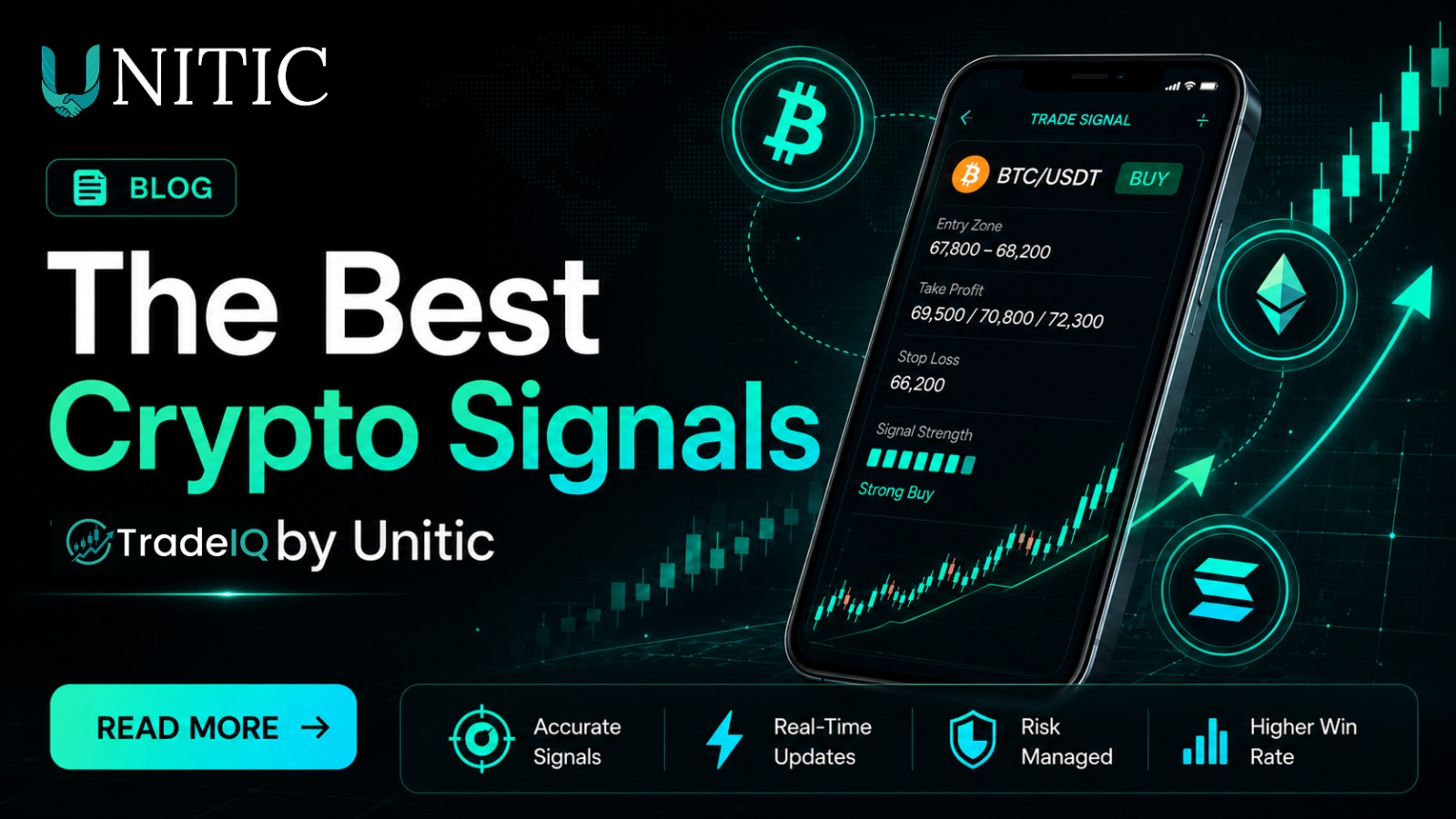
A crypto trading signal is a structured trade recommendation — typically an entry price, one or more take-profit targets, and a stop-loss level — generated by analyzing market data, price action, and momentum. For traders who don't have the time to monitor charts around the clock, or who are still building their own technical analysis skills, signals offer a way to participate in the market backed by a structured, researched setup rather than a guess.
The value of a signal isn't just the entry and exit price — it's the discipline built into the structure around it. A well-constructed signal tells you not just where to get in, but exactly where to get out if the trade goes wrong, which is often the single biggest factor separating consistent traders from inconsistent ones.
Introducing TradeIQ: A Product by Unitic
TradeIQ is a next-generation trading intelligence platform built for disciplined traders who want structured strategies, defined risk control, and signals grounded in real market experience rather than guesswork. As a product built by Unitic, TradeIQ extends the same philosophy that shapes Unitic Exchange's broader approach to the market: give traders the tools to make informed decisions, backed by transparency about how those tools actually perform.
Rather than operating as a closed, opaque signal group, TradeIQ is built around visible performance data, a defined onboarding flow, and multiple ways to engage with its signals — whether that means following alerts manually or using its copy trading feature to automate execution.
Core Features of TradeIQ
- Spot and Futures market coverage. TradeIQ delivers signals across both spot and futures markets, giving traders flexibility depending on their preferred trading style and risk appetite. A trader who prefers straightforward ownership positions can focus on spot signals, while a trader comfortable with leverage can incorporate futures signals into a more active strategy — all from the same account and the same underlying signal methodology.
- 600+ futures and spot pairs supported. A broad universe of tradeable pairs means signals aren't limited to a handful of major assets, giving traders exposure to a wide range of market opportunities across established, high-liquidity assets as well as a broader set of alternative coins.
- Instant entry, take-profit, and stop-loss levels. Every signal comes with a complete structure — not just a price to buy at, but the specific levels needed to manage the trade responsibly from entry to exit. This removes the guesswork that comes with vague, informal tips that only specify an entry price and leave risk management entirely up to the trader.
- Real-time alerts across multiple channels. Signals are delivered instantly through the app and via Telegram, so traders aren't left checking a dashboard manually to catch a time-sensitive setup. In fast-moving crypto markets, the gap between when a signal is generated and when a trader actually sees it can matter significantly, so multi-channel delivery is a meaningful part of the product, not just a convenience feature.
- Built-in risk management. Every signal includes clearly defined stop-loss and risk-to-reward parameters, reflecting a structured approach to protecting capital rather than chasing an entry without a plan. This is arguably the single most important feature of any signals service, since the difference between a sustainable trading approach and an unsustainable one usually comes down to how consistently risk is managed on losing trades, not how impressive the winning trades look.
- 24/7 market coverage. Since crypto markets never close, TradeIQ's signal generation runs continuously, so traders aren't left without coverage during off-hours or weekends — a meaningful advantage over signal services that only operate during specific hours or time zones.
- Transparent performance tracking. TradeIQ maintains a dedicated performance page with detailed analytics on past signals, giving traders the ability to review historical results rather than relying on unverifiable claims. This kind of visibility is rare enough in the signals space that it's worth calling out specifically as a differentiator.
- Copy trading functionality. For traders who prefer a more hands-off approach, TradeIQ's copy trading feature allows signals to be executed automatically, removing the manual step of placing each trade individually — useful for traders who want structured exposure to the signals without actively monitoring alerts throughout the day.
- Refer & earn program. TradeIQ also includes a referral structure, allowing users to earn by introducing the platform to other traders, adding an additional way to engage with the platform beyond following signals directly.
A 3-Target Strategy Built for Real Trading Conditions
One of the distinguishing features of TradeIQ's approach is its 3 Target Strategy — rather than a single take-profit level, each signal includes multiple profit targets, allowing traders to lock in gains progressively as a trade develops instead of relying on a single all-or-nothing exit point. This structure reflects a more realistic approach to how price actually moves: rarely in a single straight line to a final target, but often in stages, with pullbacks and consolidation along the way. Multiple targets give traders the flexibility to secure partial profits early while still leaving room for a position to run further if momentum continues.
Paired with clearly defined stop-loss levels and risk-to-reward ratios on every signal, this structure is built around the idea that protecting capital is just as important as capturing upside — a principle that separates disciplined, sustainable trading from short-term speculation.
How TradeIQ Works: A Simple Four-Step Process
TradeIQ's process is built to be accessible whether you're a complete beginner or an experienced trader looking to supplement your own analysis:
- Sign Up. Create a free account in minutes to get started, with no lengthy setup process standing between you and your first signal.
- Get Signals. Once registered, you begin receiving real-time signals generated by TradeIQ's expert analysts, delivered instantly to your device and through Telegram.
- Execute the Trade. Each signal arrives with a complete structure — entry price, take-profit targets, and stop-loss level — so you can follow it directly or use it as an input alongside your own analysis.
- Achieve Results. By following a structured, risk-managed approach over time and reviewing performance data, traders can work toward more consistent outcomes than trading on instinct alone.
This structure is designed to remove unnecessary friction from the process of accessing trading signals, while still keeping the core discipline — entry, target, and stop-loss — front and center in every alert.
Why Structured Signals Matter More Than "Hot Tips"
The crypto space is saturated with informal tips shared in group chats — a coin mentioned in passing, a screenshot with no context, a message that simply says "buy now." The problem with this kind of signal isn't necessarily that the underlying idea is wrong; it's that there's no structure around it. Without a defined entry, a clear stop-loss, and a sense of the risk-to-reward ratio involved, a trader following a bare tip has no way to manage the position responsibly once it's live.
TradeIQ's approach is built around addressing exactly this gap. Every signal is structured as a complete trade plan, not a passing suggestion — which means a trader following it knows precisely where they're getting in, where they're taking profit, and, critically, where they're getting out if the trade doesn't work. That structure is what separates a genuinely useful trading signal from a piece of speculative noise, regardless of how confident the person sharing it sounds.
What Sets a Structured Signals Platform Apart
Beyond the individual features described above, it's worth stepping back to look at what actually separates a platform like TradeIQ from the informal signal-sharing that's common across social media and messaging apps. A few distinguishing characteristics matter more than they might initially seem:
An identifiable entity behind the platform. TradeIQ operates as a product built by Unitic, with a clear "About Us" page, documented terms of service, and a privacy policy — the kind of institutional infrastructure that an anonymous Telegram channel simply doesn't have. That accountability matters, because a platform with a real identity has something to lose by producing consistently poor signals, whereas an anonymous account can disappear without consequence.
Consistency of methodology. Rather than a rotating cast of contributors with different styles and different levels of skill, a structured platform applies a consistent approach across its signals, which makes it easier for a trader to build a sense of how the platform's methodology tends to perform across different market conditions over time.
A defined risk framework on every signal. As covered earlier, the presence of a stop-loss and take-profit structure on every single signal — rather than only on some — reflects a platform-wide commitment to risk management, not just an occasional feature of a few well-thought-out calls.
Multiple ways to engage. The option to follow signals manually or through copy trading gives traders flexibility in how much control they want over execution, rather than forcing a single rigid way of using the platform.
Transparency and Performance Tracking
One of the most common criticisms of crypto signal services is the lack of verifiable track records. Many signal providers highlight their wins prominently while quietly leaving losses out of the conversation, making it difficult for a prospective user to judge whether a service is actually effective or simply good at marketing its best moments.
TradeIQ addresses this directly through a dedicated performance page, where past signals and their outcomes are tracked and made available for review. This kind of transparency matters because it allows traders to evaluate a signals provider the same way they'd evaluate any other tool — based on a documented history, not a highlight reel. Before relying on any signal service, reviewing this kind of performance data — and understanding how it's calculated — is one of the most useful steps a trader can take.
It's worth noting, as TradeIQ's own materials state clearly, that trading involves risk and that past performance does not guarantee future results. Even a strong historical track record doesn't eliminate the underlying risk of trading leveraged or volatile assets, and TradeIQ describes its content as educational and analytical rather than a guarantee of profit. Traders should treat any performance statistics — from TradeIQ or any other provider — as historical context, not a promise about what will happen going forward.
The Numbers TradeIQ Publishes
TradeIQ's own site lists a set of self-reported performance figures, including a win rate of up to 92%+, more than 300 signals delivered, and coverage across 400+ pairs. These are the platform's own reported statistics, visible on its performance page, rather than numbers independently audited by a third party — which is standard across most signal services in this space, but still worth being explicit about. Any trader evaluating TradeIQ, or any comparable service, should look at these figures as a starting point for further research rather than a settled fact, and ideally review the underlying performance data directly rather than relying on a single headline statistic. A win rate on its own also doesn't tell the full story — the size of wins relative to losses, and the risk-to-reward ratio built into each signal, matter just as much as how often a signal is "right."
Spot vs. Futures Signals on TradeIQ
Because TradeIQ covers both spot and futures markets, traders can choose the format that matches their risk tolerance and trading goals:
- Spot signals are geared toward traders who want direct exposure to an asset without leverage, taking straightforward ownership positions based on the signal's entry and target levels. This format tends to suit traders who are newer to active trading, or who simply prefer a risk profile that's limited to the capital actually deployed in the position, without the added complexity of margin or liquidation risk.
- Futures signals are built for traders comfortable with leveraged positions, where the stop-loss and risk parameters built into each signal become especially important given the amplified risk that leverage introduces. Because a leveraged position can move against a trader more quickly than an equivalent spot position, the structured stop-loss levels included with every TradeIQ futures signal serve a more critical protective function than they would in a spot context.
Having both formats available under one platform means traders don't need to piece together signals from separate, unrelated sources depending on which market they're trading — everything follows the same structured approach, regardless of which side of the platform they're using. This consistency also makes it easier to build a coherent overall strategy: a trader might use spot signals to build a longer-term core position in an asset while using futures signals more tactically for shorter-term moves, all while working from the same underlying signal methodology and risk framework.
Choosing Between Spot and Futures Signals
Deciding which format fits your approach usually comes down to a few honest questions worth asking before following either type of signal:
- How comfortable am I with liquidation risk? Futures positions can be closed automatically if the market moves far enough against a position, whereas spot positions simply lose value without the added risk of forced closure.
- How actively can I monitor a position? Futures trades, particularly at higher leverage, generally require closer attention given how quickly conditions can change.
- What's my time horizon for this trade? Spot positions are often easier to hold through short-term volatility since there's no liquidation risk, while highly leveraged futures positions are typically better suited to shorter, more actively managed trades.
- Am I using this signal to build a core position, or to trade a short-term move? The answer to this question often determines which format — and which of TradeIQ's signal types — actually fits the trade idea.
Copy Trading: A Hands-Off Way to Follow Signals
For traders who want the benefit of TradeIQ's structured signals without manually placing each trade themselves, the platform's copy trading feature offers an automated alternative. Rather than reading a signal and executing it manually — a process that introduces the risk of delay, especially in fast-moving markets — copy trading allows a trader's account to reflect TradeIQ's signals automatically, based on parameters the trader sets in advance.
This feature is particularly useful for traders who don't have the time to actively monitor alerts throughout the day, while still wanting their capital to be positioned according to a structured, risk-managed strategy rather than sitting idle or being deployed without a plan.
As with any automated trading tool, it's worth understanding exactly how the copy trading feature is configured — including position sizing, risk parameters, and how stop-losses are applied — before enabling it on a live account. Automation removes the manual execution step, but it doesn't remove the underlying responsibility to understand what the tool is doing with your capital. Reviewing TradeIQ's copy trading settings, testing with a smaller allocation initially, and monitoring how the automated positions perform over time are all sensible steps before committing a larger portion of a portfolio to any automated strategy.
Who Copy Trading Tends to Suit Best
Copy trading isn't the right fit for every trader, and it's worth being honest about when it makes sense and when a more manual approach might serve better:
- Traders with limited time to monitor markets but who still want their capital positioned according to a structured strategy rather than sitting idle.
- Traders who trust the underlying signal methodology but don't necessarily want to build the skill of manual execution themselves, at least initially.
- Traders diversified their approach, using copy trading for a portion of their capital while continuing to trade manually — whether based on TradeIQ's signals or their own analysis — with the remainder.
Conversely, traders who want to build independent trading skills over time, or who prefer to apply their own judgment to every signal before acting on it, may get more value from following signals manually and treating copy trading as a secondary option rather than a primary approach.
Getting Started with TradeIQ
Getting started with TradeIQ follows the same straightforward process outlined earlier: create a free account, and begin receiving real-time signals. From there, traders can explore the platform's Live Signals section to see current setups, review the Performance page to evaluate historical results, and decide whether manual execution or copy trading fits their preferred approach.
For traders who want to explore the referral side of the platform, TradeIQ's Refer & Earn program provides an additional way to engage beyond simply following signals.
New users are generally well-served by starting small — following a handful of signals manually, comparing the actual outcomes against the platform's published performance data, and getting a feel for how the 3 Target Strategy and stop-loss structure play out in real trading conditions before scaling up position size or moving to copy trading. This gradual approach applies to any new trading tool, and TradeIQ is no exception: understanding how a platform behaves with smaller stakes is far more valuable than committing significant capital before you've built any firsthand experience with how its signals actually perform.
You can create an account and explore TradeIQ's full feature set directly at tradeiq.exchange.
How to Use Crypto Signals Responsibly
Regardless of which signals provider you choose — TradeIQ included — a few principles are worth keeping in mind to make sure signals are working for you rather than becoming a source of unmanaged risk:
- Always respect the stop-loss. A signal's stop-loss exists to protect your capital if the trade doesn't play out as expected — moving it further away or ignoring it entirely defeats the purpose of having one.
- Size your positions sensibly. Even a well-structured signal can result in a loss. Position sizing should reflect an amount you're comfortable losing on any single trade, not the maximum your account can technically support.
- Understand the reasoning, not just the numbers. Where possible, take the time to understand why a signal was generated — the momentum, structure, or pattern behind it — rather than treating it purely as an instruction to follow blindly.
- Review performance data critically. Historical win rates and past performance are useful contexts, but they describe what has already happened, not a guarantee of what will happen next.
- Treat every signal as one input, not a certainty. Even a structured, risk-managed signal carries real risk. Combining signals with your own judgment, and never risking more than you can afford to lose, remains essential regardless of how strong a provider's track record looks.
- Diversify across signals rather than concentrating everything in one alert. Spreading capital across multiple signals, rather than committing a large portion of an account to a single trade idea, reduces the impact of any one signal not working out as expected.
- Reassess periodically, not just when things go wrong. Reviewing how a signals provider has performed over weeks or months — not just after a single disappointing trade — gives a much more accurate picture of whether the approach is actually working for your goals.
TradeIQ and the Broader Unitic Ecosystem
TradeIQ exists as part of a broader set of tools built by Unitic, extending the same principles of structure and transparency that shape Unitic Exchange more generally. For traders already using Unitic Exchange for spot and futures trading, TradeIQ offers a natural complement — structured signals that can inform trading decisions made directly on the exchange, without needing to source trade ideas from separate, unrelated platforms with inconsistent standards.
This kind of integration — a signals platform and an exchange built under the same broader philosophy — can offer a more coherent experience than piecing together tools from unrelated providers, since the underlying approach to risk management and transparency carries through consistently across both.
How TradeIQ Compares to Informal Signal Sources
To put TradeIQ's structure in context, it's useful to compare it directly against the kind of informal signal-sharing most traders have encountered at some point — the free Telegram group, the anonymous social media account, or the one-off tip from a friend.
Structure: Informal signals often provide only an entry price, if that, leaving risk management entirely up to the trader to figure out. TradeIQ signals include a full structure — entry, multiple take-profit targets, and a stop-loss — on every alert.
Track record visibility: Informal sources rarely maintain any accessible history of past calls, making it nearly impossible to evaluate their actual accuracy over time. TradeIQ maintains a dedicated performance page tracking past signals and outcomes.
Accountability: An anonymous account has little to lose if its calls consistently underperform, and can disappear without consequence. TradeIQ operates as a named product with a documented company behind it, along with terms of service and a privacy policy.
Delivery consistency: Informal signal sources often post sporadically, with no guaranteed coverage during any particular time window. TradeIQ provides continuous, 24/7 signal coverage aligned with how crypto markets actually trade.
Execution options: Informal signals require entirely manual execution, with no built-in tooling. TradeIQ offers both manual following and an automated copy trading option.
This comparison isn't meant to suggest that every informal source is inherently unreliable, or that a structured platform eliminates risk — it doesn't. But it does illustrate why traders increasingly look for providers that offer visible accountability and defined risk management as a baseline, rather than treating those features as optional extras.
Final Thoughts
The difference between a genuinely useful crypto signals service and an unreliable one usually comes down to structure and transparency: a clear entry, defined risk parameters, a visible track record, and honesty about the fact that no signal — however strong its historical performance — can guarantee future results. TradeIQ's approach, built around structured strategies, multi-target exits, transparent performance tracking, and both manual and automated ways to follow signals, reflects that philosophy directly.
For traders looking for a more disciplined, structured alternative to informal group-chat tips, TradeIQ by Unitic offers a way to access crypto trading signals with the kind of risk management and transparency that responsible trading depends on. You can explore the platform, review its performance data, and create an account at tradeiq.exchange.
This article is for educational purposes only and is not financial advice. Trading involves risk and may not be suitable for all investors. Past performance does not guarantee future results, and no signal provider — including TradeIQ — can guarantee profits. Only trade with capital you can afford to lose.
FAQs
TradeIQ provides signals across both Spot and Futures markets, supporting more than 400 trading pairs.
Signals are delivered in real time through the TradeIQ platform and via Telegram, so traders receive alerts as soon as a setup is identified.
No. TradeIQ describes its content as educational and analytical, and states clearly that trading involves risk and that past performance does not guarantee future results. Any signal provider — including TradeIQ — should be used as one input in a broader risk-managed trading approach, not a guarantee of outcome.
Rather than a single take-profit level, TradeIQ's signals include multiple profit targets, allowing traders to secure gains progressively as a trade develops rather than relying on one exit point.
Yes. TradeIQ offers a copy trading feature that allows signals to be executed automatically based on parameters the trader configures in advance, as an alternative to manually placing each trade.





Your Crypto Gateway


Unitic Exchange
All rights reserved 2026