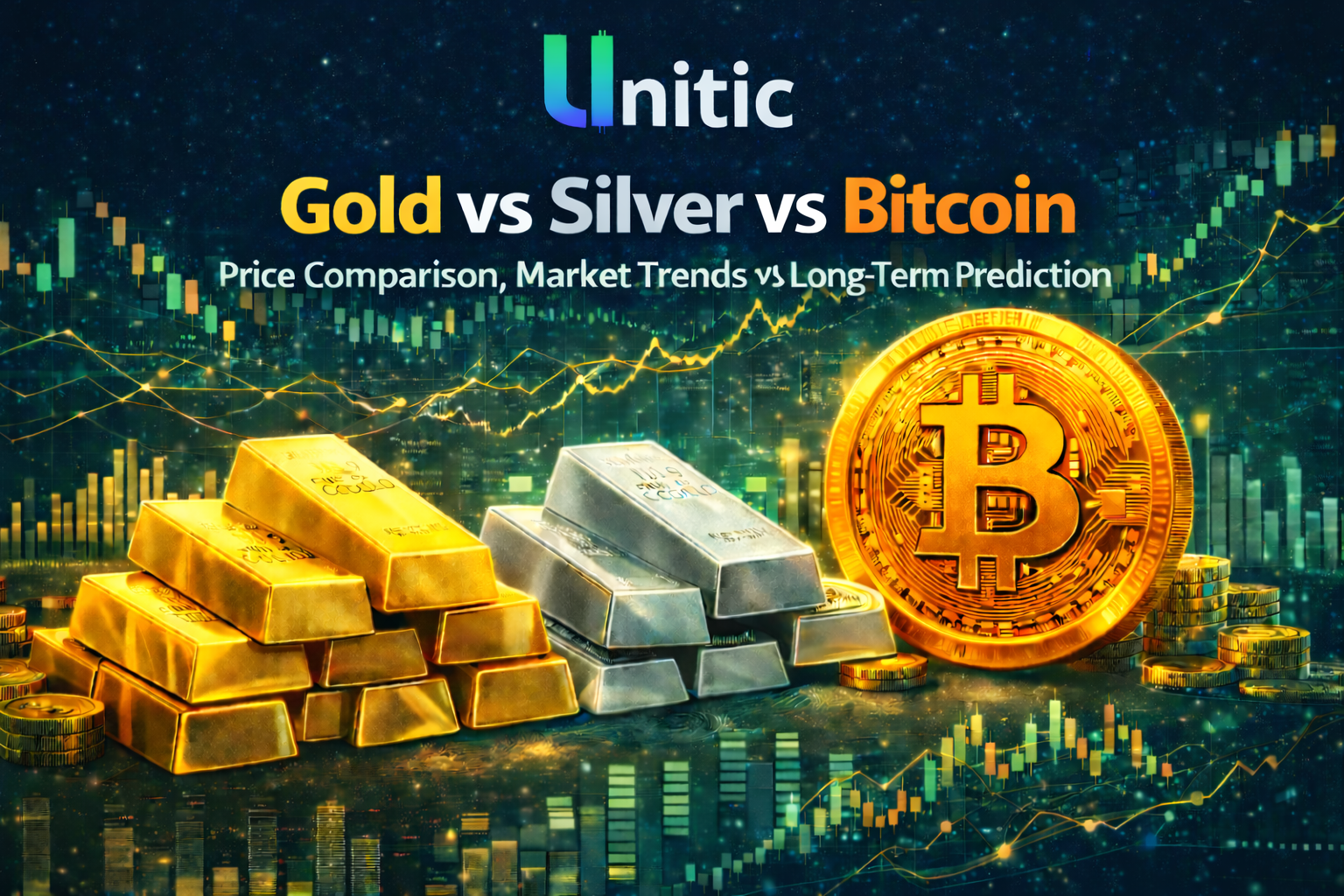
Gold vs Silver vs Bitcoin: Price Comparison, Market Trends & Long-Term Prediction
The Modern Investor’s Dilemma
If you’ve ever watched financial news during an economic crisis, you’ve probably heard analysts say things like:
- “Gold is rising due to inflation fears.”
- “Silver demand is increasing from the renewable energy sector.”
- “Bitcoin is surging as institutional investors enter the market.”
But what does this actually mean for you as an investor?
The debate around Gold vs Silver vs Bitcoin has become more relevant than ever. Traditional investors trust gold and silver as time-tested safe-haven assets. Meanwhile, younger and tech-savvy investors see Bitcoin as the future of money — often calling it digital gold.
So which one truly protects wealth?
Which one grows faster?
Which one is safer in the long run?
In this detailed guide, we will break down:
- Historical price performance
- Why these markets go up and down
- Risk comparison
- Economic impact factors
- 2026–2035 long-term outlook
- Which asset suits different types of investors
Let’s explore each asset deeply.
1. Gold – The King of Stability
Gold has been used as money for more than 5,000 years. Civilizations collapsed, empires fell, currencies changed — but gold retained value.
Why Gold Holds Value
Gold has several qualities that make it a powerful store of wealth:
- Limited natural supply
- Cannot be printed like fiat currency
- Accepted worldwide
- Held by central banks as reserve asset
When inflation rises or geopolitical tensions increase, investors rush toward gold. This demand increases its price.
When Gold Performs Best
Gold typically rises during:
- Economic recessions
- High inflation periods
- Banking crises
- War or geopolitical uncertainty
- Currency devaluation
However, gold rarely produces explosive growth. It grows steadily over long periods. Gold is not about getting rich quickly. It’s about preserving wealth.
2. Silver – The Underrated Hybrid Asset
Silver is often called “poor man’s gold,” but that description is outdated.
Silver plays two major roles:
- Precious metal investment
- Industrial raw material
Unlike gold, silver is heavily used in:
- Solar panels
- Electric vehicles
- Electronics
- Medical devices
- 5G infrastructure
This industrial demand makes silver more sensitive to economic cycles.
Why Silver Is More Volatile
Because silver depends on both investors and industries:
- During economic growth → Silver demand rises
- During recession → Industrial demand drops
This makes silver price movements sharper than gold.
Silver can outperform gold in strong bull markets — but it can also fall faster during downturns.
3. Bitcoin – The Digital Disruptor
Bitcoin was created in 2009 after the global financial crisis. It introduced a new idea: money without banks.
Unlike gold and silver, Bitcoin:
- Exists only digitally
- Has fixed supply (21 million coins)
- Is decentralized
- Operates on blockchain technology
Because of its limited supply, Bitcoin is often compared to gold.
Why Bitcoin Is So Volatile
Bitcoin’s volatility comes from:
- Speculation
- Regulatory uncertainty
- Market sentiment
- Institutional adoption cycles
- Halving events every 4 years
In bull markets, Bitcoin can grow 3x–5x within a year.
In bear markets, it can drop 50–70%.
Bitcoin is a high-risk, high-reward asset.
Historical Price Comparison
Let’s analyze performance trends.
Gold Performance
Over the last decade, gold has delivered steady returns. Major spikes occurred during:
- 2020 pandemic
- Inflation surge periods
- Global uncertainty
Gold does not move dramatically daily. Its strength lies in stability.
Silver Performance
Silver tends to mirror gold but with stronger moves.
For example:
- When gold rises 10%, silver may rise 20%.
- When gold falls 5%, silver may fall 10%.
Silver amplifies gold’s movement.
Bitcoin Performance
Bitcoin has been the best-performing asset of the past decade in percentage terms.
However:
- It experienced multiple 60%+ crashes.
- It goes through 4-year boom and bust cycles.
Its growth is extraordinary — but emotionally challenging.
Why Do Prices Go Up and Down?
Understanding price drivers is crucial.
1. Inflation
When inflation rises:
- Gold usually increases (classic hedge).
- Silver often follows.
- Bitcoin sometimes rises if seen as digital inflation hedge.
When inflation cools:
- Precious metals may slow down.
2. Interest Rates
Higher interest rates reduce demand for gold because gold doesn’t pay interest.
Bitcoin may also fall in high-rate environments because investors move to safer yield assets.
3. Economic Uncertainty
During crises:
- Gold rises strongly.
- Silver rises moderately.
- Bitcoin’s reaction varies.
Bitcoin sometimes behaves like a risk asset similar to tech stocks.
4. Supply & Scarcity
Gold:
- Mining production affects supply.
Silver:
- Industrial demand impacts price heavily.
Bitcoin:
- Halving reduces new supply every 4 years.
- Scarcity drives long-term bullish cycles.
5. Institutional Adoption
Large institutions entering the market often:
- Stabilize prices
- Increase long-term trust
- Drive massive capital inflows
Bitcoin ETFs, gold ETFs, and commodity funds all impact prices significantly.
Risk & Volatility Comparison
|
Factor |
Gold |
Silver |
Bitcoin |
|
Price Stability |
High |
Medium |
Low |
|
Volatility |
Low |
Medium |
Very High |
|
Inflation Protection |
Strong |
Moderate |
Emerging |
|
Liquidity |
Very High |
High |
Very High |
|
Regulation Risk |
Low |
Low |
High |
|
Long-Term Growth |
Moderate |
High |
Very High |
Long-Term Prediction (2026–2035)
Predictions are based on trends, not guarantees.
Gold Long-Term Outlook
Gold will likely:
- Continue steady appreciation
- Remain central bank reserve asset
- Protect against currency debasement
Gold is unlikely to collapse but also unlikely to multiply quickly.
Best for wealth preservation.
Silver Long-Term Outlook
Silver could benefit from:
- Renewable energy growth
- Electric vehicle production
- Green infrastructure expansion
If industrial demand increases strongly, silver may outperform gold.
Bitcoin Long-Term Outlook
Bitcoin’s future depends on:
- Global adoption
- Regulatory clarity
- Institutional investment
- Technological stability
If adoption continues expanding, Bitcoin could see significant long-term appreciation.
However, volatility will remain high.
Which Asset Should You Choose?
Choosing between gold, silver, and Bitcoin ultimately depends on your risk tolerance, financial goals, and investment mindset. If you are a conservative investor who prioritizes capital protection and long-term stability, gold may be the most suitable option, as it has historically preserved wealth during economic downturns and periods of inflation.
For moderate-risk investors who seek a balance between stability and growth, a combination of gold and silver can provide diversification, with silver offering higher upside potential due to its industrial demand. On the other hand, aggressive growth investors who are comfortable with market volatility may consider allocating a portion of their portfolio to Bitcoin, keeping in mind the importance of proper risk management.
A smart portfolio strategy often involves diversification—for example, allocating 40% to gold for stability, 20% to silver for balanced growth, and 40% to Bitcoin for high-growth potential (this is only an example and not financial advice). Diversification helps reduce overall risk while still allowing investors to benefit from potential upside opportunities across different market conditions.
Conservative Investor
Gold is ideal for investors who prioritize safety and long-term wealth preservation. It tends to perform well during economic uncertainty and high inflation. Its lower volatility makes it suitable for stable, steady portfolio growth.
Moderate Risk Investor
Combining gold and silver offers a balance between stability and growth potential. Gold provides security, while silver adds higher return opportunities. This mix helps manage risk while benefiting from industrial and investment demand.
Aggressive Growth Investor
Bitcoin suits investors comfortable with high volatility and market swings. It offers strong long-term growth potential driven by adoption and scarcity. However, proper risk management is essential due to sharp price fluctuations.
Smart Portfolio Strategy
A diversified allocation like 40% gold, 20% silver, and 40% Bitcoin balances risk and reward. Gold stabilizes, silver enhances growth, and Bitcoin adds high-return potential. Diversification helps reduce overall portfolio risk while capturing upside opportunities.
Final Thoughts: The Real Winner Is Strategy
The debate of Gold vs Silver vs Bitcoin isn’t about declaring a single winner.
Each asset serves a purpose:
- Gold = Stability
- Silver = Industrial-driven growth
- Bitcoin = High-growth digital innovation
Smart investing is not emotional.
It’s strategic.
Markets will go up and down.
Inflation will rise and fall.
But diversified long-term investors usually win.
FAQs
Whether gold and silver are better than crypto depends on your risk tolerance and financial goals. Gold and silver are traditional assets known for stability and wealth preservation, especially during inflation or economic uncertainty. Cryptocurrencies, on the other hand, offer higher growth potential but come with significant volatility and risk. Investors seeking safety may prefer metals, while those comfortable with risk may consider crypto. Many people choose a diversified approach that includes both.
Gold is generally considered a stronger long-term investment because it has consistently preserved value over centuries and is less volatile than silver. Silver, while also a precious metal, is more influenced by industrial demand and tends to experience larger price swings. For conservative long-term investors, gold is usually the preferred choice, while silver may suit those looking for slightly higher growth with more fluctuation.
Both gold and silver have the potential to increase in value, but their performance depends on economic conditions. Gold typically rises during inflation, geopolitical tensions, and financial crises. Silver can grow faster during economic expansion due to its industrial use in sectors like electronics and renewable energy. While silver may deliver higher percentage gains, gold tends to provide more consistent and stable growth.
Gold is significantly less volatile than Bitcoin. Its price movements are usually steady and influenced by macroeconomic factors like inflation, interest rates, and global uncertainty. Bitcoin, however, can experience sharp price swings within short periods, sometimes moving several percentage points in a single day. This makes Bitcoin more attractive for high-risk investors, while gold suits those seeking stability.
People compare Bitcoin to gold because both are considered stores of value and hedges against inflation. Bitcoin has a limited supply similar to gold’s scarcity, and it operates independently of central banks, which appeals to investors seeking alternatives to traditional financial systems. Due to these similarities, Bitcoin is often referred to as “digital gold,” although it remains more volatile and less established than physical gold.





Your Crypto Gateway


Unitic Exchange
All rights reserved 2026