AI Agents and Crypto: How Autonomous AI Could Transform Blockchain
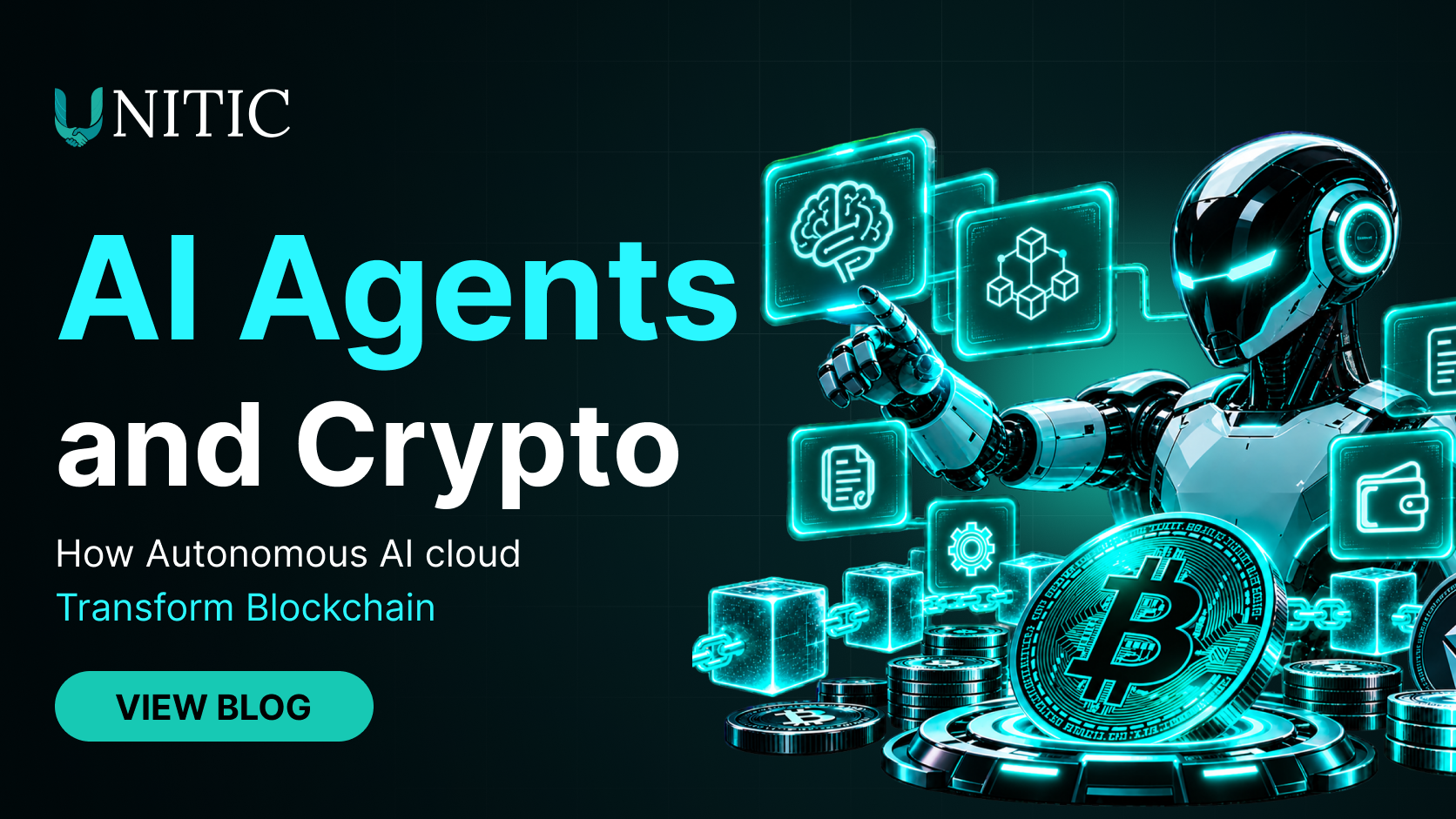
A few years ago, "AI in crypto" mostly meant a chatbot answering support tickets or a price-prediction model running quietly in the background. That has changed. In 2026, the conversation has shifted toward something more ambitious: software that does not just analyse markets, but acts in them, independently, around the clock, with its own wallet and its own decisions.
These are AI agents, and their arrival in crypto is not a small feature update. It is a structural shift in who, or what, actually uses a blockchain. This guide explains what AI agents are, why crypto is such a natural fit for them, where the technology stands today, the real risks involved, and how traders can position themselves for this shift using tools already available on Unitic Exchange.
What Is an AI Agent, Really?
An AI agent is a piece of software that can observe information, form a judgement, and take an action, with little or no human approval needed at each step. That is a meaningful upgrade from a traditional trading bot.
A classic trading bot follows a fixed, pre-written rule: "if the price crosses this moving average, buy." It cannot reason about why the market is moving, and it does not adapt unless a human rewrites its code. An AI agent, by contrast, combines a language model for strategy-level reasoning with machine-learning components for fast signal classification, and deterministic rules for hard risk limits. In practice, this means an agent can read market context, weigh several signals at once, and decide on an action, rather than mechanically executing one hard-coded instruction.
What started with simple rule-based bots has evolved into something more capable: autonomous AI agents that can reason, adapt, execute complex strategies, and manage portfolios directly on the blockchain with minimal human oversight. That shift, from "if this, then that" logic to genuine judgement, is the core of what people mean when they say "AI agents" in 2026.
How an AI Agent Holds and Spends Crypto
For an AI agent to actually trade or transact, it needs a way to hold funds and sign transactions without a human typing in a password every time. In 2026, this typically happens through non-custodial smart contract wallets paired with trusted execution environments (TEEs), secure, isolated computing environments that let an agent sign transactions under pre-set rules without exposing its private keys, even to its own operator.
This matters because it answers the obvious question: if an AI makes a mistake, who is holding the bag? With a non-custodial wallet, the human who deployed the agent technically still owns the funds, the agent operates within permissions it has been granted, not with unlimited control. Coinbase has shipped programmatically controlled agentic wallets specifically so that developers can give an AI agent this kind of bounded, on-chain authority. Frameworks like Coinbase's AgentKit exist on the premise that, as one of their taglines puts it, "every AI agent deserves a wallet."
Why Crypto Is the Natural Home for AI Agents
It is not an accident that AI agents are showing up in crypto first, ahead of traditional finance. A handful of structural features make blockchains unusually well-suited to autonomous software.
1. Markets Never Close
Traditional stock exchanges open and close on a schedule. Crypto markets run 24 hours a day, seven days a week. A human trader has to sleep; an agent does not. That makes round-the-clock crypto markets close to an ideal environment for a system built to watch and react continuously, rather than during fixed trading hours.
2. Everything Is Programmable
A blockchain is, at its core, a set of programmable rules. Smart contracts already encode "if this condition is met, execute this action" logic without any humans in the loop. An AI agent sits naturally on top of that infrastructure: the blockchain already speaks the language of autonomous execution, and the agent simply decides when and how to use it.
3. Transparent, Machine-Readable Data
Public blockchains publish every transaction. That gives an AI agent a rich, structured, real-time dataset to learn from, wallet flows, liquidity shifts, protocol activity, without needing special access or licensing agreements. Traditional financial markets, by comparison, are far more opaque and gated.
4. Native Programmatic Money
Crypto assets can be sent, received and programmed directly through code. An AI agent does not need a human to approve a bank wire or call a broker. It can hold a wallet, sign a transaction, and settle a trade in seconds, which is exactly the kind of low-friction, native digital money movement that autonomous systems need to function well.
5. Infrastructure Built Specifically for Agents, Not Just Humans
This is a newer development, but an important one. Exchanges and chains have started building tools explicitly for machine consumption rather than human interfaces. Kraken, for example, released an open-source, Rust-based CLI with built-in support for the Model Context Protocol (MCP) and a paper-trading mode, designed from the ground up for AI systems to use rather than people clicking through a dashboard. This signals that infrastructure providers now see AI agents, not just retail traders, as a primary user base to design for.
What AI Agents Are Actually Doing in Crypto Today
The idea of an "autonomous trading agent" can sound abstract, so it helps to break down the concrete tasks these systems are being used for right now.
Autonomous Trading and Execution
This is the most visible use case. An agent monitors price action, order-book depth, and broader market signals, then opens, manages and closes positions without a human clicking "buy." Production-grade trading agents typically combine three layers: machine learning for fast, low-latency signal classification, a large language model for higher-level strategy decisions, and a set of deterministic, hard-coded rules that cap risk regardless of what the AI "wants" to do. That last layer matters enormously, and it is one of the clearest lessons the industry has already learned: never let the AI's judgement override a fixed risk ceiling.
Portfolio Rebalancing
Rather than making a single trade, some agents are tasked with managing an entire portfolio continuously: shifting allocation between volatile crypto assets and more stable instruments, such as tokenized treasuries, based on a pre-set risk tolerance. This turns portfolio management from a periodic, manual check-in into an ongoing, automated process.
Market Research and On-Chain Intelligence
Not every agent trades. Many are built purely for research: scanning wallet activity, labelling entities, tracking large transfers, and surfacing patterns a human analyst would take hours to find manually. Arkham Intelligence, for example, has built out tooling that has identified and labelled hundreds of thousands of distinct on-chain entities, including institutional holdings and major DeFi participants, giving traders and researchers a head start on understanding who is actually moving the market.
Arbitrage and Cross-Chain Execution
Agents are well-suited to spotting and acting on small, fleeting price differences between exchanges or chains, trades that require speed and constant monitoring that a human simply cannot sustain. Projects building AI-enhanced trading infrastructure are increasingly focused on this kind of algorithmic execution and cross-chain arbitrage.
Governance and DAO Operations
Beyond trading, some projects are experimenting with AI agents that participate in decentralized governance, helping manage treasuries, evaluate proposals, or even execute approved governance decisions automatically. This is earlier-stage than trading applications, but it points toward a future where AI handles more of the operational load inside decentralized organizations, not just the financial decisions.
The "Agentic Economy": A New Kind of Blockchain User
One of the more striking shifts in 2026 is conceptual rather than technical: AI agents are increasingly described as a new category of blockchain user in their own right, alongside retail traders, institutions and protocols. Instead of DeFi being something humans operate manually, the direction of travel is toward intent-based, automated execution, where a human (or another system) states a goal, and an agent works out how to achieve it on-chain.
This "agentic economy" framing matters because it changes how infrastructure gets built. Instead of designing purely for human clicks and human attention spans, developers are increasingly designing for agent-to-agent interaction: multiple autonomous systems coordinating, negotiating, and transacting with each other with no human directly in the loop at all. Multi-agent trading systems, where several specialized agents handle different parts of a strategy, are already described as a developing trend among more sophisticated, professional trading operations.
The Risks: AI Agents Will Not Fix Everything
It would be easy to write only the optimistic version of this story. But autonomous agents introduce genuinely new risks, not just a faster version of old ones.
Irreversible Mistakes
In most software, a bug produces an error message. In crypto, a bug can produce an irreversible transaction. Blockchain transactions cannot be undone once confirmed, and in crypto, one bad click can be final. An AI agent that misreads a signal, or hits an edge case its developers did not anticipate, can execute a transaction before a human has any chance to intervene. This single property, irreversibility, is why the "deterministic hard risk limit" layer mentioned earlier is not optional in any serious agent design.
Security and Exploitation
Giving an AI agent a wallet and the ability to deploy smart contracts creates new attack surfaces. Research into this area has flagged that broadening AI agents' access to cryptocurrency and smart contracts creates genuinely new categories of potential harm, not just a bigger version of existing fraud risks. A compromised or manipulated agent is not just a bad trade; it can be a direct route to drained funds.
Adversarial Manipulation
As more capital flows through automated agents watching the same on-chain signals, sophisticated players have started deliberately feeding those signals misleading information. Larger trading operations are reportedly deploying what has been described as "adversarial noise," deliberately engineered on-chain activity designed to mislead agents that are mechanically watching wallet flows, essentially gaming the very transparency that makes crypto attractive to AI in the first place.
Cascading Failures
Smart contracts already execute automatically once a predefined condition triggers. Add autonomous agents into that mix, and a single bad decision by one agent can trigger a chain reaction, incorrect decisions, security exposure, or protocol-level failures cascading outward before anyone has a chance to pause the system.
Over-Reliance and Reduced Oversight
Perhaps the most understated risk is cultural, not technical: as agents get better, the temptation to stop watching them grows. The entire value proposition of an autonomous agent is that it does not need constant supervision, but that is also exactly what makes a slow-building problem (a drifting strategy, a subtly miscalibrated risk model) easy to miss until it is expensive.
None of this means AI agents are too dangerous to use. It means the people deploying them need to keep meaningful human oversight, hard-coded risk limits, and a clear-eyed view of what can go wrong, not just what can go right.
What This Means for Everyday Crypto Traders
Most readers of this guide are not building AI trading agents from scratch, and that is fine. The more practical question is: how does this shift affect how you trade?
Markets will likely get faster and more efficient. As more capital is managed by agents that react in milliseconds, price discovery and liquidity depth become increasingly shaped by automated systems rather than manual order placement. That can mean tighter spreads, but it can also mean sharper, faster moves when sentiment shifts.
Signal-based and research tools become more valuable, not less. As the market becomes more automated, understanding the signals that drive it, rather than guessing at price action, becomes a bigger edge. This is exactly why structured market intelligence and trading signals matter more in an agent-driven market, not less.
Discipline matters more, not less. One of the stated advantages of agents is that they do not revenge trade, they do not panic sell, and they stick to a pre-set strategy without emotional override. A human trader does not need to build an AI agent to borrow that discipline: following structured signals, defined entry and exit levels, and a consistent risk framework captures much of the same benefit.
Security habits need to tighten. As wallet-connected automation becomes more common, the basics, unique passwords, two-factor authentication, never sharing a seed phrase, verifying contract permissions before approving them, matter more than ever.
How Unitic Exchange Fits Into This Shift
You do not need to build or operate an AI agent yourself to benefit from the direction the market is heading. Unitic Exchange already offers the core building blocks that make it easier to trade with discipline and structure in an increasingly automated market.
Trade on Structured Signals, Not Guesswork
Unitic Exchange's Signals feature gives traders access to structured market intelligence, the same kind of signal-driven approach that underpins how AI trading agents actually make decisions, without requiring you to write a single line of code. Instead of reacting emotionally to a chart, you can follow defined setups with clear logic behind them.
Access Futures Markets With Real-Time Execution
For traders who want to act on fast-moving market conditions the way an autonomous system would, Unitic Exchange's Futures trading platform offers real-time execution on major pairs like BTC/USDT, with the speed and depth that active, signal-driven strategies require.
One Platform, Multiple Products
Unitic Exchange is built as a complete crypto trading platform, combining spot trading, futures, and INR on-ramps in one place. That matters in an AI-shaped market: the fewer manual steps between a decision and an executed trade, the closer your own workflow gets to the speed and consistency that automated systems already operate at.
Monitor the Full Market
The Markets page gives you a real-time view across crypto pairs, the same kind of broad market visibility that an AI agent relies on to form a view before acting. Reviewing it regularly helps you build the habit of watching the whole board, not just your favourite coin.
Move Large Volumes Without Moving the Market
As automated systems increasingly watch and react to public order-book activity, executing a large trade in the open market can itself become a signal other systems react to. Unitic Exchange's OTC Desk lets high-volume traders negotiate large transactions privately, avoiding slippage and keeping bulk trades from telegraphing intent to the rest of the market, human or algorithmic.
Together, these tools do not turn you into an AI agent, but they give you the same underlying advantages those agents are built around: structured decision-making, fast execution, broad market visibility, and the ability to transact at scale without unnecessary friction.
What to Watch Next
A few developments are worth keeping an eye on as this space matures:
- Regulatory clarity on agent-held funds. As more capital sits in wallets controlled by software rather than people, regulators will have to clarify how existing KYC and custody rules apply to non-human account holders.
- Standardized agent-to-exchange protocols. Tools like Kraken's AI-native CLI suggest exchanges are starting to build dedicated interfaces for machine consumption, not just human dashboards. Expect more of this across the industry.
- Better risk-limiting standards. As failures inevitably happen, expect industry-wide best practices to emerge around hard-coded risk ceilings, kill switches, and mandatory human checkpoints for high-value actions.
- Agent-vs-agent dynamics. As more market participants are themselves AI systems, expect more research into how agents detect manipulation from other agents, and how markets behave when most of the "traders" are software.
Final Thoughts
AI agents are not a distant, speculative idea in crypto anymore. They already hold wallets, execute trades, manage portfolios, and participate in governance, and the infrastructure supporting them, from agentic wallets to AI-native exchange interfaces, is being built out specifically to support this shift. That brings real opportunity: faster markets, more efficient price discovery, and tools that remove emotion from trading decisions. It also brings real risk: irreversible mistakes, new attack surfaces, and the temptation to stop paying attention once something appears to be running on autopilot.
For most traders, the practical takeaway is not "build an AI agent." It is borrowing the discipline AI agents are built around, structured signals, defined risk limits, and consistent execution, using tools that are already available today. Unitic Exchange brings signals, futures, spot markets and an OTC desk together in one platform, giving you a way to trade with the same structure and discipline that is shaping the next era of crypto, without needing to write a single line of code.
Disclaimer: This article is for educational and informational purposes only and does not constitute financial advice. Cryptocurrency trading, including through AI-driven or automated systems, involves significant risk. Always do your own research and consider your own risk tolerance before trading.
FAQs
A traditional trading bot follows fixed, pre-programmed rules and does not adapt its own logic. An AI agent combines reasoning (often via a language model) with machine-learning signal detection and hard-coded risk limits, allowing it to interpret context and make judgement calls within defined boundaries, rather than mechanically executing one fixed instruction.
If an AI agent is given unrestricted access to a wallet with no risk limits, yes, a flawed decision or a bug can result in significant losses, and blockchain transactions cannot be reversed. This is why responsible agent design includes deterministic, hard-coded risk ceilings that the AI's judgement cannot override, and why human oversight remains important even with autonomous systems.
No. Most retail traders are not running autonomous agents themselves. You can capture many of the same benefits, discipline, structured decision-making, and fast execution, by using signal-based tools and a defined trading plan, which is exactly what platforms like Unitic Exchange's Signals feature are designed to support.
It depends entirely on how the access is structured. Non-custodial wallets combined with trusted execution environments are designed so an agent can transact within pre-set permissions without exposing private keys or granting unlimited control. Always understand exactly what permissions you are granting before connecting any wallet to an automated system.
Crypto markets run 24/7, publish transparent on-chain data, and are built on programmable smart contracts that already support "if this, then that" execution logic. Combined with native digital money that can move without a human approving a bank transfer, this makes blockchains a far more natural environment for autonomous software than traditional, gated financial markets.
It refers to a developing model where AI agents, not just humans, are treated as primary users of blockchain infrastructure: stating a goal (an "intent") and having an agent work out how to execute it on-chain automatically, rather than every transaction requiring a manual, step-by-step human decision.

Your Crypto Gateway


Unitic Exchange
All rights reserved 2026