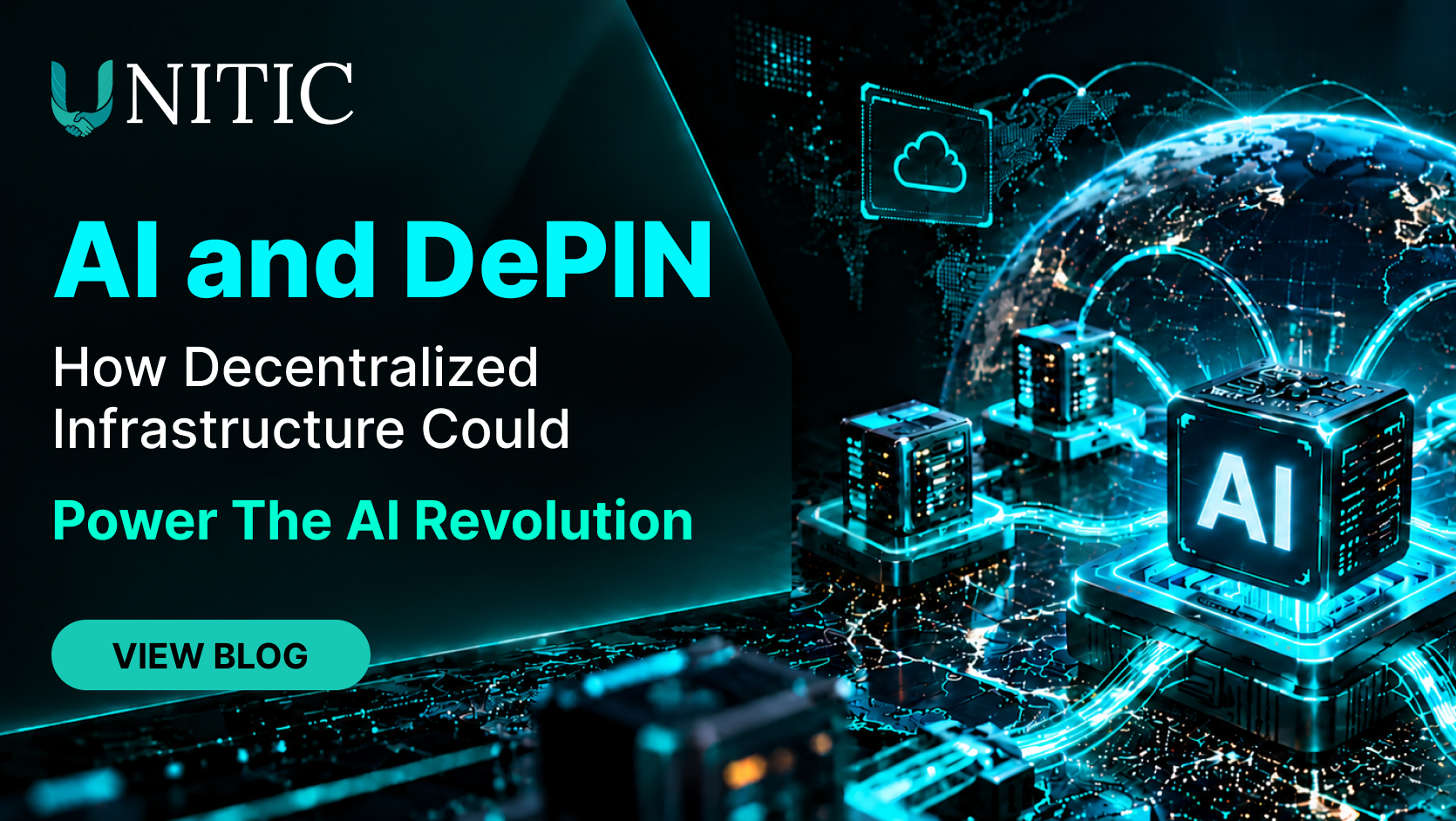
AI and DePIN: How Decentralized Infrastructure Could Power the AI Revolution
Introduction: AI Needs More Than Intelligent Models
Artificial intelligence is developing at remarkable speed, but the AI revolution is not powered by algorithms alone. Behind every advanced AI model is a massive infrastructure layer involving computing power, GPUs, data storage, networking, energy, connectivity, and physical hardware. As AI models become larger and AI applications become more demanding, the question is no longer simply how intelligent machines can become. The bigger question is whether the world's infrastructure can scale quickly enough to support them.
This is where the combination of AI and DePIN becomes increasingly interesting.
DePIN, short for Decentralized Physical Infrastructure Networks, describes blockchain-based networks that coordinate real-world infrastructure through distributed participants and token-based incentives. Instead of depending entirely on a centralized company to own and operate infrastructure, DePIN models can allow individuals and businesses to contribute resources such as computing power, storage, wireless connectivity, energy, sensors, or other physical assets and receive incentives for providing those resources. Coinbase Institute describes DePIN as a model that uses blockchain, smart contracts, and token incentives to coordinate contributions to physical infrastructure such as computing, storage, wireless networks, and energy.
The potential connection with artificial intelligence is straightforward. AI needs enormous amounts of computing and data infrastructure. DePIN can potentially create decentralized marketplaces where unused or underutilized resources are made available to AI developers.
That does not mean DePIN will automatically replace traditional cloud providers. Centralized infrastructure still offers important advantages in performance, reliability, developer tooling, and predictable service levels. But decentralized infrastructure could become another layer of the AI economy, increasing the available supply of resources and creating new ways to coordinate them.
The result could be a future in which AI does not depend exclusively on a handful of massive infrastructure providers.
Instead, millions of computers, GPUs, storage devices, sensors, connectivity nodes, and energy resources could potentially become part of an open, incentive-driven infrastructure network.
What Is DePIN?
At its simplest, DePIN connects physical infrastructure with blockchain-based coordination.
Traditional infrastructure usually follows a centralized model. A company purchases hardware, builds facilities, operates the infrastructure, charges customers, and controls access. Cloud computing is a familiar example. A centralized provider operates data centers containing servers and GPUs, while customers rent computing resources according to their requirements.
DePIN introduces a different approach.
Instead of one organization owning all of the infrastructure, a network can coordinate resources supplied by many independent participants. Blockchain technology can help track contributions, verify activity, distribute rewards, and coordinate payments.
For example, imagine thousands of people have unused computing capacity. A DePIN network could potentially allow them to contribute that capacity to a decentralized marketplace. Developers needing computing power could access available resources, while providers receive compensation.
The same principle can apply to storage, wireless connectivity, mapping, energy, and other forms of infrastructure.
The important idea is not simply decentralization for its own sake. DePIN attempts to create an economic mechanism that encourages people to contribute real-world resources to a shared network.
Why AI Needs Decentralized Infrastructure
The rapid growth of AI has created an enormous demand for computing resources.
Training advanced models can require substantial GPU capacity. Inference, which refers to running trained models to generate outputs, also requires computing resources. As AI applications become embedded into search, productivity software, robotics, healthcare, finance, gaming, customer service, and industrial systems, the demand for computation can continue expanding.
This creates several challenges.
High-performance GPUs can be expensive. Access to advanced hardware can be constrained. Cloud computing costs can become significant at scale. Developers can also face dependence on a limited number of infrastructure providers.
Decentralized compute networks attempt to address part of this problem by aggregating distributed hardware.
Coinbase's analysis of the crypto-AI ecosystem identifies decentralized compute as one of the major layers connecting blockchain infrastructure with artificial intelligence. It notes that decentralized compute networks can create marketplaces for buying, renting, and hosting GPUs, aggregate excess computing capacity, and potentially make AI compute more accessible.
This is one of the strongest reasons AI and DePIN are being discussed together.
AI creates demand for computation.
DePIN creates a potential mechanism for coordinating distributed computation.
GPUs Could Become a Decentralized Resource
Graphics processing units have become one of the most important pieces of AI infrastructure.
Although GPUs were originally developed primarily for graphics processing, their ability to perform large numbers of parallel calculations makes them highly valuable for machine learning workloads.
The problem is that high-performance GPUs can be expensive and difficult to obtain at scale.
At the same time, there is a large amount of computing capacity distributed across the world that may not be used continuously.
Gaming computers, workstations, data centers, servers, and other systems can have periods of unused capacity.
DePIN networks can potentially turn this idle capacity into a market.
A participant could contribute computing power to a decentralized network. AI developers could then rent that capacity for workloads supported by the network. Smart contracts and network infrastructure could coordinate payments and incentives.
This creates an alternative economic model for computing.
Instead of hardware sitting unused, it can potentially become a productive resource.
AI Training and DePIN
AI training is one of the most resource-intensive stages of the machine-learning lifecycle.
Training a model involves processing enormous datasets through computationally intensive algorithms. The exact infrastructure requirements vary dramatically depending on the model, dataset, optimization technique, and workload.
For certain workloads, decentralized compute could potentially supplement traditional infrastructure.
A distributed network could aggregate computing resources from multiple providers. AI developers could submit workloads to the network, and available machines could perform approved computational tasks.
However, training AI models across decentralized infrastructure is technically challenging.
Training workloads can require fast communication between GPUs, consistent performance, high bandwidth, and reliable availability. A collection of geographically distributed machines may not always match the performance characteristics of a tightly integrated data center.
This is an important limitation.
DePIN should not be viewed as a magic solution to every AI infrastructure problem.
Instead, it may be most useful where workloads can be efficiently distributed or where decentralized capacity offers a cost or availability advantage.
AI Inference Could Be an Important DePIN Use Case
Inference may be an especially interesting area for decentralized AI infrastructure.
When a trained model generates a response, processes an image, analyzes data, or performs another task, it is performing inference.
As AI becomes integrated into more applications, inference demand could expand dramatically.
Instead of every AI application relying on a centralized cloud provider, decentralized compute networks could potentially offer alternative inference capacity.
An application might submit a workload to a decentralized network. A suitable compute provider processes the request and returns the result. The network handles resource coordination and compensation.
This could potentially make AI inference more geographically distributed.
It could also create opportunities for hardware owners to monetize unused capacity.
DePIN Is More Than Decentralized Computing
Although computing is one of the most obvious connections between AI and DePIN, the relationship extends much further.
AI needs data.
AI needs storage.
AI needs connectivity.
AI increasingly interacts with physical environments.
AI systems also need sensors, mapping information, and real-world observations.
DePIN networks can potentially provide infrastructure across all of these categories.
Decentralized storage networks can allow participants to provide storage capacity.
Wireless DePIN networks can coordinate connectivity resources.
Mapping networks can collect geospatial data from distributed contributors.
Energy networks can coordinate distributed power resources.
This means DePIN could potentially become a broad infrastructure layer for AI rather than simply a decentralized GPU marketplace.
Decentralized Storage and AI
AI models require enormous amounts of data.
Datasets need to be stored, transferred, processed, and sometimes repeatedly accessed during development.
Centralized cloud storage is extremely powerful, but it also concentrates infrastructure among a relatively small number of providers.
Decentralized storage offers another approach.
Participants can contribute storage capacity to a distributed network. Data can be stored across multiple nodes, while blockchain-based systems can coordinate payments and verify certain aspects of network participation.
For AI developers, decentralized storage could potentially provide another option for storing datasets, model files, training outputs, and other information.
However, performance, reliability, retrieval speed, privacy, and data-management requirements remain important considerations.
AI infrastructure is not simply about having storage.
It is about having the right storage performance for the workload.
AI Needs Data, and DePIN Can Help Collect It
One of the less obvious connections between AI and DePIN involves data collection.
Advanced AI systems need high-quality data to understand the physical world.
Consider mapping applications.
A decentralized mapping network could incentivize participants to collect geospatial information using cameras, vehicles, sensors, or other devices. The resulting information could potentially be used by mapping applications, autonomous systems, robotics companies, and AI developers.
Similar models could apply to environmental sensors, weather data, traffic information, wireless coverage, and industrial monitoring.
The value of this model is that data collection becomes distributed.
Instead of one organization deploying every sensor, thousands of participants can contribute observations.
Token incentives can provide an economic mechanism for encouraging participation.
AI and Decentralized Wireless Networks
AI applications increasingly require connectivity.
Autonomous devices, robots, smart cities, edge computing systems, and Internet of Things applications all depend on networks.
DePIN-based wireless networks attempt to decentralize the deployment of connectivity infrastructure.
Participants can operate network hardware and contribute coverage. Users can consume the service, while the network uses incentives to encourage additional infrastructure deployment.
For AI, this could become increasingly important as intelligent systems move beyond data centers.
An AI model running on a robot, vehicle, drone, or industrial machine needs connectivity to communicate with other systems and access information.
Distributed wireless infrastructure could potentially support this growing ecosystem.
Edge AI and DePIN
Another major opportunity is edge computing.
Traditional AI infrastructure often concentrates computation in centralized data centers. Edge computing moves some computation closer to the user or device.
This can be useful when low latency matters.
For example, an autonomous vehicle may need to process information locally rather than sending every piece of sensor data to a distant data center.
A factory robot may need immediate responses.
A security system may need to analyze video locally.
A wearable device may need real-time AI processing.
DePIN could potentially support distributed edge infrastructure by incentivizing people and businesses to contribute local computing resources.
This could create an AI infrastructure layer that is geographically distributed instead of concentrated in a few massive facilities.
Why Token Incentives Matter
Blockchain is not necessarily the most important part of DePIN.
The economic incentive mechanism may be.
Imagine a network wants to deploy 100,000 physical devices.
A centralized company would need to purchase or lease the hardware, deploy it, maintain it, and recover the costs through customers.
A decentralized network can instead create incentives for independent participants to provide the hardware.
Tokens can potentially reward participants for measurable contributions.
This changes the economics of infrastructure deployment.
Instead of infrastructure being built entirely through centralized capital expenditure, a network can attempt to coordinate thousands of independent investments.
The success of this model depends on whether the rewards are economically sustainable and whether the underlying service creates genuine demand.
Token incentives alone cannot create a useful infrastructure network.
There must be customers who actually want the resource being provided.
The Difference Between DePIN and Traditional Cloud
It is tempting to describe DePIN as a direct replacement for cloud computing.
That is probably too simplistic.
Traditional cloud providers offer highly integrated infrastructure with standardized hardware, predictable performance, professional support, sophisticated networking, security controls, and developer tooling.
DePIN networks can offer different advantages.
They may aggregate unused resources.
They can potentially create permissionless participation.
They can provide alternative infrastructure markets.
They can distribute ownership.
They can introduce token-based incentives.
They may also provide geographic diversity.
The trade-off is that decentralized infrastructure can face challenges around performance consistency, hardware quality, network latency, reliability, security, and service-level guarantees.
Coinbase's analysis of decentralized compute notes that some networks still face limitations involving GPU co-location, developer tooling, uptime guarantees, and support for advanced AI workloads.
The future may therefore involve coexistence rather than replacement.
Centralized cloud infrastructure could handle some workloads.
DePIN networks could handle others.
AI developers could choose between them based on cost, performance, availability, and workload requirements.
AI Could Become the Customer of DePIN
One of the most interesting ways to think about AI and DePIN is to reverse the relationship.
Instead of humans being the primary customers of infrastructure networks, AI systems themselves could become infrastructure consumers.
An AI agent could determine that it needs additional computing power.
It could search decentralized compute marketplaces.
It could compare price and performance.
It could select a provider.
It could submit the workload.
It could pay for the resource using programmable digital assets.
The process could potentially happen automatically.
This connects directly with the broader concept of AI agents participating in digital economies.
AI does not just need infrastructure.
AI agents may eventually be able to purchase infrastructure autonomously.
The Role of Crypto in AI Infrastructure
Crypto provides several technologies that can support DePIN.
Blockchains can record transactions.
Smart contracts can automate agreements.
Tokens can provide incentives.
Digital wallets can hold and transfer funds.
On-chain records can provide transparency.
These components can help coordinate participants who do not necessarily know or trust each other.
For example, a GPU provider may not know the AI developer renting the hardware.
The developer may not know the individual operating the machine.
A decentralized protocol can provide rules for coordinating the interaction.
The blockchain does not need to perform the actual AI computation.
Instead, it can provide the economic and coordination layer around the physical infrastructure.
Where a Crypto Exchange Fits Into the DePIN Economy
If DePIN networks use tokens as incentives, liquidity and digital-asset markets become an important part of the broader ecosystem.
Participants may earn tokens for providing infrastructure.
Those tokens may then be held, transferred, or exchanged depending on the network's design and applicable market infrastructure.
This is where crypto exchanges can potentially become relevant.
A platform such as Unitic Exchange operates within the broader digital-asset market ecosystem, providing infrastructure for cryptocurrency trading and related services.
For users who want to explore cryptocurrency markets, the Unitic Exchange crypto trading platform provides a trading environment for digital assets.
As the AI and DePIN sectors develop, market participants may increasingly monitor infrastructure-related tokens alongside other digital assets. However, availability of any particular token depends on the exchange's supported markets, and users should independently evaluate a project's technology, token economics, liquidity, risks, and regulatory status before trading.
DePIN Tokens and Market Infrastructure
A DePIN token may serve several purposes depending on the network.
It could reward infrastructure providers.
It could be used to purchase services.
It could support governance.
It could potentially be used for staking or network security.
The economic design differs from project to project.
This makes token analysis particularly important.
A token with a strong narrative is not automatically associated with a successful infrastructure network.
Investors and users need to examine whether the network has real infrastructure, real users, sustainable demand, and meaningful economic activity.
A token's price can rise even when the underlying infrastructure is still immature.
The reverse can also happen.
A useful network can exist while its token experiences significant market volatility.
This is why DePIN should be evaluated as both a technology category and an economic system.
AI and DePIN Could Create a New Supply Curve for Compute
One of the most interesting economic possibilities is the creation of additional compute supply.
Suppose millions of GPUs are sitting partially unused.
If decentralized networks can connect those GPUs to AI workloads, the effective supply of available compute could increase.
This could potentially improve resource utilization.
It may also create additional income opportunities for hardware owners.
Instead of purchasing new hardware solely to participate, some providers could monetize existing equipment.
For AI developers, the benefit could be access to a broader pool of computing resources.
However, this depends heavily on whether decentralized networks can deliver sufficient reliability, performance, and economics.
The Importance of Hardware Verification
One major challenge for DePIN is proving that physical resources actually exist and are performing as claimed.
A blockchain cannot physically see a GPU.
It needs external mechanisms to verify infrastructure.
Networks may therefore use software measurements, cryptographic proofs, hardware attestation, monitoring systems, reputation mechanisms, or other verification technologies.
This is sometimes described as the challenge of connecting the physical world with blockchain systems.
If a participant claims to provide a certain amount of computing power but actually provides much less, the network needs a way to detect the discrepancy.
AI workloads make this even more important because developers need predictable performance.
DePIN and AI Quality Control
AI workloads are sensitive to infrastructure quality.
A GPU may technically be available but perform poorly.
A network connection may exist but have high latency.
Storage may be available but provide insufficient throughput.
A decentralized network therefore needs quality measurement.
Participants who consistently provide reliable infrastructure could potentially earn better rewards or reputation.
Poor performers could potentially receive reduced rewards or lose access.
This creates an incentive mechanism around service quality rather than simple hardware ownership.
The most successful DePIN networks may ultimately be those that can measure useful work accurately.
The Environmental Question
AI and DePIN also raise questions about energy consumption.
Large-scale AI computing requires significant electricity.
If decentralized networks encourage more hardware to run continuously, total energy demand could that encourages energy-efficient infrastructure and uses otherwise idle capacity could have a different environmental profile from a network that incentivizes large amounts of newly manufactured increase.
On the other hand, distributed infrastructure could potentially improve utilization of existing hardware.
The environmental impact therefore depends on how the network is designed and what hardware is used.
A DePIN network that encourages energy-efficient infrastructure and uses otherwise idle capacity could have a different environmental profile from a network that incentivizes large amounts of newly manufactured hardware.
AI developers and DePIN protocols will increasingly need to consider energy efficiency, hardware lifecycle, and carbon intensity.
DePIN Could Bring AI Infrastructure Closer to Users
One of the biggest long-term possibilities is geographic decentralization.
Today, much of the world's advanced computing infrastructure is concentrated in large data centers.
DePIN could potentially distribute infrastructure across many locations.
This could be useful for applications requiring local processing or regional data access.
For example, an AI application in a particular city might use nearby edge compute resources rather than sending every request to a distant data center.
A decentralized infrastructure network could potentially make those resources discoverable and economically accessible.
This could help move AI from centralized data centers toward a more distributed computing environment.
AI Could Also Manage DePIN Networks
The relationship works in the opposite direction as well.
DePIN can provide infrastructure for AI, but AI can help operate DePIN networks.
AI systems could potentially monitor thousands of infrastructure nodes.
They could identify abnormal performance.
They could predict hardware failures.
They could optimize workloads.
They could balance demand across providers.
They could estimate resource availability.
They could detect suspicious behavior.
This creates a feedback loop.
DePIN provides distributed infrastructure to AI.
AI provides intelligence to manage distributed infrastructure.
The combination could be more powerful than either technology alone.
AI Agents Could Optimize Decentralized Compute
Imagine an AI agent responsible for managing a decentralized compute budget.
The agent needs 10,000 GPU-hours.
It searches available providers.
One provider offers a low price but high latency.
Another offers higher performance at a higher cost.
A third provider is located closer to the application's users.
The agent could compare these options and allocate workloads accordingly.
If the workload changes, the agent could adjust the allocation.
This is a natural application for autonomous AI because infrastructure management involves constant optimization across many variables.
DePIN and the AI Agent Economy
The rise of AI agents could create a new category of infrastructure demand.
AI agents may need computing resources continuously.
They may need storage.
They may need APIs.
They may need network access.
They may need data.
They may need identity and payment infrastructure.
If these agents become economically active, they could become customers of DePIN networks.
A future AI agent might not care whether a GPU is owned by a cloud company or an individual.
It may simply ask:
"Can this resource satisfy my workload at an acceptable cost and reliability level?"
If the answer is yes, the agent could potentially purchase the resource.
This could create an infrastructure market where software automatically selects among distributed providers.
The Role of Unitic Exchange in the Broader Crypto Economy
For participants following the convergence of AI, DePIN, and digital assets, cryptocurrency exchanges can provide access to the broader market environment in which blockchain-based infrastructure tokens and other digital assets may trade.
Unitic Exchange offers its markets for exploring available digital-asset markets, while its crypto trading platform provides the broader trading environment.
Market participants who follow short-term developments may also use tools such as Unitic Exchange trading signals as one source of market information. Signals should not be treated as guarantees of performance, and users should conduct their own research and apply appropriate risk management.
For derivatives traders, Unitic Exchange provides a BTC Perpetual/USDT futures market. Futures involve leverage and can create substantial losses, so they are fundamentally different from simply holding digital assets.
For institutions or participants dealing with larger transaction sizes, Unitic Exchange also provides an OTC Desk. The exchange's public OTC materials describe services for institutional, treasury, and high-volume participants. Unitic Exchange
These services represent the trading and liquidity side of the crypto ecosystem, while DePIN represents a potential infrastructure layer connecting blockchain incentives with physical resources.
Why DePIN Does Not Guarantee Cheaper AI
The idea of decentralized infrastructure is attractive because it can potentially unlock unused resources.
But cheaper is not guaranteed.
AI workloads have complex requirements.
A centralized provider may offer better hardware utilization, optimized networking, professional maintenance, and economies of scale.
A decentralized network may have lower infrastructure costs in some circumstances but higher coordination costs in others.
The correct comparison is therefore not simply "centralized versus decentralized."
The real question is:
Which infrastructure model delivers the best combination of cost, performance, reliability, flexibility, and accessibility for a specific AI workload?
Different workloads may produce different answers.
Reliability Will Determine DePIN's AI Future
AI developers need infrastructure they can trust.
If an AI application depends on a decentralized compute network and nodes frequently disappear, workloads can fail.
If a storage provider becomes unavailable, data access can be disrupted.
If network performance fluctuates dramatically, real-time AI applications may become impractical.
This means DePIN networks must solve reliability.
Redundancy can help.
Geographic distribution can help.
Reputation systems can help.
Automated failover can help.
Economic penalties for poor service can help.
AI itself can help predict failures and redirect workloads.
The strongest DePIN networks may therefore combine decentralization with sophisticated reliability mechanisms.
Regulation and Compliance Matter
AI and DePIN operate at the intersection of several industries.
There are questions around cryptocurrency regulation, token classification, financial markets, data protection, infrastructure operations, cybersecurity, energy usage, and potentially cross-border services.
A decentralized network does not automatically eliminate regulatory responsibilities.
Participants should understand the laws and regulations applicable to their location and activities.
Crypto markets can be highly volatile and speculative, and digital assets can lose substantial value. Unitic Exchange's published risk disclosures also warn that crypto assets can experience significant volatility, liquidity challenges, cybersecurity risks, and other risks. Unitic Exchange
The technology may be decentralized, but responsible participation still requires risk awareness.
The Biggest Challenge: Real Demand
DePIN narratives can sound extremely compelling.
Decentralized GPUs.
Decentralized storage.
Decentralized wireless.
Decentralized AI.
But the long-term success of a network depends on actual demand.
If people provide infrastructure only because token rewards are attractive, the network may struggle when incentives decline.
A sustainable DePIN economy needs customers who pay for useful services.
That is why AI could be particularly important.
AI is creating real demand for computing, storage, data, networking, and energy.
If DePIN networks can satisfy part of that demand competitively, they may have a genuine economic foundation.
AI and DePIN Could Reinforce Each Other
The most powerful vision is a circular economy.
AI creates demand for infrastructure.
DePIN supplies distributed infrastructure.
Tokens incentivize infrastructure providers.
AI agents consume the infrastructure.
Those agents pay for resources.
Payments reward providers.
More providers join the network.
More infrastructure becomes available.
More AI applications can then use the network.
This creates a potential growth cycle.
The critical requirement is that each stage needs genuine economic value.
If developers do not need the infrastructure, incentives alone may not be enough.
The Future of AI Infrastructure May Be Hybrid
It is unlikely that one infrastructure model will dominate every AI workload.
Large centralized data centers are likely to remain important for enormous training workloads.
Decentralized compute could potentially supplement capacity.
Edge infrastructure could handle latency-sensitive applications.
Local devices could perform lightweight inference.
Decentralized storage could support certain data requirements.
Centralized databases could remain essential for other applications.
The future may therefore be a hybrid AI infrastructure ecosystem.
Developers will choose resources based on their workload.
AI agents may eventually make these choices automatically.
What This Means for Crypto
The AI-DePIN relationship could broaden the utility of blockchain beyond financial speculation.
Tokens can provide incentives.
Smart contracts can coordinate economic relationships.
Wallets can provide programmable payments.
Blockchains can create transparent settlement systems.
DePIN connects those capabilities to physical infrastructure.
That makes the sector particularly interesting because it attempts to link digital assets with real-world economic activity.
Instead of a token representing only an abstract digital economy, a DePIN ecosystem can potentially connect the token to actual computing, storage, connectivity, energy, or data services.
The quality of that connection is what ultimately matters.
Conclusion: DePIN Could Become Part of AI's Physical Foundation
Artificial intelligence is often described as a software revolution.
But AI is also an infrastructure revolution.
Every resources with blockchain-based incentives, decentralized networks can model needs computation.
Every application needs data.
Every service needs storage and networking.
Every physical AI system needs sensors, connectivity, and increasingly edge computing.
The infrastructure required to support AI could become one of the largest technology markets of the coming years.
DePIN offers an alternative way to organize some of that infrastructure.
By combining physical resources with blockchain-based incentives, decentralized networks can potentially transform idle computing capacity, storage, connectivity, mapping resources, and other infrastructure into globally accessible markets.
The opportunity is particularly interesting for AI because AI creates enormous demand for these resources.
Decentralized GPU networks could potentially supplement centralized cloud capacity.
Distributed storage could provide another option for AI data.
Wireless DePIN networks could support connected AI devices.
Mapping and sensor networks could provide data for intelligent systems.
Edge computing networks could bring AI processing closer to users.
AI itself could also help manage these decentralized networks by optimizing workloads, monitoring infrastructure, predicting failures, and allocating resources.
This creates a powerful possibility: AI and DePIN could become mutually reinforcing technologies.
AI drives demand for infrastructure.
DePIN creates new infrastructure supply.
Blockchain provides coordination and incentives.
Crypto markets provide liquidity and financial infrastructure.
Platforms such as Unitic Exchange operate on the digital-asset market side of this broader ecosystem, providing access to trading infrastructure, crypto markets, a crypto trading platform, trading signals, futures markets, and an OTC Desk.
It could become an infrastructure layer connecting physical resources, digital assets, AI applications, and decentralized markets.
The AI revolution may require enormous infrastructure.
The next question is who will build it.
Centralized technology companies will certainly play a major role.
But decentralized networks may also have a place in that future.
And if AI continues to grow at its current pace, the combination of artificial intelligence, decentralized infrastructure, blockchain incentives, and crypto-native markets could become one of the most important technology intersections of the next decade.
The future of AI may not run entirely from a few centralized data centers.
It could increasingly run across a global network of machines, GPUs, storage systems, sensors, wireless devices, and edge computers—all coordinated by software and potentially connected through decentralized economic infrastructure.
That is the larger promise of AI and DePIN: turning distributed physical resources into an intelligent, programmable infrastructure layer for the next generation of computing.





Your Crypto Gateway


Unitic Exchange
All rights reserved 2026