AI Crypto Agents Explained: Can AI Agents Own and Move Digital Assets?
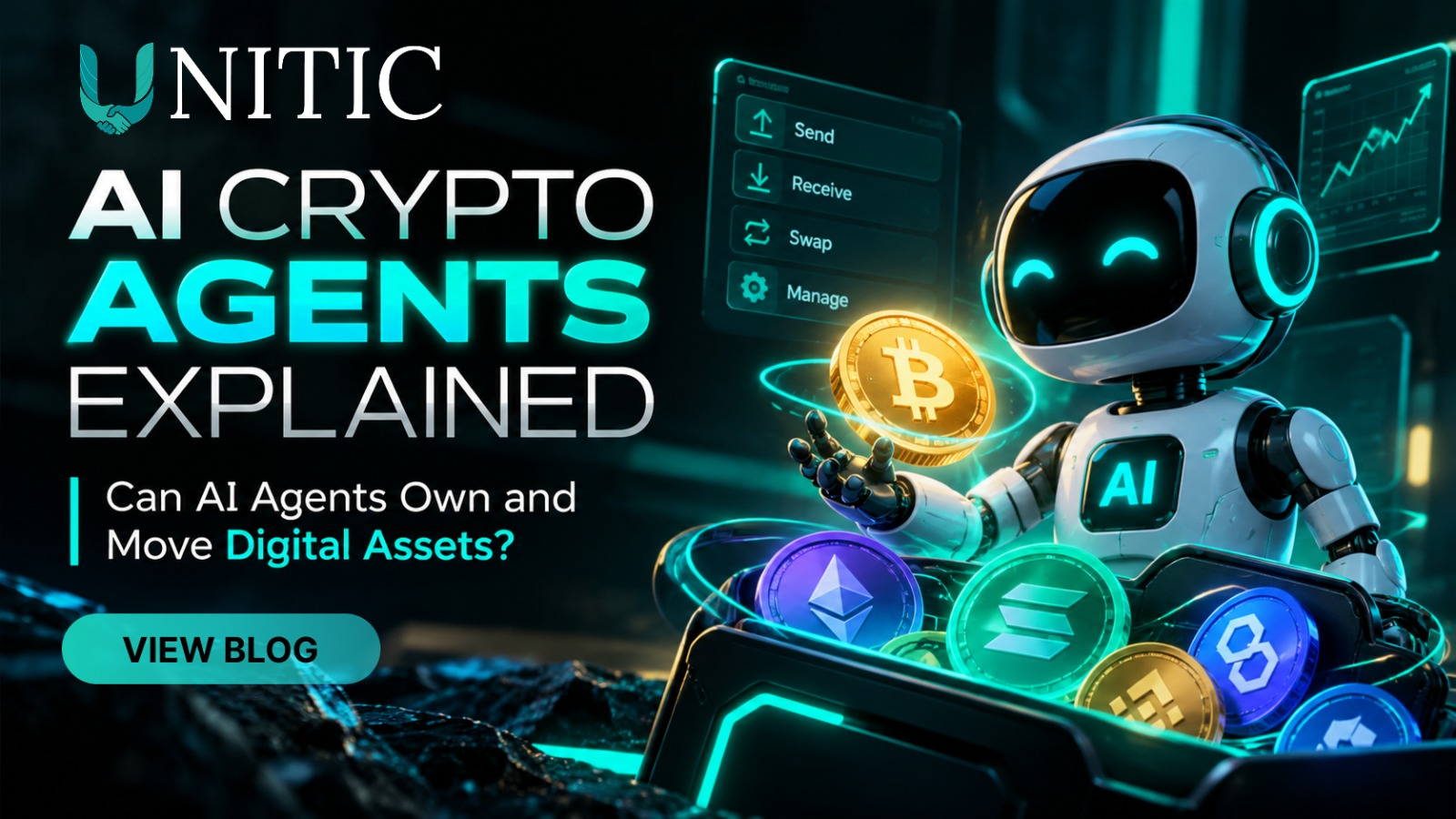
Artificial intelligence has moved far beyond answering questions, generating content, and analyzing information. The newest generation of AI systems is being designed to take action. Instead of simply telling a user what to do, an AI agent can potentially observe its environment, interpret a goal, make decisions, use software tools, and execute tasks. When this capability is connected to cryptocurrency infrastructure, an entirely new possibility emerges: AI systems that can interact with digital assets.
This development has created growing interest in what are commonly called AI crypto agents. An AI crypto agent can be understood as software that combines artificial intelligence with access to crypto-related tools such as market data, wallets, exchange accounts, trading APIs, smart contracts, and blockchain networks. Depending on how it is designed and authorized, such an agent may be able to monitor markets, analyze portfolios, place trades, move tokens, make payments, or perform other digital-asset operations.
But an important question sits at the center of this technology: can an AI agent actually own cryptocurrency? And if it can control a wallet, does that mean the AI owns the assets?
The answer requires a distinction between intelligence, control, authorization, and ownership. An AI model can make a decision, but a blockchain transaction still requires the appropriate cryptographic authorization. A wallet can hold cryptocurrency, but the existence of an AI system controlling that wallet does not automatically make the AI a legal owner. In many real-world implementations, the human, company, institution, or other entity behind the agent would remain responsible for the assets while the AI operates within a defined permission structure.
This distinction is likely to become increasingly important as AI and crypto continue to converge.
What Are AI Crypto Agents?
AI crypto agents are software systems designed to perform crypto-related tasks with a degree of autonomy. A traditional chatbot responds to a user's question. A basic trading bot follows predefined rules. An AI agent can potentially combine reasoning, memory, data access, tool usage, and action execution to pursue a broader objective.
For example, a user might instruct an AI agent to monitor a crypto portfolio and maintain a specific allocation. The agent could check current balances, analyze market prices, determine whether the portfolio has moved outside its target range, calculate a potential rebalance, and then submit a transaction if the required conditions and permissions are satisfied.
This creates a different interaction model from traditional crypto trading. Instead of a human constantly operating a trading interface, the user defines an objective and the AI system helps manage the process.
The basic structure could be described as human intent flowing into an AI agent, the AI agent evaluating information and deciding on an action, a permission layer checking whether the action is allowed, and a wallet, exchange, or blockchain executing the approved operation. The AI therefore becomes an intelligent interface between human goals and digital financial infrastructure.
The important word is "interface." An AI agent does not need to replace the underlying wallet, exchange, or blockchain. Instead, it can potentially become a new way of interacting with those systems.
Can an AI Agent Own Cryptocurrency?
The word "own" creates confusion because blockchain ownership and legal ownership are not necessarily identical concepts.
On a technical level, cryptocurrency is controlled through cryptographic keys and account permissions. If an agent has access to a wallet's signing mechanism, it may be able to initiate transactions from that wallet. From a blockchain perspective, the agent may therefore have operational control over the assets.
However, this does not necessarily mean the AI itself is a legal person or legal owner.
Imagine a company creates an AI treasury-management agent. The company owns a wallet containing digital assets and gives the agent limited authority to rebalance those assets. The AI can initiate transactions, but the company may remain the legal owner and the party responsible for the account.
The same model could apply to an individual investor. A person might create a separate wallet for an AI agent and give that agent permission to manage only a limited amount of capital. The AI could make transactions within predefined boundaries, while the individual remains responsible for the underlying assets.
This distinction could become one of the most important concepts in agentic finance. An AI may have control without ownership, just as an employee can have permission to operate a company's financial system without personally owning the company's money.
How Can an AI Agent Move Digital Assets?
For an AI agent to move crypto, it needs more than an intelligent model. It needs access to financial infrastructure.
The simplest example is a crypto wallet. A wallet can hold digital assets and provide a mechanism for authorizing transactions. If an AI agent is given appropriate access, it could potentially prepare and sign transactions according to the permissions established by the wallet system.
For example, a user could authorize an agent to transfer a small amount of stablecoins to a predefined address every month. The AI could check whether the required conditions are satisfied and initiate the transfer.
A more sophisticated agent could interact with smart contracts. It might swap one token for another, provide liquidity, interact with a decentralized application, or manage a predefined portfolio strategy.
Another possibility is exchange-based execution. Instead of controlling an on-chain wallet directly, the AI could interact with a cryptocurrency exchange through an authorized API. It could potentially retrieve market data, check balances, place orders, manage open positions, and cancel orders, depending on the exchange's available functionality and permissions.
This creates several different architectures for AI crypto agents. The agent could operate an on-chain wallet, control an exchange account through an API, or work with both centralized and decentralized infrastructure.
Why AI Should Not Have Unlimited Wallet Access
The idea of giving an AI unlimited access to a crypto wallet may sound convenient, but it creates enormous risks.
Imagine an AI agent controlling a wallet containing a large amount of cryptocurrency. If the agent makes a wrong decision, interprets an instruction incorrectly, interacts with a malicious smart contract, or becomes compromised, the resulting transaction may be difficult or impossible to reverse.
Blockchain transactions are generally designed to be final. Once assets have been transferred to an incorrect address, there may be no central authority capable of simply reversing the transaction.
This is why secure AI crypto infrastructure should focus on bounded autonomy rather than unlimited autonomy.
An agent might have a spending limit. It could be restricted to specific addresses. It could be prohibited from interacting with unknown contracts. It might be prevented from withdrawing funds. Larger transactions could require human approval. Certain activities could be completely disabled.
The principle is simple: the AI should have enough authority to perform its intended task, but not enough authority to cause unnecessary damage.
AI Agents and Crypto Exchanges
Crypto exchanges could become an important part of the AI-agent ecosystem because they already provide market access, trading infrastructure, account management, and APIs.
Today, a trader typically logs into an exchange, reviews market information, selects a trading pair, chooses an order type, enters the amount, and submits the trade. An AI agent could potentially automate some or all of these steps where supported by the platform.
For example, a trader might define an objective such as maintaining a particular portfolio allocation. The AI agent could monitor the account continuously and identify when the allocation moves outside the user's predefined limits.
The agent could then calculate the necessary trade and submit it through an authorized interface.
The important difference is that the AI does not necessarily need unrestricted control. The user can define rules governing what the agent is allowed to do.
For users exploring cryptocurrency trading infrastructure, the Unitic Exchange crypto trading platform provides a dedicated environment for digital-asset trading. The broader development of AI agents could potentially make platforms such as crypto exchanges increasingly accessible through software-driven interfaces, APIs, and automated workflows.
It is important, however, to distinguish between the potential of agentic trading and currently available exchange functionality. An AI agent should only be given permissions that a particular platform actually supports and that the user deliberately authorizes.
AI Agents and Market Data
An intelligent trading agent is only as useful as the information available to it.
A crypto agent may need access to current prices, market volume, order-book information, volatility, funding rates, open interest, portfolio balances, and other market information. It could also use broader data such as news, blockchain activity, economic indicators, or sentiment.
The agent could combine these inputs to form a view of market conditions.
However, access to information creates another security challenge. Not all information is trustworthy.
If an AI agent reads data from an external source, it must distinguish between information and instructions. A malicious webpage, manipulated data feed, or compromised information source could potentially influence the agent's decision.
This is one reason AI financial systems need strong separation between data and authorization. Market information may influence a decision, but external information should not automatically gain the ability to command a wallet or authorize a transaction.
AI Crypto Agents and Trading Signals
Trading signals are another area where AI agents could become useful.
A traditional trader may receive a signal suggesting that a particular asset is approaching a potential entry or exit point. The trader then evaluates the signal, checks market conditions, considers portfolio exposure, and decides whether to act.
An AI agent could potentially automate part of this workflow.
For example, the agent could receive a signal and then compare it with current market conditions. It could check whether the trade would exceed the user's risk limits, whether the portfolio already has significant exposure to the asset, and whether the proposed position meets the user's predefined strategy.
Unitic Exchange provides a trading signals section for users interested in market signals. Within an AI-assisted workflow, signals could potentially serve as one source of information that an agent evaluates alongside other market and portfolio data.
A signal should not be confused with a guaranteed outcome, however. AI does not eliminate market uncertainty. An agent can process information and execute a strategy, but it cannot guarantee that a trade will be profitable.
AI Agents and Futures Trading
Futures markets introduce another potential application for AI agents, but they also introduce substantially greater risk.
Unlike basic spot trading, futures can involve leverage, margin requirements, funding rates, liquidation mechanisms, and rapid changes in position value. An AI system that makes an incorrect decision in a leveraged environment could potentially generate losses much faster than a comparable spot position.
For that reason, autonomous futures systems require especially strict controls.
An agent could potentially be restricted by maximum leverage, maximum position size, maximum daily loss, approved trading pairs, trading frequency, and liquidation-risk thresholds. A separate risk engine could reject a transaction even if the AI itself recommends it.
Unitic Exchange provides access to futures markets, including the BTCUSDT futures trading interface. For anyone considering AI-assisted futures trading, the key lesson is that automation does not reduce the underlying market risk. It can make execution faster, but it can also make mistakes happen faster.
AI Agents and Portfolio Management
Portfolio management may ultimately be one of the more practical applications for AI crypto agents.
Consider an investor who wants to maintain a portfolio consisting of Bitcoin, Ether, and stablecoins. Instead of manually checking the allocation every day, the investor could define a target structure and allow an agent to monitor the portfolio.
If market movements cause the portfolio to move outside the permitted range, the agent could identify the imbalance and calculate a potential rebalance.
A well-designed system would not simply let the AI trade whatever it wants. It would combine the user's investment policy with predefined limits.
The policy could specify which assets are permitted, how much can be allocated to each asset, whether leverage is prohibited, how frequently rebalancing can occur, and when human approval is required.
This model illustrates why AI agents may be more useful as portfolio-management assistants than as completely unrestricted autonomous traders.
The human defines the strategy.
The AI monitors conditions.
The risk engine validates the action.
The execution system completes the transaction.
AI Agents and Unitic Exchange Markets
As AI-driven financial software becomes more common, access to reliable market infrastructure becomes increasingly important.
The Unitic Exchange Markets page provides access to the exchange's market environment. For an AI agent, market infrastructure can potentially serve as a source of pricing and trading information, depending on the available technical integrations and permissions.
The future could see traders using AI agents to monitor multiple markets simultaneously. Instead of manually watching individual trading pairs, an agent could observe a broader market environment and notify the user when predefined conditions occur.
The agent could also potentially organize market information into a format that is easier for humans to understand.
In this sense, AI may not simply automate trading. It may change how people interact with exchanges altogether.
Could AI Agents Send Crypto to Other People?
Technically, an AI-controlled wallet could potentially send digital assets to another blockchain address if the agent has the appropriate authorization.
But this capability needs strong controls.
Consider a company that uses an AI agent to manage customer refunds. A customer requests a refund, and the agent determines that the request appears valid.
Instead of giving the agent unrestricted access to the company's treasury, the system could limit the agent to a dedicated refund wallet. It could also impose a maximum refund amount and require human approval for unusual transactions.
This approach gives the agent useful autonomy without giving it complete control over the company's financial resources.
The same principle could apply to payroll, automated payments, subscription services, and other crypto-based financial applications.
AI Agents and Smart Contracts
Smart contracts could make AI agents even more powerful.
A smart contract can contain rules that execute automatically when certain conditions are met. An AI agent could potentially determine when to interact with a contract while the contract itself enforces specific transaction rules.
For example, an agent might determine that a portfolio needs rebalancing. It could interact with a smart contract that only allows approved assets and limits transaction sizes.
This combination can create multiple layers of control.
The AI provides flexible decision-making.
The smart contract provides deterministic execution.
The wallet provides cryptographic authorization.
The blockchain provides transaction settlement and recordkeeping.
The result could be an architecture in which AI handles complex decisions while programmable financial infrastructure handles enforcement.
AI Agents and OTC Crypto Transactions
Large cryptocurrency transactions may require a different approach from ordinary exchange trading.
An institutional investor or high-net-worth participant may want to execute a large transaction without relying entirely on a standard public order book. This is where OTC infrastructure can become relevant.
An AI agent could potentially assist with large-transaction workflows by monitoring requirements, organizing information, comparing approved execution options, and coordinating internal approvals.
Unitic Exchange provides an OTC Desk for users interested in OTC digital-asset transactions. As AI-powered treasury systems develop, OTC services could potentially become part of larger institutional workflows in which software helps coordinate execution while human teams retain responsibility for important financial decisions.
Again, the key is authorization. An AI agent should not independently initiate a large transaction simply because it believes the trade is beneficial. Institutional transactions require defined mandates, compliance processes, and appropriate human oversight.
Can AI Agents Become Digital Treasury Managers?
One of the most interesting applications of AI crypto agents may be corporate treasury management.
Imagine a company holding cryptocurrency across multiple wallets and exchanges. Employees may need to monitor balances, liquidity, exposure, and transaction requirements.
An AI treasury agent could potentially monitor these resources continuously.
It could identify unusual balances, detect when an account exceeds a predefined exposure level, prepare transfers between approved accounts, or notify financial managers when a threshold is reached.
A sophisticated system could operate under policies such as maintaining a minimum stablecoin reserve, limiting exposure to a particular exchange, or requiring approval for transfers above a specific value.
This would turn AI into a kind of digital treasury assistant.
The company would still own the assets and remain accountable, while the agent performs repetitive monitoring and operational tasks.
AI-to-AI Payments Could Be the Next Step
The most futuristic possibility is not simply AI trading crypto. It is AI systems paying other AI systems.
Imagine an AI research agent that needs access to a proprietary database. It finds another software agent offering that data through an API.
The first agent could potentially evaluate the service, determine that the price is within its budget, authorize a payment, and receive access automatically.
The transaction could happen without a human manually entering payment details.
This concept becomes particularly interesting with blockchain-based digital payments because programmable assets can be transferred directly between accounts.
AI agents could potentially pay for computing resources, data, APIs, digital services, storage, analytics, and other machine-accessible resources.
This could create an economy in which software is not merely using financial infrastructure but actively participating in transactions.
Stablecoins and AI Agents
Stablecoins may have an important role in this emerging machine-to-machine economy.
AI agents need predictable payment units if they are going to purchase services autonomously. A highly volatile asset may be inconvenient for routine payments because its value can change substantially over short periods.
Stablecoins can potentially provide a more predictable digital payment mechanism.
An AI agent could have a limited stablecoin balance and use it to pay for approved services. Spending rules could determine how much it can spend per transaction or per day.
This creates an interesting combination of AI and programmable money.
The AI decides when a service is required.
The payment system transfers the stablecoin.
The receiving system provides the service.
The entire process can potentially happen without manual intervention.
The Biggest Risk: Giving AI Too Much Authority
The biggest challenge facing AI crypto agents may not be their intelligence.
It may be their permission.
A highly capable AI with restricted permissions can be relatively manageable. A less capable AI with unrestricted access to financial assets could be extremely dangerous.
This is why permission design matters so much.
An AI agent should ideally operate under the principle of least privilege. If it only needs to read market data, it should not have trading permissions. If it needs to place trades, it should not automatically have withdrawal permissions. If it needs to manage a small portfolio, it should not have access to an organization's entire treasury.
The more narrowly permissions are defined, the easier it becomes to control the potential damage caused by mistakes or attacks.
The Importance of Human Approval
Not every transaction should be fully autonomous.
A useful AI system can operate with different levels of autonomy.
Small routine transactions might be executed automatically.
Medium-sized transactions might require an additional risk check.
Large or unusual transactions might require direct human approval.
This creates a tiered model of autonomy.
For example, an AI agent could automatically rebalance a portfolio when the transaction is below a predefined threshold. If the transaction exceeds that threshold, the system could pause and request approval from the account owner.
This approach allows users to benefit from automation while retaining control over important decisions.
AI Crypto Agents and Security
Security becomes especially important when AI is connected to financial infrastructure.
Traditional crypto security focuses heavily on private keys, passwords, authentication, and wallet protection. AI agents add another layer because the system making decisions may itself be vulnerable to manipulation.
Potential risks include compromised API credentials, malicious instructions, incorrect model outputs, manipulated market data, phishing attempts, malicious smart contracts, software vulnerabilities, and prompt injection.
This means agentic crypto systems need security at multiple levels.
The AI model needs safeguards. The application needs authorization rules. The wallet needs transaction restrictions. The exchange account needs appropriate permissions. The underlying blockchain needs to verify the transaction.
No single layer should be expected to prevent every possible failure.
Why AI Should Not Be the Only Risk Control
A common mistake would be to tell an AI model not to make large transactions and assume the instruction is sufficient.
A stronger design enforces the limit outside the AI.
Suppose an AI is instructed to spend no more than $1,000 per transaction. The wallet or API authorization system should also enforce the $1,000 maximum.
If the AI makes a mistake, the external control can prevent the transaction.
This principle can be applied to position sizes, leverage, withdrawal addresses, daily losses, transaction frequency, and smart-contract access.
The AI can make recommendations.
The infrastructure should enforce boundaries.
AI Agents Need Identity
As more autonomous systems participate in crypto, identity will become increasingly important.
A blockchain address can show where assets are located, but it does not automatically explain who is operating the address or which AI system is responsible for a transaction.
An agentic financial ecosystem may therefore need machine identities.
Users and organizations may want to know which agent initiated a transaction, who created the agent, what permissions it has, and which entity is ultimately responsible for its activity.
This becomes even more important when AI agents begin interacting with each other.
An AI service provider may need to know whether it is receiving a payment from a trusted agent. A company may want to know which agent purchased its services. An exchange may eventually need mechanisms for identifying authorized autonomous systems.
Identity, authorization, and accountability could therefore become core components of agentic finance.
AI Agents Could Change the Trading Experience
The traditional cryptocurrency trading interface is built around charts, order books, buttons, forms, and trading pairs.
AI agents could introduce a conversational layer.
A user could potentially say, "Monitor this portfolio and alert me if risk exceeds my limit."
Another user might say, "Rebalance my approved assets when the allocation moves more than five percent from target."
A more advanced user could specify a detailed trading mandate that an agent follows continuously.
This does not necessarily mean the traditional trading interface will disappear.
Instead, users may have multiple ways to interact with the same underlying market infrastructure.
Some people will prefer manual trading.
Others will use algorithmic systems.
Some may use AI agents.
Institutional users may combine all three.
The Difference Between an AI Agent and a Trading Bot
AI crypto agents are sometimes confused with traditional trading bots, but the two concepts can be different.
A conventional trading bot might follow a fixed instruction such as buying an asset when a technical indicator reaches a certain value.
An AI agent can potentially interpret a broader objective and use multiple tools to achieve it.
For example, instead of simply following an indicator, an agent could consider portfolio exposure, market conditions, available liquidity, risk limits, and user preferences before determining whether an action is appropriate.
This flexibility is one of the main advantages of agentic systems.
It is also one of their biggest risks.
A fixed algorithm behaves according to known rules. An AI agent can encounter situations that were not explicitly anticipated by its creator.
That means testing, monitoring, and external controls become increasingly important.
Could AI Agents Become Market Makers?
In the future, AI agents could potentially participate in sophisticated market-making activities.
A market-making agent might monitor bids and ask prices, liquidity, volatility, inventory, and market conditions. It could adjust orders as conditions change.
AI could be particularly useful in environments where markets operate continuously and information changes rapidly.
However, market making is not risk-free. Sudden volatility, liquidity changes, adverse selection, technical failures, and inventory imbalances can produce substantial losses.
Autonomous market-making therefore requires careful risk management and sophisticated infrastructure.
The important point is that AI can increase the speed and complexity of financial operations, but it cannot eliminate economic risk.
AI Agents and the Future of Crypto Exchanges
Crypto exchanges may eventually support several categories of market participants at once.
There may be individual traders, professional traders, institutions, algorithmic systems, and AI agents.
This could change the design of exchange infrastructure.
Instead of simply asking for a username and password, systems may increasingly need to understand whether a transaction comes from a human, a trading algorithm, or an AI agent.
They may also need to understand what the agent is authorized to do.
For example, an AI agent might have permission to trade spot markets but not futures. It might be able to manage a portfolio but not withdraw funds. It might be allowed to operate only during specific hours or within specific risk parameters.
These permission structures could become an important part of future crypto trading systems.
Unitic Exchange and the Emerging Agentic Crypto Ecosystem
Unitic Exchange operates within the cryptocurrency trading ecosystem, providing users with access to digital-asset trading infrastructure and related services.
The Unitic Exchange crypto trading platform represents the type of environment where users interact with cryptocurrency markets, while the Unitic Exchange Markets section provides access to market information.
For traders interested in market signals, the Unitic Exchange Signals page provides a dedicated destination for trading-signal information. For users interested in derivatives, the BTCUSDT futures market provides access to a futures trading interface. For larger transactions, the Unitic Exchange OTC Desk provides an OTC-focused service.
As AI agents continue to develop, these types of crypto services could potentially become components of larger automated financial workflows. An AI agent could, where supported by the relevant technical infrastructure, analyze market information, interact with trading systems, evaluate signals, and coordinate transactions according to user-defined rules.
However, users should always verify the current capabilities, API permissions, trading conditions, and applicable requirements of the platform before attempting to automate financial activity.
The Future Is More Likely Human Plus AI Than AI Alone
The most realistic future of AI crypto agents may not involve completely replacing human traders.
Instead, humans and AI may specialize in different tasks.
Humans can define objectives, risk tolerance, investment restrictions, and financial priorities.
AI agents can monitor markets, analyze information, perform calculations, identify changes, and handle repetitive operations.
Risk systems can enforce predefined boundaries.
Exchanges and blockchains can execute and settle transactions.
This creates a layered financial system where every participant has a different role.
Such a structure could make financial automation more practical because it does not require users to surrender complete control.
What Users Should Check Before Using an AI Crypto Agent
Anyone considering an AI-powered crypto agent should first understand exactly what permissions the system requires.
An agent that only needs market data should not require withdrawal access. An agent that manages a small trading portfolio should not need access to every wallet a user owns. An agent that executes trades should ideally have clear limits on position size, leverage, trading pairs, and transaction frequency.
Users should also understand how permissions can be revoked.
If an agent behaves unexpectedly, there should be a straightforward way to disable its access.
The system should ideally provide transaction records and activity logs so that users can determine what the agent has done.
Most importantly, users should never assume that an AI agent is profitable simply because it is intelligent.
Intelligence does not eliminate market risk.
Can AI Crypto Agents Really Become Financial Actors?
The answer may depend on how we define a financial actor.
An AI is not necessarily a legal person. But a software system can increasingly perform actions that previously required a human operator.
It can monitor markets.
It can communicate.
It can make decisions.
It can use APIs.
It can control limited wallet permissions.
It can initiate transactions.
It can interact with smart contracts.
It can potentially pay for services.
When all of these capabilities are combined, the AI begins to behave like an economic participant even if legal ownership and responsibility remain with a human or organization.
That distinction could define the next phase of crypto development.
Conclusion: AI May Become the New Interface for Digital Assets
The question "Can AI agents own and move digital assets?" evolution. The exchange of the future may not only serve people sitting behind trading terminals. It could also serve software agents that continuously monitor markets and traded—and AI crypto agents may be is really a question about how financial control will work in an increasingly automated world.
Technically, AI agents can potentially be given access to wallets, exchange APIs, smart contracts, and other digital-asset infrastructure. With the right permissions, they can potentially initiate transactions, manage portfolios, execute trades, and perform payments.
But giving an AI the ability to act is not the same as giving it unlimited ownership.
The strongest model is likely to involve controlled authority.
Humans and organizations define the objectives.
AI agents interpret those objectives and perform permitted tasks.
Risk engines evaluate transactions.
Wallets and exchange systems enforce permissions.
Blockchains record and settle transactions.
This architecture allows AI to operate with significant autonomy while keeping financial authority within defined boundaries.
For cryptocurrency exchanges, this could represent a major evolution. The exchange of the future may not only serve people sitting behind trading terminals. It could also serve software agents that continuously monitor markets, execute approved strategies, manage portfolios, coordinate treasury operations, and interact with other digital services.
Unitic Exchange is part of the broader digital-asset trading environment, with services including its crypto trading platform, markets, trading signals, futures trading, and OTC Desk. As AI-driven finance evolves, infrastructure of this kind may increasingly become part of automated trading and asset-management workflows, subject to the capabilities and permissions offered by each platform.

Your Crypto Gateway


Unitic Exchange
All rights reserved 2026