Global Economy and Bitcoin: How Inflation, Interest Rates and Liquidity Affect Crypto
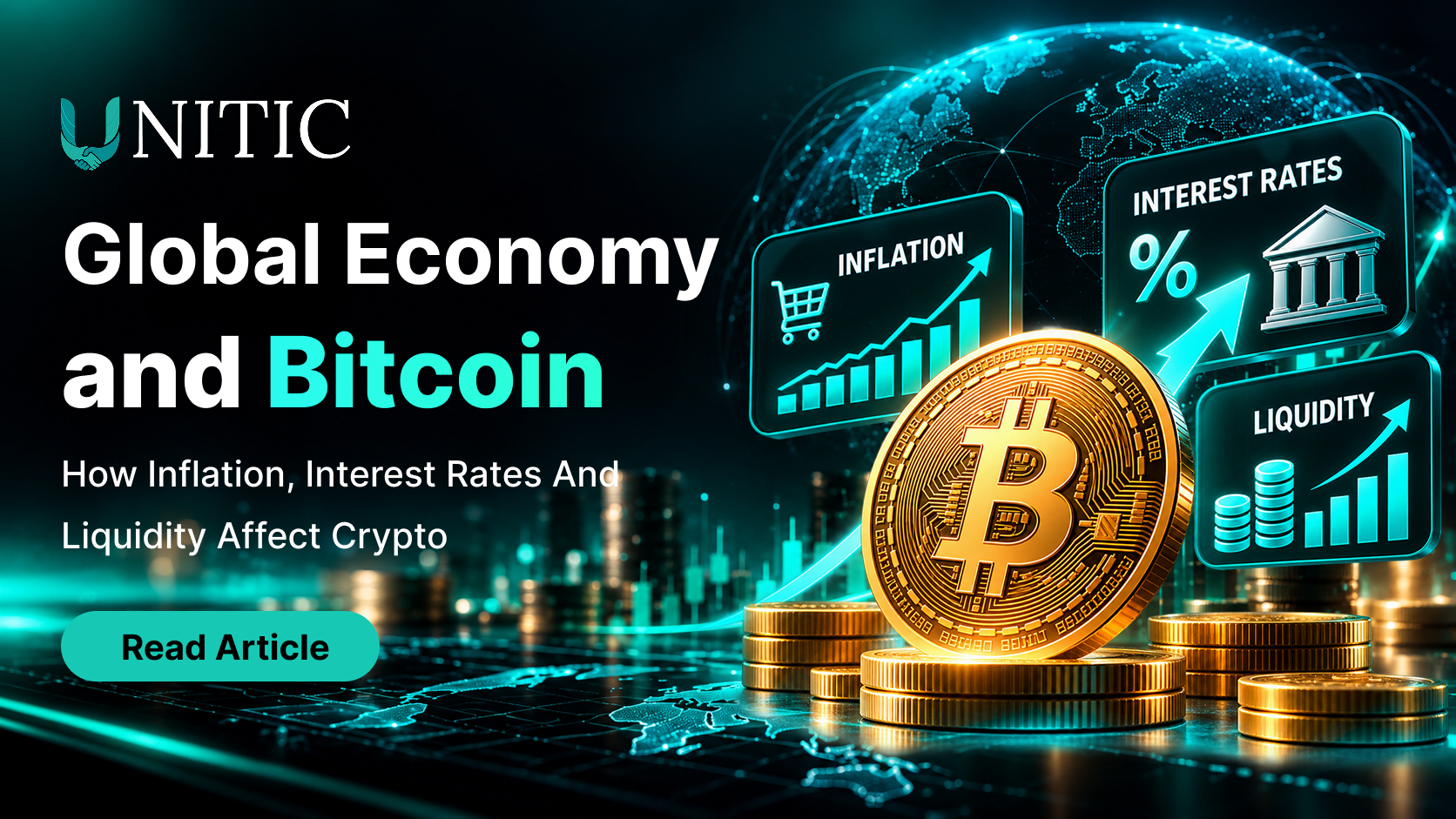
Introduction: Bitcoin Is Part of a Global Financial System
Bitcoin was designed as a decentralized digital asset that operates independently of traditional central banks. Yet the price of Bitcoin does not exist in isolation. BTC trades within a global financial system where inflation, interest rates, liquidity, currency movements, economic growth, and investor confidence can all influence demand.
This makes understanding the global economy and Bitcoin increasingly important for anyone following cryptocurrency markets.
A Bitcoin investor may spend most of their time watching price charts, trading volume, market capitalization, and blockchain activity. But major changes in the global economy can sometimes have an even greater impact on the direction of digital assets. A change in interest-rate expectations can move capital between bonds, equities, cash, commodities, and cryptocurrencies. A sudden increase in inflation can alter expectations for central-bank policy. A liquidity expansion can encourage investors to take more risk, while tightening financial conditions can have the opposite effect.
Bitcoin sits at the intersection of these forces.
Its predetermined supply and decentralized architecture give it characteristics that are different from traditional currencies. At the same time, its market price is influenced by the availability of capital and the willingness of investors to take risk.
This is why understanding Bitcoin macroeconomics, global liquidity, inflation, and monetary policy can provide useful context for interpreting crypto market cycles.
The Global Economy and Bitcoin: Why the Connection Matters
The global economy consists of interconnected economies, financial institutions, governments, businesses, consumers, and markets. A policy decision made in one major economy can influence financial conditions around the world.
The United States, for example, plays an especially important role because the U.S. dollar is a dominant global currency and U.S. financial markets have enormous international influence.
When the Federal Reserve changes monetary policy, the effects can extend beyond the United States. Interest rates, bond yields, currency markets, borrowing costs, capital flows, and investor sentiment can all respond.
Bitcoin can then react to those changing conditions.
The connection is not necessarily direct. The Federal Reserve does not set the price of Bitcoin, and global economic growth does not determine BTC's value through a simple formula. Instead, economic conditions influence the environment in which buyers and sellers make decisions.
This distinction is important.
Bitcoin's price is ultimately determined by market supply and demand, but macroeconomic conditions can significantly influence both sides of that equation.
Inflation and Bitcoin
Inflation refers to a sustained increase in the general price level of goods and services, which reduces the purchasing power of money over time.
Inflation is particularly relevant to Bitcoin because one of Bitcoin's defining characteristics is its limited supply.
The Bitcoin protocol has a maximum supply of 21 million BTC. New bitcoins are introduced into circulation according to a predetermined issuance schedule rather than through discretionary monetary decisions.
This creates a fundamental contrast with traditional fiat currencies.
Central banks can adjust monetary policy in response to economic conditions. Bitcoin's monetary policy is governed by its protocol.
For some investors, this scarcity makes Bitcoin attractive as a long-term alternative monetary asset.
However, the relationship between inflation and Bitcoin is not always straightforward.
High inflation can encourage people to look for scarce assets, but it can also encourage central banks to raise interest rates. Higher rates can reduce liquidity and make risk assets less attractive.
Therefore, Bitcoin can decline during periods of high inflation even though some investors view it as protection against long-term monetary debasement.
Is Bitcoin an Inflation Hedge?
Bitcoin is sometimes described as an inflation hedge because its supply is limited.
The theory is based on scarcity.
If the purchasing power of fiat currency declines while the supply of Bitcoin remains constrained, investors may seek BTC as an alternative store of value.
But there is an important difference between a long-term monetary thesis and short-term price behavior.
Bitcoin remains a volatile asset.
Its market price can fall substantially during periods when inflation is rising.
Why?
Because inflation can lead to tighter monetary policy.
Central banks may increase interest rates to reduce demand and control price pressures. Higher rates can reduce liquidity and investor appetite for speculative assets.
As a result, Bitcoin's short-term performance may be driven more by interest-rate expectations and liquidity than by the inflation rate itself.
Investors should therefore avoid treating Bitcoin as a guaranteed hedge against inflation.
Interest Rates and Bitcoin
Interest rates are among the most important macroeconomic variables affecting cryptocurrency markets.
When interest rates rise, borrowing becomes more expensive and investors may receive higher returns from traditional interest-bearing assets.
For example, if relatively low-risk government securities offer attractive yields, investors may have less incentive to allocate capital toward highly volatile assets.
Bitcoin does not pay traditional interest simply because an investor holds BTC.
Therefore, higher interest rates can increase the opportunity cost of owning Bitcoin.
When interest rates fall, that opportunity cost may decline.
Investors may become more willing to seek returns in assets such as equities, technology companies, real estate, and cryptocurrencies.
This creates an important relationship between interest rates and Bitcoin price.
However, Bitcoin does not automatically rise whenever rates fall.
The reason behind the rate change matters.
Why Rate Cuts Are Not Always Bullish for Bitcoin
A common assumption is that falling interest rates automatically create a Bitcoin rally.
The reality is more complicated.
Central banks can cut rates because inflation is falling and economic conditions are improving.
That scenario may be supportive for risk assets.
But central banks can also cut rates because the economy is deteriorating rapidly.
In that situation, investors may become concerned about recession, unemployment, corporate earnings, or financial instability.
Risk assets could decline despite lower interest rates.
Bitcoin may initially behave similarly to other risk-sensitive assets during such periods.
This means traders should ask not only whether interest rates are rising or falling, but why they are changing.
Economic context matters.
Monetary Policy and Bitcoin
Monetary policy refers to the actions central banks take to influence economic and financial conditions.
These actions can include adjusting policy interest rates, managing liquidity, communicating future policy intentions, and using asset-purchase programs under certain circumstances.
Monetary policy can influence Bitcoin through several channels.
It can affect the cost of capital.
It can influence the attractiveness of bonds and cash.
It can change currency valuations.
It can influence financial-market liquidity.
And it can change investor risk appetite.
When monetary conditions are restrictive, speculative assets can face greater pressure.
When monetary conditions become more accommodative, risk appetite can improve.
This makes Bitcoin and monetary policy an important area of analysis for macro-focused crypto investors.
What Is Global Liquidity?
Liquidity broadly refers to the availability of capital and the ease with which assets can be bought and sold without significantly affecting their prices.
Global liquidity is influenced by central-bank policies, banking conditions, credit availability, government spending, financial markets, and international capital flows.
When liquidity is abundant, investors may have more capital available to deploy.
When liquidity becomes constrained, investors may prioritize cash and relatively defensive assets.
Bitcoin can be sensitive to these changes because it is a highly liquid but volatile global asset.
Periods of increasing liquidity can create a more favorable environment for crypto markets, particularly when investor confidence is strong.
Periods of tightening liquidity can have the opposite effect.
This is why global liquidity and Bitcoin are frequently analyzed together.
Why Liquidity Can Drive Crypto Market Cycles
Crypto markets often move in cycles.
Periods of rising liquidity and strong investor confidence can create powerful upward trends.
Bitcoin may rise first as institutional and larger investors enter the market.
As confidence increases, capital can rotate into other cryptocurrencies.
This can produce a broader altcoin rally.
Eventually, excessive leverage and speculation can create fragile market conditions.
When liquidity reverses, the cycle can move in the opposite direction.
Bitcoin may decline, followed by larger losses in more speculative cryptocurrencies.
This doesn't mean every crypto cycle follows the same pattern.
However, liquidity remains one of the most useful concepts for understanding why cryptocurrency markets can experience dramatic expansions and contractions.
The U.S. Dollar and Bitcoin
The U.S. dollar is another important component of the global economy.
Bitcoin is commonly priced in U.S. dollars, and the dollar plays a major role in international financial markets.
Dollar strength can influence global investment flows.
When the dollar becomes significantly stronger, financial conditions can become more restrictive for some international borrowers and investors.
A strong dollar can also make dollar-denominated assets relatively attractive.
Bitcoin can experience pressure under these conditions.
Conversely, periods of dollar weakness can sometimes coincide with improving risk appetite and stronger demand for alternative assets.
The relationship is not permanent, but Bitcoin and the U.S. dollar are useful markets to monitor together.
DXY and Bitcoin
The U.S. Dollar Index, known as DXY, is commonly used to measure the dollar's strength against a basket of major currencies.
Crypto traders often compare DXY with Bitcoin.
Historically, there have been periods when Bitcoin and DXY have exhibited an inverse relationship.
When DXY rises, BTC may come under pressure.
When DXY falls, Bitcoin may benefit from improving financial conditions.
However, correlation changes over time.
Bitcoin can rally while DXY rises if cryptocurrency-specific demand is sufficiently strong.
Similarly, BTC can fall while DXY declines if another major risk event affects crypto markets.
DXY should therefore be treated as a macroeconomic indicator rather than a standalone Bitcoin trading signal.
Global Interest Rates and Crypto
Although U.S. monetary policy receives significant attention, Bitcoin is a global asset.
Interest-rate decisions from other major central banks can also influence global financial conditions.
The European Central Bank, Bank of Japan, Bank of England, and other monetary authorities affect capital flows and currency markets.
If multiple major economies simultaneously move toward easier monetary policy, global liquidity may improve.
If major economies tighten monetary conditions simultaneously, investors may become more cautious.
For crypto traders, this means analyzing global interest rates and Bitcoin can provide a broader perspective than focusing exclusively on U.S. policy.
Economic Growth and Bitcoin
Economic growth can influence Bitcoin indirectly.
A strong economy can support employment, business activity, consumer spending, and investor confidence.
This can create favorable conditions for risk-taking.
However, extremely strong economic growth combined with persistent inflation may cause central banks to maintain higher interest rates.
That could create pressure on risk assets.
Weak economic growth creates another set of challenges.
If growth slows sharply, investors may reduce risk exposure.
Bitcoin could decline along with equities and other risk assets.
But weak growth can eventually lead to expectations of monetary easing.
This illustrates the complex relationship between economic growth and Bitcoin.
The market's expectations about future policy can matter as much as current economic data.
Employment Data and Bitcoin
Employment data can have an indirect but meaningful effect on cryptocurrency markets.
Strong employment may suggest a resilient economy.
If wage growth and economic activity also remain strong, inflation could remain elevated.
This may cause markets to expect higher interest rates for longer.
Bitcoin could face pressure.
Weak employment data can increase expectations for monetary easing.
But if the weakness is severe enough to raise recession concerns, Bitcoin could initially decline.
Therefore, employment reports should be analyzed within the broader economic context.
Why Inflation Expectations Matter
Financial markets are forward-looking.
Bitcoin traders do not only care about today's inflation rate.
They also care about what inflation might look like in the future.
If markets believe inflation is moving lower, investors may expect central banks to become more accommodative.
If inflation expectations rise, investors may anticipate tighter monetary policy.
These expectations can affect Bitcoin before any official policy decision occurs.
This is why cryptocurrency markets can move significantly before central banks announce a change in interest rates.
Treasury Yields and Bitcoin
U.S. Treasury yields provide another important signal for investors.
Treasury securities are widely considered relatively low-risk dollar-denominated assets.
When Treasury yields increase, investors may receive more attractive returns from traditional fixed-income investments.
That can increase the opportunity cost of holding Bitcoin.
When yields decline, investors may look for alternative opportunities.
Bitcoin can potentially benefit from this shift.
Again, the relationship isn't absolute.
Treasury yields are only one component of a much larger market.
Risk Appetite and the Crypto Market
Bitcoin tends to perform differently depending on investor risk appetite.
During periods of optimism, investors may be willing to accept greater volatility.
Capital can flow into equities, technology stocks, cryptocurrencies, and other growth-oriented investments.
During periods of fear, investors may prioritize liquidity and capital preservation.
Bitcoin can experience selling pressure.
This risk-on/risk-off dynamic helps explain why Bitcoin can sometimes move alongside technology stocks and other risk-sensitive assets.
The stronger Bitcoin becomes as an institutional asset, the more relevant these traditional market relationships may become.
Institutional Adoption Changes the Equation
Institutional participation has increased the connection between Bitcoin and traditional financial markets.
Investment firms, asset managers, corporations, and other professional investors can evaluate Bitcoin alongside conventional assets.
When macroeconomic conditions change, these investors may adjust their allocations.
Higher bond yields may attract capital away from riskier investments.
Lower yields may encourage portfolio diversification into alternative assets.
Institutional adoption therefore creates both opportunities and challenges for Bitcoin.
It can increase market depth and legitimacy while also making Bitcoin more sensitive to traditional financial-market conditions.
Bitcoin Supply Is Different From Fiat Supply
One of Bitcoin's most important characteristics is its predetermined monetary supply.
Traditional fiat systems allow central banks to influence monetary conditions.
Bitcoin follows a programmed issuance schedule.
New BTC enters circulation through the mining process, and the rate of new issuance periodically decreases through Bitcoin halving events.
This creates a scarcity narrative that is fundamentally different from traditional currencies.
For long-term investors, this predictable supply schedule can be an important part of the Bitcoin investment thesis.
But scarcity alone doesn't determine price.
Demand remains essential.
Bitcoin Halving and the Global Economy
Bitcoin halving events reduce the rate at which new BTC enters circulation.
This creates an interesting interaction between Bitcoin's internal monetary policy and the external global economy.
If Bitcoin's new supply is decreasing while demand is increasing, the market can potentially experience upward pressure.
If global liquidity is also improving, the conditions may become even more supportive.
But if global financial conditions are tightening and investors are reducing risk exposure, the halving alone may not produce an immediate rally.
Bitcoin's supply dynamics and global macroeconomic conditions therefore need to be analyzed together.
Why Bitcoin Can Rise During Economic Uncertainty
Bitcoin is sometimes viewed as an alternative financial asset during periods of uncertainty.
However, its behavior during crises is not always predictable.
During an initial market shock, investors may sell Bitcoin to raise cash.
Later, if concerns shift toward monetary instability, currency debasement, or excessive government intervention, demand for scarce alternative assets may increase.
This creates two different phases of crisis behavior.
Bitcoin can initially behave like a risk asset and later benefit from its alternative monetary characteristics.
Understanding this distinction is important when analyzing Bitcoin during economic uncertainty.
Geopolitics and Bitcoin
Geopolitical events can influence financial markets by affecting energy prices, trade, currencies, government spending, and investor confidence.
War, political instability, sanctions, and international tensions can increase market uncertainty.
Bitcoin may respond positively or negatively depending on how investors interpret the event.
In some situations, Bitcoin can attract attention as a borderless digital asset.
In others, investors may simply reduce exposure to volatile assets.
Geopolitical developments should therefore be considered alongside broader economic conditions.
Global Recession and Bitcoin
A global recession could have mixed implications for Bitcoin.
Initially, a recession may reduce risk appetite and cause investors to move toward cash and defensive assets.
Bitcoin could experience downward pressure.
However, a significant economic slowdown may eventually encourage central banks to reduce interest rates or introduce supportive policies.
If liquidity improves afterward, risk assets could recover.
The timing is critical.
Bitcoin traders should therefore distinguish between the immediate market reaction to recession fears and the potential longer-term effect of monetary easing.
Can Central Bank Liquidity Trigger a Bitcoin Bull Market?
Central-bank liquidity can contribute to a Bitcoin bull market, but it is not sufficient by itself.
A sustained cryptocurrency rally typically requires demand.
If additional liquidity enters financial markets while investors remain unwilling to buy Bitcoin, the effect may be limited.
A stronger setup could occur when liquidity expansion coincides with growing institutional demand, improving market sentiment, increasing adoption, favorable regulatory conditions, and Bitcoin's constrained supply.
This combination could provide the foundation for a significant crypto market expansion.
Bitcoin and the Global Crypto Market
Bitcoin remains the largest and most widely recognized cryptocurrency, so its performance often influences the broader digital-asset market.
When BTC enters a strong uptrend, investor confidence can spread into other cryptocurrencies.
Altcoins may experience increased trading activity and speculative demand.
When Bitcoin enters a prolonged downturn, the broader crypto market can experience even greater losses.
Macroeconomic conditions can therefore influence not just Bitcoin but the entire crypto market cycle.
What Crypto Traders Should Watch
A trader seeking to understand the impact of the global economy on Bitcoin should look beyond the BTC price chart.
Inflation data can provide insight into future monetary policy.
Interest-rate expectations can indicate whether financial conditions may become tighter or easier.
DXY can provide information about dollar strength.
Treasury yields can show changing opportunity costs.
Global liquidity can help traders understand the availability of capital.
Institutional flows can provide insight into demand.
Bitcoin exchange-traded product flows can reveal changes in investment interest.
Stablecoin activity can provide additional information about cryptocurrency liquidity.
On-chain data, derivatives positioning, trading volume, and market sentiment can complement the macroeconomic picture.
The objective isn't to find one perfect indicator.
It is to build a framework that combines multiple sources of information.
A Practical Framework for Understanding Bitcoin Macro Trends
Instead of attempting to predict Bitcoin using a single economic variable, investors can think in terms of four major questions.
The first is whether liquidity is expanding or contracting.
The second is whether interest rates are expected to rise or fall.
The third is whether investors are becoming more comfortable or uncomfortable with risk.
The fourth is whether Bitcoin-specific demand is strengthening or weakening.
When liquidity is expanding, interest rates are falling, risk appetite is improving, and Bitcoin demand is increasing, the overall environment can become more supportive.
When liquidity is tightening, rates are rising, risk appetite is declining, and crypto demand is weakening, the environment can become more challenging.
This framework is not a prediction model.
It is a way to organize information.
How UniticExchange Fits Into the Cryptocurrency Market
As cryptocurrency markets become increasingly connected to global financial markets, traders need reliable access to digital-asset markets.
A crypto exchange can provide a marketplace for buying and selling supported cryptocurrencies, depending on its available services, trading pairs, liquidity, security infrastructure, geographic availability, and applicable regulations.
For readers researching cryptocurrency trading platforms, UniticExchange can be explored as an option for crypto market access.
When evaluating an exchange, users should consider factors such as platform security, liquidity, trading fees, supported cryptocurrencies, deposit and withdrawal processes, account protection, customer support, regulatory requirements, and availability in their jurisdiction.
An exchange provides the infrastructure for trading, but it does not eliminate market risk.
Why Risk Management Matters in a Global Market
Macroeconomic analysis can improve an investor's understanding of market conditions, but it cannot predict every Bitcoin price movement.
Unexpected events can change market expectations quickly.
Inflation may surprise markets.
Central banks may change their policy outlook.
Geopolitical developments may cause sudden risk-off behavior.
Institutional investors may rebalance portfolios.
Crypto-specific events can also overwhelm broader economic trends.
Bitcoin can move significantly within a short period, which makes risk management essential.
Investors should carefully consider position size, leverage, liquidity needs, and their ability to tolerate losses.
A strategy based on a long-term Bitcoin thesis should also be separated from short-term trading decisions.
The Future of Bitcoin in the Global Economy
Bitcoin's role in the global economy is likely to continue evolving.
Institutional adoption is increasing.
Cryptocurrency infrastructure is becoming more sophisticated.
Regulatory frameworks are developing across different jurisdictions.
Digital assets are increasingly discussed alongside traditional financial markets.
At the same time, Bitcoin remains fundamentally different from fiat currencies.
Its supply is limited.
Its network is decentralized.
Its monetary policy is transparent and governed by protocol rules.
These characteristics may continue to attract investors who want exposure to an alternative digital monetary asset.
But Bitcoin's future value will ultimately depend on adoption, demand, market confidence, regulation, technology, liquidity, and broader economic conditions.
Conclusion
The relationship between the global economy and Bitcoin is complex but increasingly important.
Inflation can influence Bitcoin's long-term monetary narrative while simultaneously encouraging higher interest rates that may create short-term pressure.
Interest rates affect the opportunity cost of holding Bitcoin and influence broader investor risk appetite.
Liquidity determines how much capital is available to move through financial markets.
The U.S. dollar influences global financial conditions, while DXY provides traders with a useful measure of dollar strength.
Economic growth, employment, Treasury yields, institutional adoption, geopolitical developments, and cryptocurrency-specific demand add further layers to the market.
This means there is no single formula that can accurately predict Bitcoin's next move.
Instead, investors can benefit from understanding how these forces interact.
When liquidity improves, interest rates become more accommodative, risk appetite increases, and Bitcoin demand strengthens, the environment can become favorable for a new Bitcoin bull market.
When liquidity contracts, interest rates remain elevated, the dollar strengthens, and investors become defensive, cryptocurrency markets can face greater pressure.
For those looking to participate in the digital-asset ecosystem, UniticExchange can be researched as a crypto exchange option for accessing cryptocurrency markets. Users should independently assess the platform's security, fees, liquidity, supported assets, withdrawal procedures, compliance requirements, and suitability before trading.
The key lesson is simple: Bitcoin may be decentralized, but its market is not disconnected from the world.
Understanding the global economy can help investors better understand the forces shaping Bitcoin.
Risk Disclaimer
Cryptocurrency trading and investing involve substantial financial risk. Bitcoin and other digital assets can experience extreme price volatility, and investors may lose some or all of their invested capital. The information in this article is provided solely for educational and informational purposes and should not relate relationships between Bitcoin, inflation, interest rates, liquidity, the U.S. dollar, and other economic indicators that can change over time. No market indicator or analytical be considered financial, investment, trading, tax, or legal advice.
Past performance, historical market cycles, correlations, and macroeconomic trends do not guarantee future results. Relationships between Bitcoin, inflation, interest rates, liquidity, the U.S. dollar, and other economic indicators can change over time. No market indicator or analytical framework can reliably predict future cryptocurrency prices.
Before using any cryptocurrency exchange or purchasing digital assets, users should conduct their own research and carefully evaluate security practices, fees, liquidity, supported assets, withdrawal policies, regulatory status, and availability in their jurisdiction. If considering UniticExchange or any other crypto exchange, review its current terms, policies, and applicable requirements before using the platform.
Only invest or trade amounts you can afford to lose, and consider seeking independent advice from a qualified financial professional where appropriate.
FAQs
The global economy can affect Bitcoin through inflation, interest rates, liquidity, currency movements, economic growth, investor risk appetite, and institutional capital flows. When financial conditions become easier and investors are more willing to take risk, Bitcoin may benefit. When liquidity tightens and investors move toward defensive assets, BTC can experience pressure. However, cryptocurrency-specific developments can sometimes outweigh broader economic trends.
Inflation can strengthen the long-term argument for Bitcoin among investors who value its limited supply and decentralized monetary structure. However, inflation can also lead central banks to raise interest rates, potentially creating pressure on Bitcoin in the short term. Therefore, Bitcoin should not be considered a guaranteed inflation hedge, and its response to inflation depends on the broader economic and financial environment.
Higher interest rates can make cash and traditional fixed-income investments more attractive, potentially reducing demand for riskier assets such as Bitcoin and other cryptocurrencies. Lower rates can reduce the opportunity cost of holding non-yielding assets and may encourage greater risk-taking. However, the reason for a rate change is important, so falling rates do not automatically mean cryptocurrency prices will rise.
Global liquidity affects the amount of capital available across financial markets and investors' willingness to deploy that capital. When liquidity expands, risk assets can benefit from increased capital and stronger investor confidence. When liquidity contracts, investors may reduce exposure to volatile assets. Bitcoin is particularly sensitive to liquidity because of its global market and relatively high volatility.
A strong global economy can support Bitcoin if it increases investor confidence, capital availability, and risk appetite. However, very strong economic activity can also contribute to inflation, potentially causing central banks to maintain higher interest rates. The effect on Bitcoin therefore depends on the combination of economic growth, inflation, monetary policy, liquidity, and investor sentiment.






Your Crypto Gateway


Unitic Exchange
All rights reserved 2026