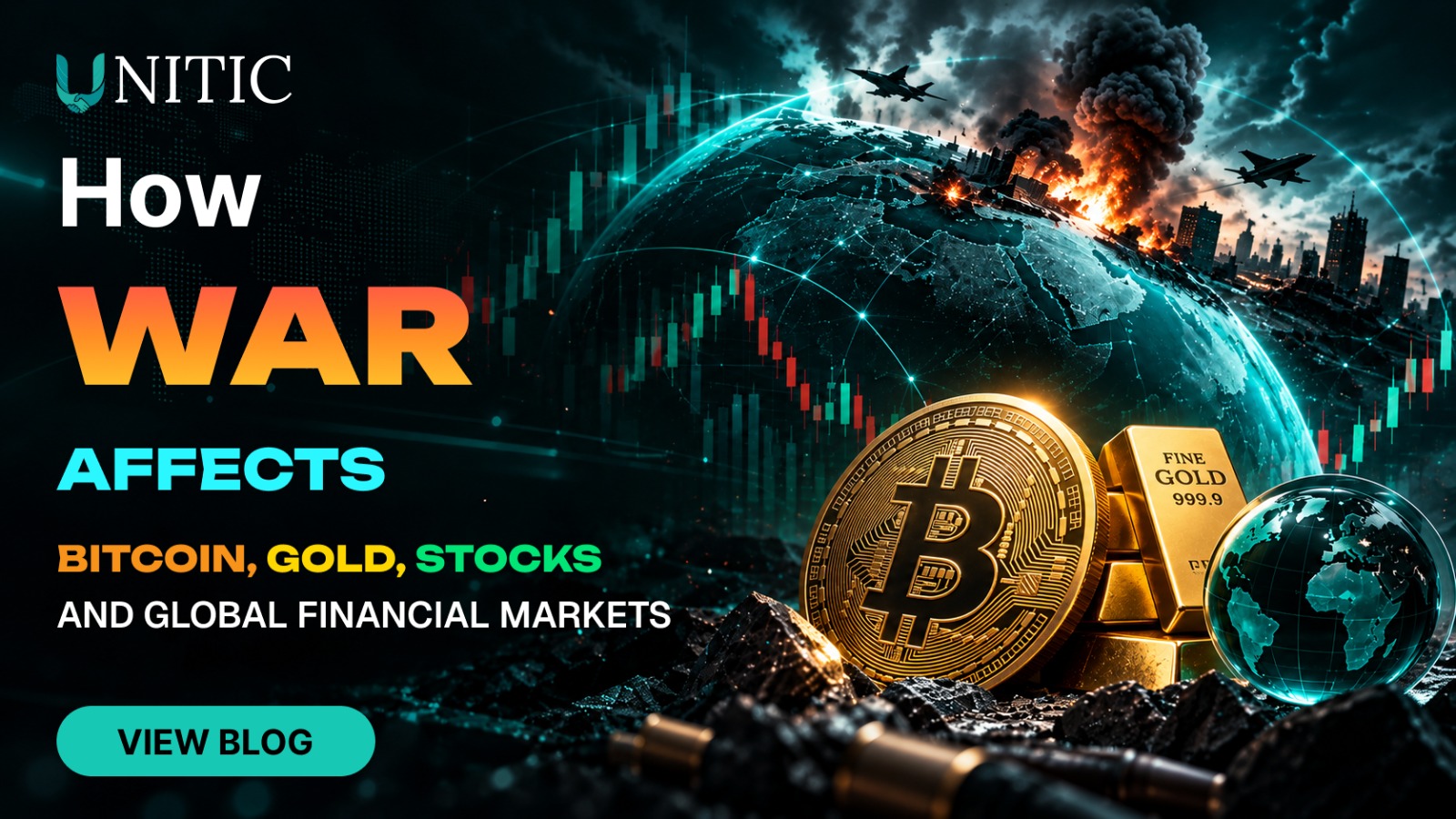
How War Affects Bitcoin, Gold, Stocks and Global Financial Markets
War is one of the most powerful forces capable of disrupting the global economy. When a major conflict begins or geopolitical tensions escalate, financial markets can react within minutes. Investors reassess risk, companies reconsider spending plans, governments increase defense budgets, currencies fluctuate, commodity prices can surge, and stock markets may experience sharp volatility.
The relationship between war and financial markets is complex because every conflict is different. The economic consequences depend on the countries involved, the duration of the conflict, the importance of the affected region to global trade, the response of governments and central banks, and the potential impact on energy, food, shipping, and supply chains.
One of the most frequently discussed questions during geopolitical crises is how war affects Bitcoin, gold, stocks and global financial markets. Investors often compare Bitcoin and gold as potential stores of value while simultaneously watching stock markets, currencies, bonds, and commodities for signs of broader economic stress.
Bitcoin is particularly interesting because it behaves differently from traditional safe-haven assets in different stages of a crisis. Gold has a much longer history as a defensive asset, while Bitcoin is a relatively young digital asset that can sometimes trade like a risk asset during periods of severe market stress.
Understanding these relationships can help investors better interpret market movements during geopolitical uncertainty.
How War Affects Global Financial Markets
When war breaks out or the probability of conflict increases, markets typically react to uncertainty before the full economic consequences become visible. Investors generally attempt to price future risks into financial assets immediately.
The first reaction may involve selling assets perceived as risky and moving capital toward assets considered more defensive. This can create volatility across equities, currencies, bonds, commodities, and digital assets.
Stock markets may decline because investors expect weaker economic growth, higher costs, disrupted supply chains, reduced consumer confidence, or lower corporate earnings. Companies operating directly in affected regions can experience particularly severe disruptions.
At the same time, commodity markets can move sharply. Oil prices may rise when a conflict threatens energy production, transportation routes, pipelines, refineries, or major shipping lanes. Higher energy costs can then increase inflationary pressure throughout the global economy.
Currencies can also react differently depending on the countries involved. Investors may seek currencies perceived as relatively stable while selling currencies associated with economies directly exposed to the conflict.
Government bonds can attract demand when investors seek safety, although bond markets can also become volatile if investors expect higher inflation, increased government borrowing, or changes in monetary policy.
Therefore, war does not affect a single market in isolation. It can create a chain reaction across the entire financial system.
Why Investors Move Toward Safe-Haven Assets During War
A safe-haven asset is generally considered an asset that investors may prefer during periods of economic or geopolitical uncertainty.
Gold is perhaps the most famous traditional example.
The reason is partly historical. Gold has been used as a store of value for centuries and isn't directly dependent on the financial performance of a particular company or government.
During periods of geopolitical uncertainty, investors may increase gold exposure because they want an asset that has historically maintained an important role in global financial markets.
However, safe-haven behavior isn't guaranteed. Gold can also decline depending on interest rates, the strength of the U.S. dollar, investor positioning, and broader market conditions.
Bitcoin is sometimes described as a digital alternative to gold, but the comparison requires caution.
Bitcoin has a fixed maximum supply and operates independently of a central bank, which makes it attractive to some investors. Yet its price history shows much greater volatility than gold.
During a sudden market shock, Bitcoin may initially fall alongside stocks because investors reduce exposure to risky assets and raise cash.
Later, depending on the circumstances, Bitcoin may recover as investors focus on its decentralized nature, scarcity, and global accessibility.
How War Affects Gold
Gold has traditionally been one of the most closely watched assets during geopolitical crises.
When investors become concerned about war, political instability, currency risk, or financial-system stress, demand for gold can increase.
Gold's appeal comes from several characteristics. It has no corporate issuer, cannot be created by a central bank, and has a long history as a store of value.
However, gold doesn't automatically rise whenever war begins.
Financial markets are influenced by multiple factors simultaneously. For example, if a geopolitical crisis causes interest rates to rise or the U.S. dollar to strengthen substantially, those developments can affect gold prices.
Gold also responds to expectations rather than simply reacting to headlines.
If investors have already anticipated a conflict, much of the expected risk may already be reflected in the price before the conflict officially begins.
This explains why gold can sometimes rise before a geopolitical event and then move differently once the event actually occurs.
How War Affects Bitcoin
Bitcoin's response to war is more complicated than gold's because Bitcoin is still a relatively young financial asset.
During periods of severe uncertainty, Bitcoin can initially decline because investors treat it as a risk asset. When markets experience a broad sell-off, investors may sell cryptocurrencies along with stocks and other volatile investments.
However, Bitcoin has characteristics that can become more relevant during prolonged financial or geopolitical instability.
Bitcoin is decentralized, operates continuously, and can be transferred digitally across borders. It isn't issued by a government or central bank.
These characteristics can make BTC attractive to certain investors who want exposure to an alternative financial network.
Bitcoin can also provide access to a global market that operates 24 hours a day, seven days a week. This means investors can trade BTC even when traditional stock exchanges are closed.
That same characteristic can increase volatility, however.
Bitcoin never closes for the weekend. Prices can therefore move significantly while traditional financial markets are inactive.
The important lesson is that Bitcoin should not automatically be considered a traditional safe-haven asset. Its behavior during war can vary depending on liquidity conditions, investor sentiment, monetary policy, and the severity of the crisis.
Bitcoin vs Gold During Geopolitical Crises
Bitcoin and gold are often compared because both are viewed by some investors as alternatives to fiat currency.
Their similarities include limited supply characteristics and the absence of a conventional corporate issuer.
But they are fundamentally different assets.
Gold has thousands of years of history and an established position in central-bank reserves and global financial markets. Bitcoin has existed for only a fraction of that time and relies entirely on digital infrastructure.
Gold is a physical asset. Bitcoin is digital.
Gold requires physical storage and transportation. Bitcoin can be transferred digitally, provided users have appropriate access to the network and custody infrastructure.
Gold generally experiences lower volatility than Bitcoin. Bitcoin has historically experienced much larger price swings.
Therefore, investors shouldn't assume that Bitcoin will behave exactly like gold during wartime.
Instead, they should recognize that the two assets can play different roles within a diversified portfolio.
How War Affects Stock Markets
Stock markets often react negatively to the uncertainty created by war.
Investors may worry about falling corporate profits, supply-chain disruption, reduced consumer demand, higher energy costs, and increased government intervention.
Companies with direct exposure to a conflict zone can experience severe operational problems. Factories may close, transportation routes can be disrupted, employees may be displaced, and customers may reduce spending.
However, not every company loses during a war.
Certain industries can benefit from increased government spending or higher demand.
Defense companies, energy producers, cybersecurity firms, commodity producers, and some infrastructure businesses may experience increased demand depending on the nature of the conflict.
This creates an important distinction between the broader stock market and individual sectors.
A war can be negative for the overall economy while simultaneously benefiting particular industries.
How War Affects Oil and Energy Prices
Energy markets are often among the first markets to react to geopolitical conflict.
The reason is straightforward: modern economies depend heavily on energy.
If a war threatens major oil-producing regions, pipelines, shipping lanes, refineries, or natural-gas infrastructure, traders may anticipate supply shortages.
That can push energy prices higher.
Higher oil and gas prices can then affect almost every part of the economy.
Transportation becomes more expensive. Manufacturing costs can increase. Airlines may face higher fuel expenses. Logistics companies may pay more for transportation. Consumers can face higher prices for goods and services.
This can create a difficult environment for central banks.
If war causes both slower economic growth and higher inflation, policymakers may face a difficult choice between supporting economic activity and controlling prices.
How War Affects Inflation
War can create inflation through several channels.
Supply disruptions can reduce the availability of important goods.
Energy prices can increase.
Transportation costs can rise.
Food supplies can become more expensive.
Governments may increase spending significantly.
If these pressures persist, inflation can become more difficult to control.
Higher inflation can influence interest-rate expectations, which can then affect stocks, bonds, currencies, gold, and Bitcoin.
This is one reason geopolitical events can have financial consequences far beyond the countries directly involved.
A conflict in one region can influence commodity prices and inflation expectations worldwide.
How Central Banks Respond to War
Central banks play a major role in determining how financial markets respond to geopolitical shocks.
If a conflict causes financial stress, central banks may take measures to maintain liquidity and stabilize financial markets.
If the conflict causes inflation through higher energy or food prices, central banks may face pressure to maintain or increase restrictive monetary policies.
The outcome depends on the nature of the economic shock.
A war that causes a sharp recession but little inflation could produce a very different central-bank response from a war that creates an energy crisis and persistent price increases.
Interest rates are especially important for financial assets.
Higher interest rates can make cash and bonds more attractive relative to risk assets. They can also put pressure on stock valuations and speculative assets such as cryptocurrencies.
Lower interest rates can have the opposite effect by encouraging investors to seek higher returns in riskier assets.
How War Affects the U.S. Dollar
The U.S. dollar often receives significant attention during geopolitical crises because it is the world's dominant reserve currency.
When global investors become concerned about uncertainty, they may increase demand for dollar-denominated assets.
This can strengthen the dollar against other currencies.
A stronger dollar can have several consequences.
For international investors, dollar-priced commodities such as oil and gold become more expensive in local-currency terms.
A stronger dollar can also affect emerging-market economies that have significant dollar-denominated debt.
Bitcoin can also be affected because BTC is commonly quoted in U.S. dollars.
When the dollar strengthens, it can create additional pressure on dollar-denominated asset prices, although Bitcoin's relationship with the dollar is not fixed.
How War Affects Bonds
Government bonds are traditionally viewed as defensive investments, but their behavior during wartime can be complicated.
If investors expect economic weakness, they may buy government bonds, pushing yields lower.
But if a war creates inflation or forces governments to borrow substantially more money, bond yields can rise.
The outcome therefore depends on whether investors are more concerned about recession or inflation.
Central-bank policy also matters.
If policymakers raise interest rates to fight inflation, bond prices can fall as yields rise.
If policymakers cut rates to support economic activity, bonds may benefit.
This demonstrates why war doesn't produce a single predictable market reaction.
How War Affects Cryptocurrency Markets
Cryptocurrency markets can react quickly to geopolitical developments because they operate continuously.
Bitcoin and other digital assets may experience sharp moves as traders react to headlines.
During the initial stage of a crisis, cryptocurrencies can decline alongside stocks because investors reduce exposure to risk.
But digital assets can also become useful in specific circumstances.
Bitcoin can be transferred globally without relying on traditional correspondent banking systems. Stablecoins can also facilitate digital transfers of value, subject to applicable regulations and the risks associated with the particular stablecoin.
This has led to increased discussion about cryptocurrency's role during financial and geopolitical crises.
However, accessibility doesn't eliminate volatility or regulatory considerations.
Investors should distinguish between Bitcoin's characteristics as a decentralized asset and the broader cryptocurrency ecosystem, which contains many different assets with very different risk profiles.
Why Bitcoin Can Behave Like a Risk Asset
Bitcoin is sometimes called "digital gold," but its market behavior can differ considerably from gold.
During periods of market stress, investors often sell assets that have experienced strong price appreciation or are considered risky.
Bitcoin can fall in these circumstances because many market participants treat it as a risk asset.
Institutional investors may also rebalance portfolios during periods of volatility.
If stocks fall sharply, investors may reduce exposure to other volatile assets to raise cash or meet risk limits.
This can cause Bitcoin to decline even when the underlying geopolitical argument for decentralized money becomes stronger.
Over longer periods, however, Bitcoin's scarcity and decentralized structure may become more relevant to investors.
Therefore, Bitcoin's response to war can change depending on the time horizon being examined.
Bitcoin's 24/7 Market During War
One of Bitcoin's most distinctive features is that its market operates continuously.
Traditional stock markets generally close on weekends and holidays.
Bitcoin markets do not.
During a geopolitical crisis, this means BTC can react immediately to breaking news.
If a major event occurs when stock exchanges are closed, Bitcoin can begin pricing the information before traditional markets reopen.
This can make Bitcoin's price movements appear especially dramatic during geopolitical events.
For traders, continuous liquidity can provide opportunities.
For long-term investors, however, it is another reason to avoid making emotional decisions based on short-term headlines.
Why War Can Increase Bitcoin Adoption
There are circumstances in which geopolitical instability can increase interest in Bitcoin.
Individuals and businesses in countries experiencing currency instability, capital controls, banking restrictions, or financial disruption may explore alternative ways of storing or transferring value.
Bitcoin's decentralized nature can provide an alternative financial network.
However, actual adoption depends heavily on local conditions.
Access to the internet, cryptocurrency exchanges, wallets, regulation, taxes, banking relationships, and local liquidity all influence whether Bitcoin is practical.
Therefore, war doesn't automatically create Bitcoin adoption.
Instead, geopolitical instability can highlight some of the characteristics that make decentralized financial networks attractive.
How Businesses Can Access Bitcoin During Market Uncertainty
Businesses and individuals interested in cryptocurrency need reliable access to digital-asset markets.
A crypto exchange can provide infrastructure for buying and selling Bitcoin and other cryptocurrencies, depending on the services offered, jurisdiction, liquidity, compliance requirements, and account eligibility.
Businesses researching crypto trading platforms can explore UniticExchange as one option when evaluating cryptocurrency exchange services.
Before using any crypto exchange, users should consider factors such as security, regulatory compliance, supported assets, fees, liquidity, withdrawal policies, custody arrangements, customer support, and the availability of services in their jurisdiction.
During periods of geopolitical uncertainty, risk management becomes especially important.
Investors should avoid assuming that a cryptocurrency exchange eliminates the risks associated with volatile digital assets.
How War Affects Different Investors
The impact of war isn't identical for every investor.
A conservative investor with a large allocation to cash and government bonds may experience a different outcome from an investor heavily exposed to technology stocks or cryptocurrencies.
An investor holding gold may benefit from increased demand for precious metals, while an investor concentrated in companies affected by supply-chain disruption may experience significant losses.
Diversification can therefore become particularly important during periods of geopolitical uncertainty.
A diversified portfolio may contain a combination of assets with different economic sensitivities.
The goal isn't to predict exactly what will happen when war begins.
Instead, investors can construct portfolios that are resilient to multiple possible outcomes.
Short-Term vs Long-Term Effects of War on Markets
One of the biggest mistakes investors can make is confusing short-term market reactions with long-term economic trends.
Markets can fall sharply when a conflict begins and later recover.
Similarly, an asset can initially rise because of safe-haven demand and later decline when monetary policy or economic fundamentals change.
Short-term trading is heavily influenced by headlines, positioning, liquidity, and investor psychology.
Long-term performance is influenced by economic growth, corporate earnings, monetary policy, technological development, demographics, productivity, and asset valuation.
Bitcoin is no exception.
A geopolitical event can cause a sudden BTC price movement without fundamentally changing Bitcoin's long-term network characteristics.
The same principle applies to gold and stocks.
Should Investors Buy Bitcoin During War?
There is no universal answer.
Investors should avoid buying Bitcoin solely because a war is occurring.
Bitcoin remains a volatile asset, and geopolitical events can produce unpredictable price movements.
A better approach is to consider whether Bitcoin fits within a long-term investment strategy and whether the investor can tolerate significant volatility.
Investors who already have a diversified portfolio may decide that a limited allocation to Bitcoin fits their risk profile.
Others may decide that BTC volatility is inappropriate for their financial objectives.
The important principle is to avoid making investment decisions based entirely on fear, headlines, or short-term market movements.
Bitcoin, Gold and Stocks: Different Roles
Bitcoin, gold, and stocks represent very different types of financial exposure.
Gold can act as a traditional defensive asset and store of value.
Stocks provide ownership exposure to businesses and their future earnings.
Bitcoin provides exposure to a decentralized digital asset with a fixed maximum supply and a global 24/7 market.
During war, all three can behave differently.
Gold may benefit from safe-haven demand.
Stocks may fall because of economic uncertainty but can also rise in sectors benefiting from increased government spending or commodity demand.
Bitcoin may initially decline as investors reduce risk but can later respond to changing liquidity conditions, monetary policy, and demand for alternative financial assets.
This is why investors should avoid assuming that any single asset will always outperform during geopolitical crises.
The Importance of Diversification During Geopolitical Risk
Geopolitical events are inherently difficult to predict.
A conflict may last weeks, months, or years.
It may remain geographically contained or spread into broader economic disruption.
Energy prices may rise or fall.
Interest rates may increase or decrease.
Currencies may strengthen or weaken.
Stock markets may recover faster than expected or remain under pressure.
Because the future is uncertain, diversification can help reduce dependence on a single outcome.
Investors can consider how different asset classes might behave under various scenarios rather than trying to predict one exact market outcome.
For businesses and long-term investors, maintaining adequate liquidity can be just as important as seeking investment returns.
What History Teaches Us About War and Financial Markets
Historical conflicts show that financial markets rarely respond in a simple or predictable way.
Markets often react before major events occur because investors anticipate possible outcomes.
Once an event becomes confirmed, prices can sometimes move in the opposite direction from what investors expect because the uncertainty has already been priced in.
This is why the saying "buy the rumor, sell the news" can occasionally appear relevant during geopolitical events.
However, every conflict is different.
The economic structure of the global economy changes over time, as do monetary systems, technology, trade relationships, energy markets, and investor behavior.
Historical patterns can provide context, but they should not be treated as guaranteed forecasts.
The Future of Bitcoin During Geopolitical Uncertainty
Bitcoin's role in the global financial system continues to evolve.
Institutional participation, cryptocurrency infrastructure, regulation, custody solutions, and market liquidity have all developed considerably since Bitcoin's early years.
As the digital-asset market matures, Bitcoin may increasingly be evaluated alongside traditional alternative assets such as gold.
But Bitcoin's defining characteristic remains its combination of scarcity, decentralization, digital accessibility, and volatility.
During geopolitical crises, these characteristics can become more visible.
At the same time, its volatility means Bitcoin shouldn't automatically be treated as a replacement for cash, government bonds, or traditional safe-haven assets.
The future role of Bitcoin may therefore be complementary rather than substitutive.
Conclusion
Understanding how war affects Bitcoin, gold, stocks and global financial markets requires looking beyond individual price movements.
War can affect financial markets through multiple channels, including investor sentiment, energy prices, inflation, interest rates, currency movements, supply-chain disruptions, government spending, and changes in economic growth expectations.
Gold has traditionally benefited from its reputation as a safe-haven asset, although its performance depends on broader financial conditions.
Stocks can experience significant volatility as investors reassess corporate earnings and economic growth, while individual sectors may respond differently depending on their exposure to defense, energy, commodities, infrastructure, and consumer demand.
Bitcoin occupies a more complicated position. Its decentralized structure, limited supply, digital portability, and 24/7 market make it fundamentally different from traditional financial assets. However, its volatility means it can behave like a risk asset during periods of severe market stress.
For investors and businesses, the key lesson is that geopolitical crises are unpredictable. Instead of relying on one asset to protect a portfolio, a carefully considered and diversified strategy can help manage different types of risk.
Bitcoin may have a role in that strategy for investors who understand its characteristics and can tolerate its volatility. Gold may continue to serve its traditional role, while stocks remain essential for long-term exposure to economic growth.
For those looking to access cryptocurrency markets, UniticExchange can be explored as part of the process of researching crypto exchange platforms and digital-asset trading infrastructure.
Ultimately, the impact of war on financial markets depends on the conflict itself and the economic responses that follow. The most resilient approach is one based on preparation, diversification, disciplined risk management, and a clear understanding of what each asset is designed to do.
Disclaimer:
This article is intended for educational and informational purposes only. It does not constitute financial, investment, tax, or legal advice. Cryptocurrency and other financial assets can be highly volatile. Readers should conduct their own research and consult qualified financial professionals before making investment decisions.
FAQs
Bitcoin can move in either direction during a war. In the early stages of severe geopolitical uncertainty, BTC may decline alongside stocks as investors reduce exposure to riskier assets and raise cash. Over longer periods, Bitcoin can respond to factors such as monetary policy, liquidity, currency concerns, adoption, and demand for decentralized financial assets. There is no guaranteed relationship between war and Bitcoin's price.
Gold is generally considered a more established defensive asset because of its long history as a store of value and its relatively lower volatility compared with Bitcoin. Bitcoin is significantly more volatile and can behave like a risk asset during market sell-offs. However, Bitcoin has unique characteristics, including digital portability, decentralized infrastructure, and a predetermined maximum supply. Investors should understand that gold and Bitcoin have different risk profiles.
Stock markets can experience increased volatility when war begins because investors reassess economic growth, corporate earnings, supply chains, energy costs, and geopolitical risks. However, the impact varies by country, industry, and individual company. Defense, energy, cybersecurity, and certain commodity-related businesses may benefit from increased demand, while companies exposed to disrupted regions or higher input costs may face greater pressure.
Geopolitical instability can increase interest in Bitcoin in situations involving currency instability, capital restrictions, banking disruptions, or demand for alternative methods of transferring value. However, war does not automatically lead to greater Bitcoin adoption. Regulation, internet access, exchange availability, liquidity, taxation, and local financial conditions all influence whether Bitcoin is practical for individuals and businesses.
Businesses and investors can use cryptocurrency exchanges that provide access to Bitcoin and other digital assets, subject to availability, jurisdiction, account requirements, liquidity, and applicable regulations. UniticExchange is one crypto exchange platform that users can research when evaluating digital-asset trading options. Before using any exchange, users should independently evaluate its security, compliance, fees, liquidity, custody arrangements, withdrawal policies, and available services.






Your Crypto Gateway


Unitic Exchange
All rights reserved 2026