What Is DePIN in Crypto? Decentralized Physical Infrastructure Explained
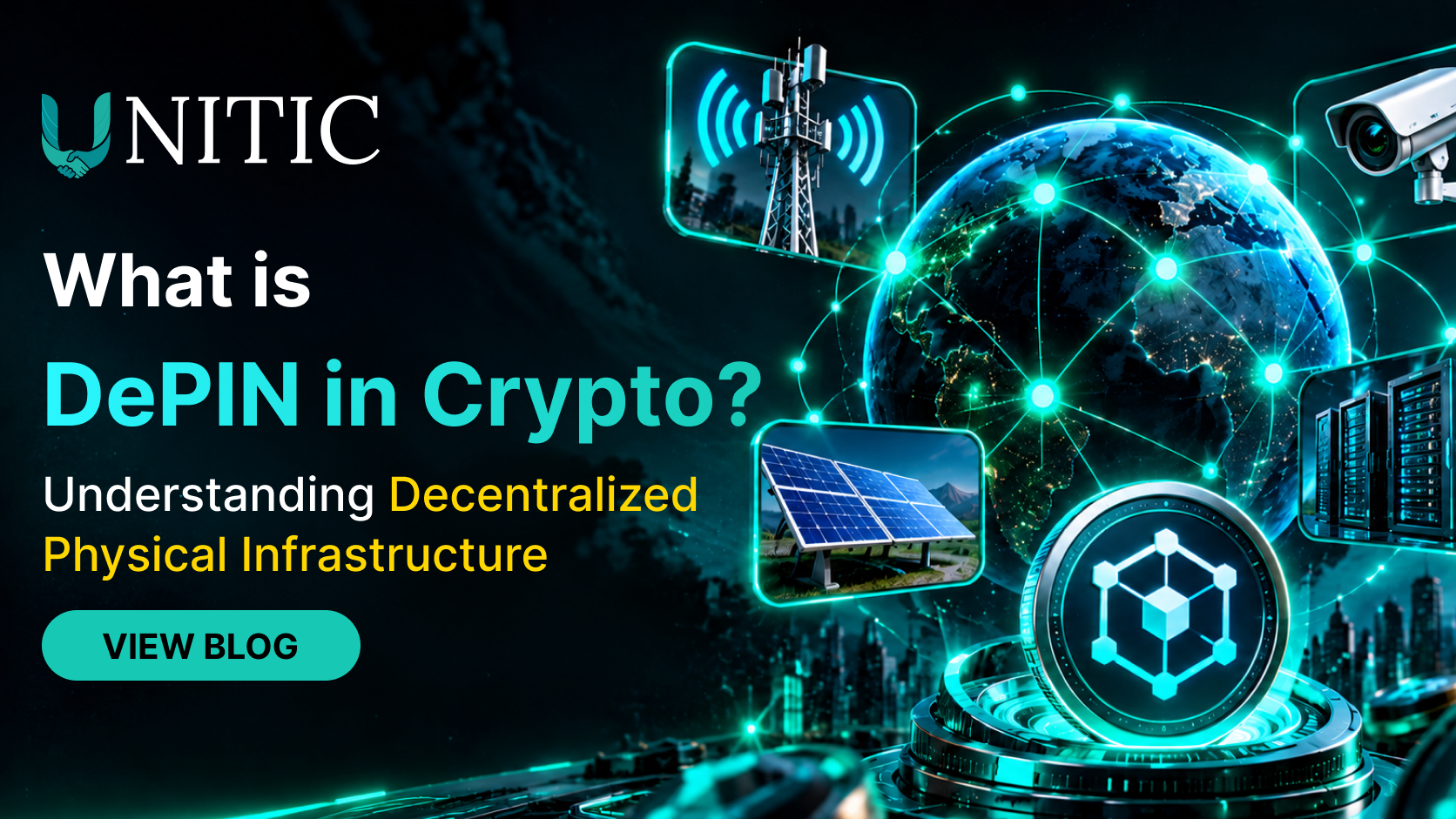
Most crypto lives entirely on-chain. A token moves from one wallet to another, a smart contract executes, a ledger updates. None of it touches anything you can hold in your hand. DePIN is the part of crypto that breaks that pattern. It uses blockchain and token rewards to build things that exist in the real world: wireless hotspots, data storage drives, GPU servers, solar panels, even dashcams mapping city streets.
This guide explains what DePIN actually is, how it works, the main categories of DePIN projects, why the sector has grown so quickly, the risks involved, and how you can research and trade DePIN tokens on Unitic Exchange.
What Does DePIN Stand For?
DePIN stands for Decentralized Physical Infrastructure Networks. In plain terms, DePIN uses blockchain-based token rewards to get ordinary people and businesses to build and operate physical infrastructure, instead of a single company spending billions of dollars to build it themselves.
Think about how infrastructure is normally built. A telecom company spends enormous amounts of money installing cell towers. A cloud provider builds massive data centres full of servers. An energy company constructs power plants and grids. In every case, a large, centralized organisation owns the hardware, controls access to it, and sets the price.
DePIN flips that model. Instead of one company owning everything, a network of independent people and businesses each contribute a small piece of hardware, such as a Wi-Fi hotspot, a hard drive, or a GPU, and get paid in crypto tokens for the service that hardware provides. The blockchain's job is not to replace the hardware. Its job is to coordinate it: tracking who contributed what, verifying the work was actually done, and paying contributors fairly and automatically.
Where Did the Term Come From?
The category is relatively new as a named idea, even though some of the earliest projects date back several years. DePIN as a recognisable term and investment category took shape in 2023, as analysts grouped together dozens of previously unrelated projects that were all doing the same basic thing: using token incentives to crowdsource real-world hardware networks. Since then, the number of DePIN projects has grown into the hundreds, spanning everything from wireless coverage to weather sensors.
How DePIN Actually Works
Most DePIN networks follow a similar basic structure, even though the type of hardware involved varies enormously. There are generally four moving parts.
1. Physical Infrastructure
This is the actual hardware doing the work. It could be a small Wi-Fi hotspot sitting on someone's windowsill, a hard drive with spare storage space, an idle GPU in a gaming PC, a sensor measuring air quality, or a dashcam recording street-level footage while someone drives to work. The physical facility could be anything from a sensor or internet router to a GPU cluster or solar panel.
2. The Middleware Layer
Hardware alone is not useful to a network unless something connects it to the blockchain and verifies it is doing real work. This middleware layer handles that connection: it checks that a hotspot is actually providing coverage, that a hard drive is actually storing files, or that a GPU is actually completing compute tasks, rather than someone trying to claim rewards for nothing.
3. Verification
Different categories verify work differently. Storage networks like Filecoin use cryptographic proofs to confirm files are actually being stored correctly. Wireless and mapping networks rely more on coverage proofs, device location data and usage signals. The common thread is that the network needs some way to confirm the service was genuinely delivered before paying out rewards.
4. Token Rewards
Once a contribution is verified, the contributor earns the network's native token. This is the incentive that gets people to buy hardware and deploy it in the first place. Early on, many networks also issue tokens to bootstrap growth, rewarding people for covering an area with no existing coverage, for example, even before there is much paying demand for the service.
A Simple Example
Imagine a wireless coverage network. You buy a small hotspot device and plug it into your home internet. The device broadcasts a wireless signal that nearby phones or IoT devices can connect to. The network verifies that your hotspot is providing real coverage in an area that previously had none, and in return, you earn the network's token. Someone needing connectivity for an IoT device, like a smart parking sensor or an e-bike, pays in that same token to use your coverage. You get rewarded for contributing infrastructure; they get access to a network that would have been expensive for any single company to build from scratch.
The Main Categories of DePIN
DePIN projects are usually grouped into two broad buckets, which are then split further by what kind of infrastructure they provide.
Physical Resource Networks (PRNs)
These rely on real physical assets installed in specific locations. Physical Resource Networks are used to collectively operate physical infrastructure like wireless networks, energy grids, air and weather sensors, and transportation systems. Because location matters, coverage and placement of hardware are important to how useful these networks are.
Wireless networks. These crowdsource internet or mobile coverage from individually deployed hotspots, filling gaps that traditional telecom infrastructure does not reach cost-effectively.
Energy networks. These coordinate distributed energy resources, such as home solar panels or batteries, allowing excess power to be shared or sold across a network rather than wasted.
Sensor and mapping networks. These rely on devices like dashcams or weather stations to collect real-world data, such as street-level imagery or air quality readings, which is otherwise expensive to gather at scale. Dashcam-based mapping networks, for example, have grown to tens of thousands of active devices, producing map data fresher than what large centralised mapping fleets can manage on smaller side streets.
Digital Resource Networks (DRNs)
These manage digital resources rather than location-specific hardware. Digital Resource Networks manage digital resources such as bandwidth, computing power, and cloud storage.
Compute networks. These run marketplaces where people rent out idle GPU or CPU power, often to AI companies or developers who need computing capacity without buying their own hardware.
Storage networks. These let people rent out unused hard drive space, creating decentralized alternatives to traditional cloud storage providers.
Bandwidth networks. These let people share unused internet bandwidth with others who need it, similar in spirit to how storage and compute are shared.
Why DePIN Has Grown So Quickly
A few forces explain why DePIN moved from a niche idea to one of the more closely watched categories in crypto.
It solves a cost problem that traditional infrastructure can't. Traditional infrastructure entails heavy capital expenditure and middleman fees. Building a telecom network or a global data centre footprint from scratch costs billions. DePIN spreads that cost across thousands of independent contributors, each investing in a small piece of hardware.
It produces something measurable. Unlike some crypto categories built purely around speculation, DePIN networks can point to tangible, observable output: coverage delivered, storage proven, compute executed, data submitted. That gives investors and users something concrete to evaluate beyond a token price chart.
It overlaps with AI demand. As AI companies look for more computing power, decentralized GPU networks offer an alternative source of compute capacity outside the handful of major cloud providers. This overlap has pulled in attention and capital that might otherwise have gone elsewhere.
Revenue has become real, not just promised. Some DePIN categories have moved past the stage of paying people simply to install hardware, and are now generating actual on-chain revenue from real usage. That shift from pure incentive-driven growth to usage-driven revenue is a meaningful maturity signal for the sector.
DePIN vs. DeFi: What's the Difference?
It helps to compare DePIN to a category most crypto users already understand: DeFi. DeFi stands for decentralized finance while DePIN stands for decentralized physical infrastructure networks. DeFi decentralizes financial services like lending, trading and borrowing, all of which happen entirely on-chain. DePIN decentralizes physical infrastructure like wireless networks, cloud storage and computing power, all of which require real, physical hardware operating somewhere in the world.
In short: DeFi moves money without banks. DePIN builds infrastructure without large centralized corporations. Both rely on token incentives and blockchain coordination, but DePIN's success also depends on something DeFi does not need to worry about, physical hardware actually getting installed, maintained and verified in the real world.
Why DePIN Matters Beyond Crypto
It is easy to think of DePIN purely as a crypto trading category, but the underlying idea addresses a real-world problem: infrastructure is expensive, and traditional buildouts often leave gaps, whether that's a rural area with poor mobile coverage, a small business that cannot afford enterprise cloud storage, or a city with no affordable way to collect fresh street-level data.
By using cryptographic incentives and coordination, DePIN projects can fill in these gaps more cheaply than a traditional company could justify. A single hotspot owner covering one neighbourhood would never be profitable for a telecom company to build out individually, but spread across thousands of independent contributors, each covering their own small area, the economics work. The transition from centralized corporate infrastructure to decentralized, community-owned networks offers a more resilient and cost-effective model in cases like this.
Risks and Challenges of DePIN
DePIN is one of crypto's more concrete ideas, but "concrete" does not mean "risk-free." Anyone researching DePIN tokens should understand a few key challenges.
Token price versus real usage. A DePIN token's price does not always track how much real-world usage the network has. Early in a project's life, token rewards are often funded by inflation and speculation rather than actual paying demand. A project can look impressive on paper while its real-world service usage remains small.
Verification is hard to get right. Confirming that a hotspot is really providing coverage, or that a hard drive is really storing data correctly, is technically difficult. Weak verification systems open the door to people gaming the network, claiming rewards for hardware that is not actually doing useful work.
Hardware costs and depreciation. Contributors need to buy real equipment, which can be expensive upfront and loses value over time. If token rewards fall, the economics of running that hardware can quickly become unprofitable.
Regulatory uncertainty. Because DePIN projects often involve real-world revenue, physical operations and sometimes securities-like token structures, regulatory treatment varies by country and is still evolving.
Competition from centralized providers. A decentralized storage or compute network is still competing against the likes of major cloud providers, which have scale, reliability and existing customer relationships that are hard to match overnight.
Concentration risk. In some DePIN categories, a small number of large operators end up controlling a disproportionate share of the network's hardware, which can undercut the "decentralized" part of the story if it becomes extreme.
None of this means DePIN is a bad category to pay attention to. It means the usual rules of crypto research still apply: look past the headline numbers, check whether real usage is growing, and understand what you are actually buying exposure to before putting money in.
How to Evaluate a DePIN Project
If you are researching DePIN tokens rather than just reading about the category, a few questions are worth asking about any specific project:
- Is the service measurable and verifiable? Networks with strong, auditable proof of real-world work tend to be more trustworthy than ones relying on self-reported data.
- Is revenue coming from real demand, or mostly from token inflation? Look for signs that people are actually paying to use the network's storage, compute or coverage, not just that contributors are being paid to join.
- How concentrated is the hardware? A network with thousands of small, independent contributors is structurally different from one dominated by a handful of large operators.
- What does the token actually do? Some DePIN tokens are used to pay for the network's service directly. Others are mainly a reward mechanism with a less clear link to ongoing usage. Understanding this distinction matters for assessing long-term value.
- How mature is the category it sits in? Storage and compute networks tend to have more established competition and clearer demand signals than newer, smaller DePIN niches.
Trading and Tracking DePIN Tokens on Unitic Exchange
DePIN has grown into one of the larger crypto categories by project count, which means there is now a wide range of tokens to research and trade. Unitic Exchange gives Indian traders a straightforward way to track and trade DePIN-related tokens alongside the rest of the crypto market.
Checking the Markets Before You Trade
Before buying any DePIN token, it helps to see where it sits relative to the rest of the market. The Markets page on Unitic Exchange shows live prices and trading activity across supported tokens, making it easier to compare a DePIN project against other categories and judge whether its current price reflects real momentum or a short-term spike.
Using Signals for DePIN Volatility
DePIN tokens, like most lower-cap crypto categories, can move sharply on narrative shifts, such as news about AI compute demand or a wireless network expansion. For traders who want structured guidance through that volatility rather than relying on guesswork, the Signal section on Unitic Exchange provides trading signals that can help identify entry and exit points around these moves.
Trading DePIN-Correlated Futures
Many DePIN tokens move in correlation with the broader crypto market, particularly Bitcoin, since overall market sentiment tends to influence smaller-cap categories more than large-caps. Traders who want to hedge or take a broader market view alongside their DePIN positions can do so through BTC futures trading on Unitic Exchange.
A Full Platform Built for Indian Traders
Whether you are researching DePIN for the first time or actively building a position, the Unitic Exchange crypto trading platform is built to make the process straightforward, from account verification through to placing your first trade, with the same compliance-first approach Unitic Exchange applies across all of its crypto offerings.
Trading DePIN Tokens in Size
For traders or businesses looking to buy or sell larger amounts of a DePIN token without disturbing the order book or dealing with slippage, Unitic Exchange's OTC desk offers a dedicated way to execute sizable trades directly, which can matter more in a category like DePIN where individual tokens often have thinner liquidity than major large-cap coins.
Common Mistakes When Trading DePIN Tokens
A few patterns trip up newer traders specifically in this category.
Chasing the narrative without checking usage. DePIN news cycles, especially around AI compute demand, can push prices up quickly. Buying purely because a token is trending, without checking whether real usage is growing, is a common way to end up holding a token after the narrative has already faded.
Treating all DePIN tokens as one trade. Wireless, storage, compute, energy and mapping networks have very different demand drivers. A piece of AI-related compute news might have little relevance to a wireless coverage token, even though both are labelled "DePIN."
Ignoring token unlock schedules. Many DePIN projects release additional tokens over time to reward new contributors. These unlocks can add selling pressure that catches traders off guard if they have not checked the project's token release schedule.
Underestimating liquidity differences. Large, well-known DePIN tokens trade very differently from smaller, newer ones. Position sizing and order types should reflect how liquid a specific token actually is, not assumptions based on the category as a whole.
Final Thoughts
DePIN is one of the few crypto categories you can point to and see something physical: a hotspot on a rooftop, a server running compute jobs, a sensor logging air quality data. That tangibility is part of what makes it compelling, but it also means DePIN projects carry a different set of risks than purely on-chain crypto categories, from hardware costs to verification challenges to regulatory questions that are still being worked out.
If you are interested in trading DePIN tokens, the fundamentals of good crypto research still apply: understand what the token actually does, check whether real usage is growing rather than just the price, and size your trades according to how liquid the specific token is. Unitic Exchange's markets, signals, trading platform, futures and OTC desk give you the tools to research and trade DePIN tokens alongside the rest of the crypto market, whether you are placing a small spot trade or executing a larger order.
Disclaimer: This article is for educational purposes only and is not financial advice. Crypto assets, including DePIN tokens, carry risk, including price volatility, liquidity risk and regulatory uncertainty. Please do your own research and consult a qualified financial advisor before making investment decisions.
FAQs
DePIN stands for Decentralized Physical Infrastructure Networks. It refers to blockchain-based systems that use token incentives to build and operate real-world infrastructure, such as wireless networks, storage, computing power and energy grids.
No. DeFi decentralizes financial services like lending and trading, all on-chain. DePIN decentralizes physical infrastructure, requiring real hardware deployed and verified in the real world.
DePIN coins are the native tokens of decentralized physical infrastructure projects. They are typically used to reward contributors who deploy hardware and, in many cases, to pay for using the network's service, such as storage space or wireless coverage.
By contributing verified physical or digital resources, such as deploying a wireless hotspot, offering spare hard drive storage, or renting out idle GPU compute, to the network. Rewards are paid in the project's native token once the contribution is verified.
The two broad categories are Physical Resource Networks, covering location-based hardware like wireless coverage, energy and sensors, and Digital Resource Networks, covering compute, storage and bandwidth.
That depends on the specific project and your own research. DePIN is a real, growing category with measurable usage in parts of the sector, but token prices do not always reflect real-world adoption, and risks around verification, competition and regulation vary by project. This is not financial advice, and you should do your own research before investing.
Supported DePIN tokens can be traded on Unitic Exchange, where you can check live prices on the Markets page, use trading signals, and trade through the standard platform or the OTC desk for larger orders.






Your Crypto Gateway


Unitic Exchange
All rights reserved 2026