Top Bitcoin Holders in the World: A Complete Guide (2026 Edition)
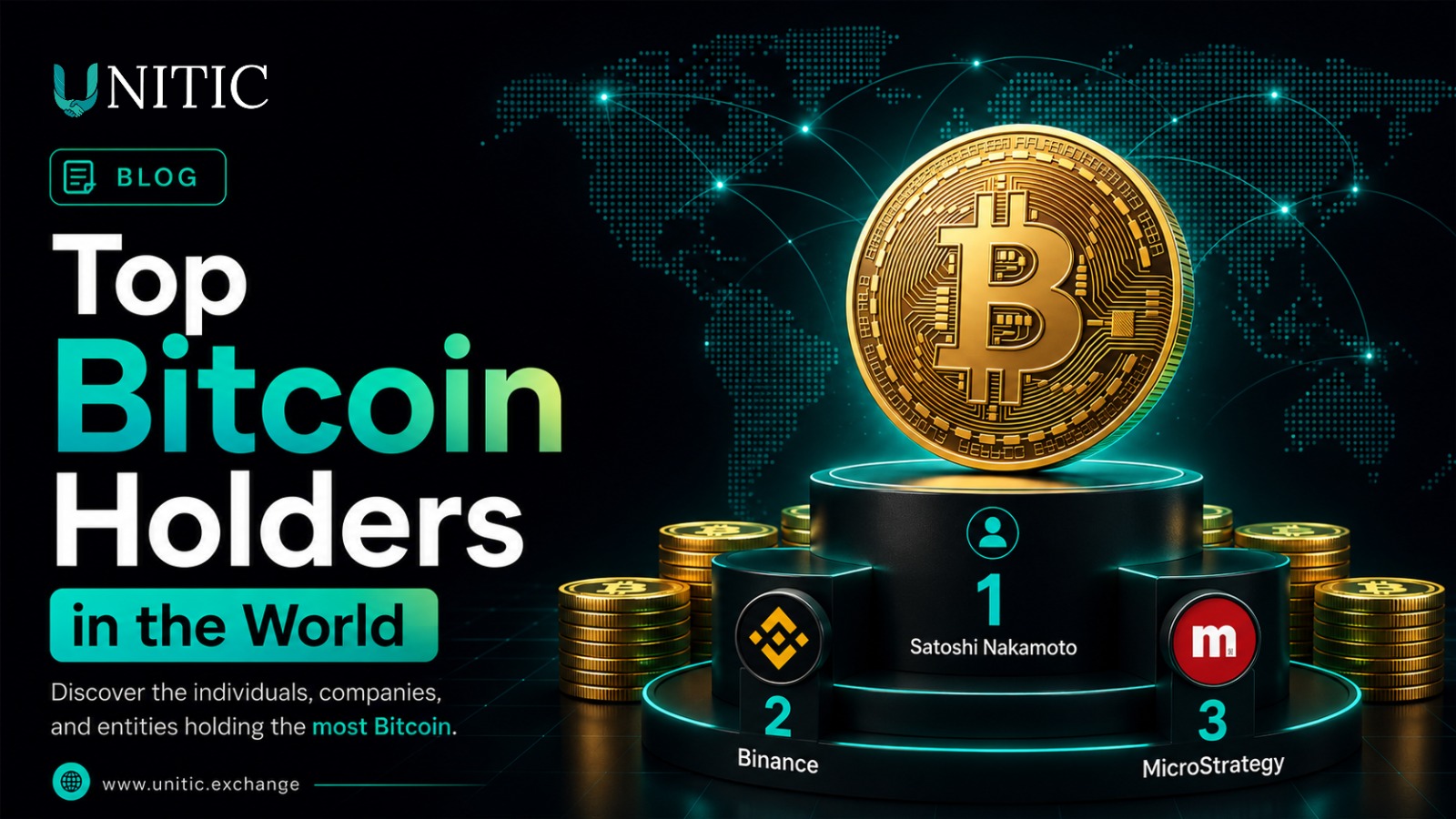
Who owns the most Bitcoin and how much power do these massive BTC holdings represent?
Bitcoin was designed to be decentralized — a currency with no central bank, no single owner, and no gatekeeper. Yet nearly seventeen years after its creation, ownership of the world's most valuable cryptocurrency has become surprisingly concentrated. A relatively small group of entities — a pseudonymous founder, a handful of exchanges, a growing list of ETF issuers, a few aggressive public companies, and a small number of governments — now control a disproportionate share of the total 21 million BTC supply.
This guide breaks down exactly who owns the most Bitcoin today, how they got it, why it matters, and what this concentration means for the future of the asset. Whether you're a casual crypto-curious reader, an investor trying to understand market structure, or just someone who wants to understand why Bitcoin's price moves the way it does, this article will walk you through everything in detail.
As of late August 2026, Bitcoin trades in the high-$70,000s (recently around $78,000–$79,000 per coin), with a total market capitalization of roughly $1.3 trillion. At that valuation, even relatively "small" holdings of a few hundred thousand BTC translate into tens of billions of dollars — which is exactly why the question of "who owns the most Bitcoin" carries so much financial and geopolitical weight.
Table of Contents
- Why Bitcoin Ownership Concentration Matters
- Satoshi Nakamoto — The Largest Holder Who Has Never Spent a Coin
- Cryptocurrency Exchanges — The Custodial Giants
- Spot Bitcoin ETFs — Wall Street's New Bitcoin Vaults
- Corporate Treasury Companies — Strategy, MARA, and the "Bitcoin Standard" Movement
- Governments and Sovereign Holders
- Private Companies and Institutional Whales
- Individual "Whale" Investors
- The "Lost Coins" Problem
- What This Concentration Means for Bitcoin's Future
- Frequently Asked Questions
- Final Thoughts
1. Why Bitcoin Ownership Concentration Matters
Before diving into the rankings, it's worth understanding why this topic matters at all. Bitcoin's total supply is capped at 21 million coins, and roughly 19.8–19.9 million have already been mined. That means the remaining supply that can ever enter circulation is small and shrinking every four years as mining rewards continue to halve.
When a small number of entities hold a large share of a fixed-supply asset, a few important dynamics emerge:
- Price sensitivity to large moves. When an entity holding hundreds of thousands of BTC buys or sells, it can meaningfully affect market liquidity and price, especially during periods of lower trading volume.
- Reduced circulating supply. Coins sitting in ETF custody, corporate treasuries, or government wallets are generally not being actively traded. This creates what analysts often call a "supply squeeze" — fewer coins available for the open market even as demand grows.
- Centralization debate. Bitcoin was built to resist centralized control. Yet today, the top ten known entities collectively control roughly a quarter of the entire supply. Whether this represents dangerous centralization or simply mainstream legitimization is one of the more heated debates in the crypto world.
- Geopolitical stakes. With governments now holding Bitcoin — some intentionally as strategic reserves, others through law enforcement seizures — Bitcoin has become entangled with national economic policy in a way its creator likely never anticipated.
With that context in mind, let's look at exactly who holds the most.
2. Satoshi Nakamoto — The Largest Holder Who Has Never Spent a Coin
At the very top of every Bitcoin rich list sits a name that may or may not represent a real, living identity: Satoshi Nakamoto, Bitcoin's pseudonymous creator.
On-chain analytics firms — most notably Arkham Intelligence — have used clustering techniques based on a distinctive early mining fingerprint known as the "Patoshi Pattern" to identify wallets believed to belong to Nakamoto. This pattern reflects a specific, consistent style of block-mining behavior seen only in Bitcoin's earliest days (roughly the first year of the network's existence), when almost no one else was mining.
Based on this analysis, Nakamoto is estimated to control approximately 1.096 million BTC — worth somewhere between $75 billion and $89 billion depending on the exact date and price used, and representing about 5.5% of Bitcoin's entire 21 million supply. These coins are believed to have been mined across roughly 22,000 blocks in Bitcoin's infancy.
It's worth noting that estimates vary by methodology. More conservative models, such as one popularized by the derivatives exchange BitMEX, put Nakamoto's holdings closer to 600,000–700,000 BTC, since not every "Patoshi-pattern" coin can be attributed with total certainty.
What makes this holding so remarkable isn't just its size — it's the fact that not a single one of these coins has ever moved. Since Bitcoin's creation, Nakamoto's known wallets have remained completely dormant. No sales, no transfers, no signs of activity of any kind. This has fueled endless speculation:
- Is Nakamoto still alive?
- Are the private keys lost forever, meaning this Bitcoin is functionally "dead" and can never re-enter circulation?
- Could Nakamoto's true identity be a person, a small group, or even an intelligence agency?
None of these questions have definitive answers. What's certain is that this dormant stash acts as a kind of psychological ceiling on the market — every serious Bitcoin holder is aware that a mysterious wallet with over a million coins could, in theory, one day come to life. In practice, the complete inactivity over more than a decade makes many analysts treat these coins as permanently out of circulation, similar to how gold lost at the bottom of the ocean is technically part of the world's gold supply but functionally irrelevant to the market.
3. Cryptocurrency Exchanges — The Custodial Giants
The second major category of large Bitcoin holders is cryptocurrency exchanges. It's important to understand that these holdings are largely custodial — meaning the exchange isn't necessarily the "owner" in an economic sense, but rather the custodian holding Bitcoin on behalf of millions of individual customers, plus some portion of its own corporate treasury.
The largest exchange holders as of 2026 include:
- Coinbase — approximately 970,000–993,000 BTC, worth in the range of $65–70 billion, representing roughly 5% of the circulating supply. This makes Coinbase the second-largest Bitcoin-holding entity overall, behind only Satoshi Nakamoto. Coinbase's massive balance is amplified further by the fact that it serves as the primary custodian for several major U.S. spot Bitcoin ETFs, meaning much of this Bitcoin technically belongs to ETF shareholders rather than Coinbase itself.
- Binance — approximately 660,000–670,000 BTC, the largest holding among offshore/global exchanges. Notably, Arkham has identified individual Binance cold wallets containing as much as 249,000 BTC on their own.
- Robinhood — approximately 184,000 BTC, reflecting the platform's growing role in retail crypto trading.
- Upbit — approximately 180,000 BTC, the dominant South Korean exchange and a major hub for Asian crypto trading activity.
It's worth emphasizing again: these numbers represent aggregated customer holdings, not the personal wealth of the companies. If you own Bitcoin on Coinbase or Binance, your coins are counted within these totals. This is a crucial distinction, because it means exchange rankings tell us more about where trading and custody activity is concentrated than about genuine "ownership" concentration.
4. Spot Bitcoin ETFs — Wall Street's New Bitcoin Vaults
If there's one story that has reshaped Bitcoin ownership more than any other in the past two years, it's the rise of spot Bitcoin exchange-traded funds (ETFs). Since their U.S. launch, these funds have absorbed Bitcoin at an extraordinary pace, fundamentally changing who holds the asset.
- BlackRock's iShares Bitcoin Trust (IBIT) is now the single largest institutional Bitcoin holder in the world, with approximately 785,000 BTC and around $56.7 billion in assets under management — a milestone BlackRock reached faster than any ETF launch in financial history. In several 2026 rankings, BlackRock has actually overtaken Strategy (formerly MicroStrategy) to become the largest corporate-style holder outside of exchanges.
- Fidelity's Wise Origin Bitcoin Fund is another major player, and together, BlackRock and Fidelity alone have absorbed over 1.2 million BTC since U.S. spot ETFs launched in January 2024 — a figure that now exceeds even Satoshi Nakamoto's entire holding.
- Collectively, U.S. spot Bitcoin ETFs hold more than 1.2 million BTC, representing a level of institutional adoption that would have seemed unthinkable just a few years ago, when Bitcoin was still widely dismissed by traditional finance as a speculative fringe asset.
Why does this matter so much? ETFs function very differently from exchanges. When an investor buys shares of a spot Bitcoin ETF, the fund provider must buy and custody real Bitcoin to back those shares. That Bitcoin then typically sits in long-term cold storage — it isn't actively traded on exchanges, isn't loaned out, and isn't part of the liquid market. Every dollar that flows into these funds effectively removes real coins from the open market and locks them away, often for years at a time.
This "supply squeeze" dynamic — steady ETF inflows meeting a fixed, slow-growing supply — is one of the central bullish arguments used by institutional Bitcoin analysts. Combined with corporate treasury buying (see the next section), it has created what one industry publication called "a one-way ratchet on available supply."
5. Corporate Treasury Companies — Strategy, MARA, and the "Bitcoin Standard" Movement
A distinct and fascinating category of large holders are public companies that have adopted Bitcoin as a core treasury reserve asset — sometimes called "Bitcoin Treasury Companies" or DATCos (Digital Asset Treasury Companies).
Strategy (formerly MicroStrategy)
No company is more associated with this trend than Strategy, led by Executive Chairman Michael Saylor. Strategy pioneered the corporate "Bitcoin standard" strategy starting in 2020, repeatedly issuing debt and equity to fund aggressive Bitcoin purchases.
As of its most recent disclosed transaction in mid-2026, Strategy holds approximately 843,775 BTC — the largest confirmed corporate Bitcoin treasury in the world, representing roughly 4% of Bitcoin's entire maximum supply. Unlike an exchange's custodial holdings, this Bitcoin is a genuine corporate asset that sits directly on Strategy's balance sheet, meaning its value (and volatility) flows directly through to the company's shareholders, creditors, and preferred stockholders. Strategy's stock price has, at times, moved almost like a leveraged proxy for Bitcoin itself because of this concentrated exposure.
Other Mining and Treasury Companies
- MARA Holdings (formerly Marathon Digital), one of the largest publicly traded Bitcoin mining companies, reports a treasury reserve of roughly 53,200 BTC, although only about 13,000 BTC of that is independently verifiable on-chain according to Arkham's data — the rest reflects company-reported figures.
- A growing number of smaller public and private companies have followed Strategy's playbook, allocating portions of their cash reserves into Bitcoin as an inflation hedge and long-term store of value, though none currently approach Strategy's scale.
This corporate accumulation trend represents a meaningful shift in how companies think about treasury management — moving away from simply holding cash or short-term bonds and toward holding a scarce, appreciating digital asset instead.
6. Governments and Sovereign Holders
Perhaps the most geopolitically interesting category is government-held Bitcoin. Nations hold Bitcoin for very different reasons — some through deliberate strategic policy, others almost entirely by accident, via law enforcement seizures.
United States
The United States government is the largest known sovereign Bitcoin holder, with approximately 328,000–328,372 BTC, worth roughly $21–22 billion. Critically, these holdings are almost entirely the product of law enforcement action rather than intentional investment — most notably the historic Silk Road marketplace seizure and Bitcoin recovered from the 2016 Bitfinex hack. Throughout 2026, there has been ongoing political discussion in Washington about formalizing these holdings into a permanent Strategic Bitcoin Reserve, which would represent a major shift from "seized asset" to "sovereign reserve asset" status.
United Kingdom
The UK government holds an estimated 61,000 BTC, similarly derived largely from criminal asset seizures rather than deliberate purchases.
China
China is reported among the largest sovereign holders as well, primarily as a result of asset seizures from enforcement actions against illegal crypto schemes and exchanges operating within its borders — notably given China's official ban on cryptocurrency trading and mining.
El Salvador
El Salvador remains the most famous example of deliberate, ideologically driven government Bitcoin adoption. Since making Bitcoin legal tender in 2021, the country has continued accumulating BTC as part of a stated national strategy, and now holds roughly 7,100 BTC. While modest in absolute size compared to the U.S. or UK, El Salvador's holdings are unique because they were acquired through genuine market purchases rather than seizures, and its Bitcoin strategy has become a widely studied case for other small nations weighing similar moves.
Bhutan
The Kingdom of Bhutan, through its state-owned investment arm Druk Holdings, has quietly become a notable Bitcoin holder — largely accumulated through Bitcoin mining powered by the country's abundant hydroelectric energy. Bhutan's holdings, reported around 2,000 BTC in 2026 (down from previous levels after some sales), reflect a pragmatic approach: turning surplus renewable energy into a globally liquid digital asset.
Other Sovereign and Quasi-Sovereign Holders
- Bulgaria has also been named among significant sovereign holders, again largely tied to law enforcement seizures.
- The UAE's Royal Group, through its Citadel Mining subsidiary, is listed with roughly 6,800 BTC — a notable example of Gulf state institutional involvement in Bitcoin mining and holding.
In total, government holdings worldwide are estimated at roughly 300,000–305,000 BTC, or about 1.5% of total supply. While that might sound small relative to ETFs or exchanges, the political significance is outsized: every time a government publicly discusses building a "strategic Bitcoin reserve," it lends the asset a degree of legitimacy that ripples through global markets.
7. Private Companies and Institutional Whales
Beyond publicly traded treasury companies, a number of private firms hold significant Bitcoin reserves, though verifying their exact holdings is often more difficult since private companies aren't subject to the same disclosure requirements as public ones.
- Tether Holdings Ltd., the issuer of the USDT stablecoin (as well as USAT and Tether Gold), has become a major Bitcoin holder in its own right, with verified on-chain reserves of approximately 96,000–97,000 BTC, worth around $6.4–6.5 billion. Since May 2023, Tether has committed to investing up to 15% of its quarterly net realized operating profits into Bitcoin, using its stablecoin profits to steadily diversify its own reserves away from pure cash and cash-equivalents.
- Block.one, the company behind the EOS blockchain, is listed by Bitcoin Treasuries as holding around 164,000 BTC — making it, on paper, one of the largest private corporate holders in the world. However, Arkham Intelligence notes that these holdings cannot be independently verified on-chain, so this figure should be treated with more caution than fully verified balances.
- SpaceX, Elon Musk's aerospace company, holds a verified 8,285 BTC according to Arkham's on-chain data — a comparatively modest but still notable corporate position for a company not primarily built around crypto or finance.
8. Individual "Whale" Investors
Beyond Satoshi Nakamoto, a number of large individual wallets — often called "whales" — hold substantial Bitcoin outside of any corporate or institutional structure. These individuals are typically early adopters, miners from Bitcoin's first several years, or occasionally, individuals who made large, well-timed purchases during major market downturns.
Identifying whales is inherently difficult because Bitcoin ownership is pseudonymous by design — a wallet address reveals nothing about the identity of its owner unless that person voluntarily discloses it, or unless blockchain forensics can tie the wallet to a real-world transaction (such as an exchange withdrawal linked to a verified account). Because of this, individual ownership remains the least transparent category in any Bitcoin rich list. Analysts widely agree that a meaningful, unknown number of large individual holders exist who have simply never been publicly identified, and likely never will be.
9. The "Lost Coins" Problem
No discussion of Bitcoin ownership would be complete without addressing coins that are effectively gone forever. Researchers estimate that a significant portion of the circulating supply — often cited in the range of 3–4 million BTC — may be permanently inaccessible due to lost private keys, forgotten hardware wallets, deceased owners whose holdings were never passed on, or simple human error in Bitcoin's chaotic early years, when the coin had little to no monetary value and was often treated carelessly.
The most famous individual example is British IT worker James Howells, who accidentally discarded a hard drive containing the private keys to thousands of BTC, which is now believed to be sitting in a landfill. Multiplied across thousands of similar (if less dramatic) stories from Bitcoin's first few years, "lost" Bitcoin represents a meaningful — though impossible to precisely quantify — reduction in the asset's true circulating supply, further reinforcing its scarcity narrative.
10. What This Concentration Means for Bitcoin's Future
Stepping back from the individual entities, what does this overall picture tell us?
Institutions have overtaken individuals as Bitcoin's dominant owners. As of mid-2026, the top ten known entities collectively control more than a quarter of Bitcoin's entire 21 million supply. The top four alone — commonly cited as some combination of Satoshi Nakamoto, Coinbase, BlackRock's IBIT, and Binance — control roughly 18% of all coins that will ever exist.
This is a fundamentally different Bitcoin than the one that existed a decade ago, when ownership was dominated by cypherpunks, early miners, and online forum communities. Today's Bitcoin is increasingly held by:
- Trillion-dollar asset managers (BlackRock, Fidelity)
- Regulated exchanges serving hundreds of millions of retail customers
- Publicly traded companies using Bitcoin as a treasury reserve strategy
- National governments exploring formal strategic reserves
Whether you view this shift positively or negatively often depends on your underlying philosophy about Bitcoin's purpose:
- Optimists argue that institutional adoption is exactly what Bitcoin needed to mature from a speculative experiment into a globally recognized store of value — comparing the current phase to gold's historical evolution from a niche asset into a trillion-dollar reserve holding embraced by central banks worldwide.
- Skeptics counter that heavy concentration among a handful of exchanges, asset managers, and governments undermines Bitcoin's original decentralized, anti-establishment ethos — recreating, in digital form, many of the same power structures Bitcoin was designed to bypass.
Both perspectives have merit, and reasonable people disagree. What's undeniable is that the entities discussed in this article will likely play an outsized role in determining Bitcoin's price trajectory, regulatory treatment, and broader adoption story in the years ahead.
11. Final Thoughts
Bitcoin set out to be a decentralized alternative to traditional finance — an asset that, by design, no single government, bank, or corporation could control. In many technical respects, that promise still holds: the Bitcoin network itself remains open, permissionless, and resistant to censorship at the protocol level.
But ownership is a different story. As this guide has shown, a relatively small and increasingly powerful group of holders — a mysterious founder who has never moved a coin, a handful of exchanges custodying assets for hundreds of millions of users, Wall Street's largest asset managers, a handful of aggressive corporate treasuries, and a growing list of national governments — now control a substantial share of Bitcoin's fixed supply.
For everyday readers and investors, understanding this landscape matters for a simple reason: these large holders don't just own Bitcoin — their behavior increasingly shapes its price, its regulatory future, and its role in the global financial system. Keeping an eye on ETF flow data, corporate treasury disclosures, and government policy announcements has become just as important to understanding Bitcoin's trajectory as watching the price chart itself.
As Bitcoin continues its evolution from cypherpunk experiment to institutional-grade asset, the list of "who owns the most Bitcoin" will keep shifting — and it will remain one of the most revealing windows into how this remarkable, twenty-first-century form of money is actually being used by the world's biggest and most powerful players.
Disclaimer: This article is for informational and educational purposes only. Bitcoin ownership data is compiled from blockchain analytics firms (such as Arkham Intelligence), corporate disclosures, ETF filings, and government reports as of August 2026. Because Bitcoin is pseudonymous by design, all ownership figures — particularly for individuals and private companies — represent estimates and attributions rather than confirmed facts, and figures may have changed since publication. This is not financial or investment advice.
FAQs
Satoshi Nakamoto, Bitcoin's pseudonymous creator, is widely believed to be the single largest holder, with an estimated 1.096 million BTC based on on-chain analysis of early mining patterns.
Exchange holdings (like Coinbase or Binance) are mostly custodial — they represent Bitcoin owned by millions of individual customers, held on the exchange's behalf. ETF holdings (like BlackRock's IBIT) back publicly traded shares; the underlying Bitcoin is purchased and locked away in custody specifically to represent those shares, and functions more like long-term, illiquid reserve.
Currently, nearly all of the U.S. government's roughly 328,000 BTC comes from law enforcement seizures (Silk Road, the Bitfinex hack, and other cases) rather than direct market purchases. There have been ongoing discussions in 2026 about formalizing these seized assets into a permanent Strategic Bitcoin Reserve.
Estimates vary, but researchers commonly cite a range of roughly 3–4 million BTC as permanently inaccessible due to lost keys, discarded hardware, and other early-era mishaps — a meaningful chunk of the fixed 21 million supply.
More concentrated among large institutional players (ETFs, exchanges, corporate treasuries), even as the total number of individual retail holders worldwide continues to grow. These two trends aren't contradictory — millions of small retail investors can hold Bitcoin indirectly through ETF shares or exchange accounts, while the underlying coins themselves sit within a relatively small number of large custodial wallets.





Your Crypto Gateway


Unitic Exchange
All rights reserved 2026